

4.3 Non-UPD Deposition of Ultrathin Metallic Layers
125
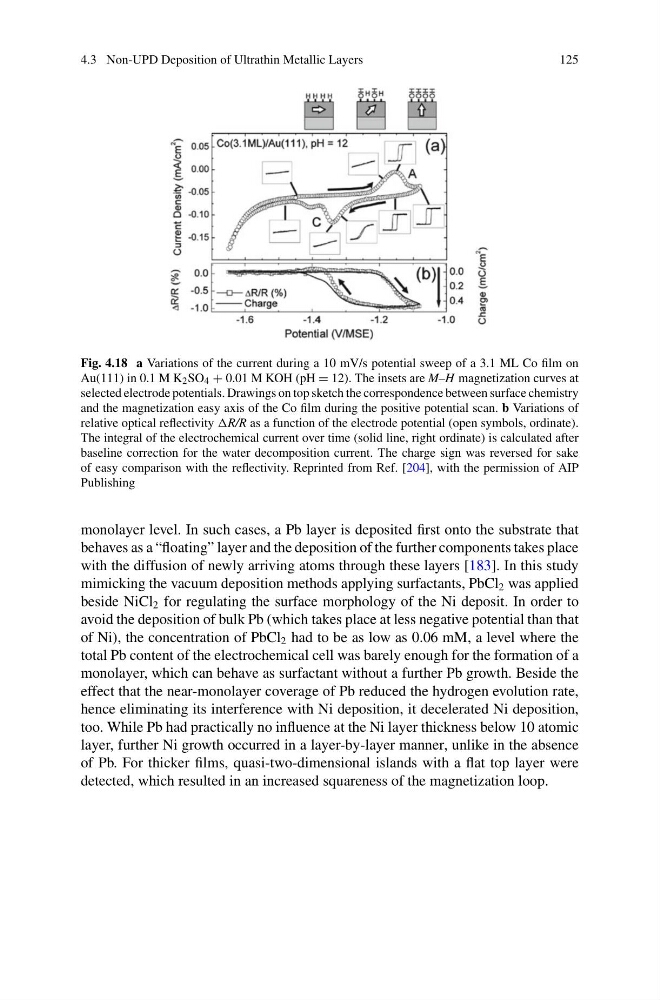
Fig. 4.18 a Variations of the current during a 10 mV/s potential sweep of a 3.1 ML Co film on
Au(111) in 0.1 M K 2 SO 4 + 0.01 M KOH (pH = 12). The insets are M–H magnetization curves at
selected electrode potentials. Drawings on top sketch the correspondence between surface chemistry
and the magnetization easy axis of the Co film during the positive potential scan. b Variations of
relative optical reflectivity R/R as a function of the electrode potential (open symbols, ordinate).
The integral of the electrochemical current over time (solid line, right ordinate) is calculated after
baseline correction for the water decomposition current. The charge sign was reversed for sake
of easy comparison with the reflectivity. Reprinted from Ref. [204], with the permission of AIP
Publishing
monolayer level. In such cases, a Pb layer is deposited first onto the substrate that
behaves as a “floating” layer and the deposition of the further components takes place
with the diffusion of newly arriving atoms through these layers [183]. In this study
mimicking the vacuum deposition methods applying surfactants, PbCl 2 was applied
beside NiCl 2 for regulating the surface morphology of the Ni deposit. In order to
avoid the deposition of bulk Pb (which takes place at less negative potential than that
of Ni), the concentration of PbCl 2 had to be as low as 0.06 mM, a level where the
total Pb content of the electrochemical cell was barely enough for the formation of a
monolayer, which can behave as surfactant without a further Pb growth. Beside the
effect that the near-monolayer coverage of Pb reduced the hydrogen evolution rate,
hence eliminating its interference with Ni deposition, it decelerated Ni deposition,
too. While Pb had practically no influence at the Ni layer thickness below 10 atomic
layer, further Ni growth occurred in a layer-by-layer manner, unlike in the absence
of Pb. For thicker films, quasi-two-dimensional islands with a flat top layer were
detected, which resulted in an increased squareness of the magnetization loop.
125
Fig. 4.18 a Variations of the current during a 10 mV/s potential sweep of a 3.1 ML Co film on
Au(111) in 0.1 M K 2 SO 4 + 0.01 M KOH (pH = 12). The insets are M–H magnetization curves at
selected electrode potentials. Drawings on top sketch the correspondence between surface chemistry
and the magnetization easy axis of the Co film during the positive potential scan. b Variations of
relative optical reflectivity R/R as a function of the electrode potential (open symbols, ordinate).
The integral of the electrochemical current over time (solid line, right ordinate) is calculated after
baseline correction for the water decomposition current. The charge sign was reversed for sake
of easy comparison with the reflectivity. Reprinted from Ref. [204], with the permission of AIP
Publishing
monolayer level. In such cases, a Pb layer is deposited first onto the substrate that
behaves as a “floating” layer and the deposition of the further components takes place
with the diffusion of newly arriving atoms through these layers [183]. In this study
mimicking the vacuum deposition methods applying surfactants, PbCl 2 was applied
beside NiCl 2 for regulating the surface morphology of the Ni deposit. In order to
avoid the deposition of bulk Pb (which takes place at less negative potential than that
of Ni), the concentration of PbCl 2 had to be as low as 0.06 mM, a level where the
total Pb content of the electrochemical cell was barely enough for the formation of a
monolayer, which can behave as surfactant without a further Pb growth. Beside the
effect that the near-monolayer coverage of Pb reduced the hydrogen evolution rate,
hence eliminating its interference with Ni deposition, it decelerated Ni deposition,
too. While Pb had practically no influence at the Ni layer thickness below 10 atomic
layer, further Ni growth occurred in a layer-by-layer manner, unlike in the absence
of Pb. For thicker films, quasi-two-dimensional islands with a flat top layer were
detected, which resulted in an increased squareness of the magnetization loop.