

4.3 Non-UPD Deposition of Ultrathin Metallic Layers
115
An important finding of the Ni deposition studies was that the place exchange of
the substrate atoms at the step edges with the deposit atoms plays a significant role
in the nucleation of the deposit, in particular at low overpotentials. This is somewhat
unexpected in the sense that Ni and Ag are immiscible as shown by the equilibrium
phase diagrams. The occurrence of the place exchange between the atoms of metals
that show zero miscibility in the bulk indicates that bulk properties may be misleading
when they are used for interpreting nanoscale phenomena.
It has to be noted that the deposition of even similar metals cannot be treated
uniformly. For instance, Co growth on Au was found to start with a biatomic layer
instead of monoatomic ones [174, 175], unlike the deposition of nickel.
The coverage level where the next atomic layer is nucleated at the surface of an
atomic terrace is a function of essentially all deposition parameters (substrate/deposit
pair, overpotential, concentration of the components etc.). The nucleation sites of
the second and further atomic layers are no longer related to the terraces of the
original substrate but rather to some stacking fault anomalies of the previous deposit
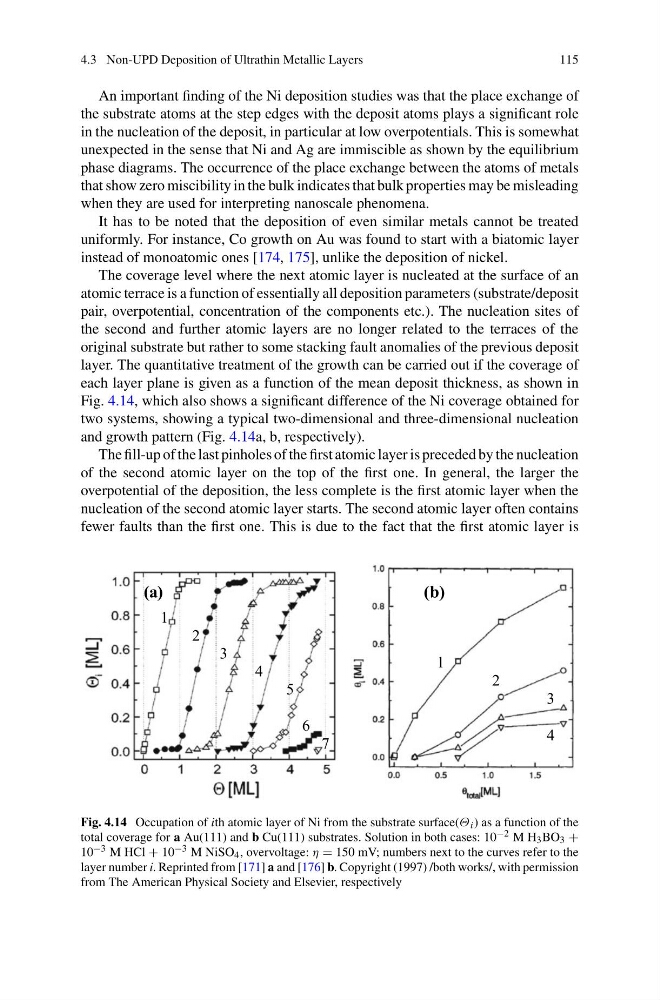
layer. The quantitative treatment of the growth can be carried out if the coverage of
each layer plane is given as a function of the mean deposit thickness, as shown in
Fig. 4.14, which also shows a significant difference of the Ni coverage obtained for
two systems, showing a typical two-dimensional and three-dimensional nucleation
and growth pattern (Fig. 4.14a, b, respectively).
The fill-up of the last pinholes of the first atomic layer is preceded by the nucleation
of the second atomic layer on the top of the first one. In general, the larger the
overpotential of the deposition, the less complete is the first atomic layer when the
nucleation of the second atomic layer starts. The second atomic layer often contains
fewer faults than the first one. This is due to the fact that the first atomic layer is
1
2
3
4
5
6
7
1
2
3
4
(a)
(b)
Fig. 4.14 Occupation of ith atomic layer of Ni from the substrate surface(Θ i ) as a function of the
total coverage for a Au(111) and b Cu(111) substrates. Solution in both cases: 10 −2 M H 3 BO 3 +
10 −3 M HCl + 10 −3 M NiSO 4 , overvoltage: η = 150 mV; numbers next to the curves refer to the
layer number i. Reprinted from [171] a and [176] b. Copyright (1997) /both works/, with permission
from The American Physical Society and Elsevier, respectively
115
An important finding of the Ni deposition studies was that the place exchange of
the substrate atoms at the step edges with the deposit atoms plays a significant role
in the nucleation of the deposit, in particular at low overpotentials. This is somewhat
unexpected in the sense that Ni and Ag are immiscible as shown by the equilibrium
phase diagrams. The occurrence of the place exchange between the atoms of metals
that show zero miscibility in the bulk indicates that bulk properties may be misleading
when they are used for interpreting nanoscale phenomena.
It has to be noted that the deposition of even similar metals cannot be treated
uniformly. For instance, Co growth on Au was found to start with a biatomic layer
instead of monoatomic ones [174, 175], unlike the deposition of nickel.
The coverage level where the next atomic layer is nucleated at the surface of an
atomic terrace is a function of essentially all deposition parameters (substrate/deposit
pair, overpotential, concentration of the components etc.). The nucleation sites of
the second and further atomic layers are no longer related to the terraces of the
original substrate but rather to some stacking fault anomalies of the previous deposit
layer. The quantitative treatment of the growth can be carried out if the coverage of
each layer plane is given as a function of the mean deposit thickness, as shown in
Fig. 4.14, which also shows a significant difference of the Ni coverage obtained for
two systems, showing a typical two-dimensional and three-dimensional nucleation
and growth pattern (Fig. 4.14a, b, respectively).
The fill-up of the last pinholes of the first atomic layer is preceded by the nucleation
of the second atomic layer on the top of the first one. In general, the larger the
overpotential of the deposition, the less complete is the first atomic layer when the
nucleation of the second atomic layer starts. The second atomic layer often contains
fewer faults than the first one. This is due to the fact that the first atomic layer is
1
2
3
4
5
6
7
1
2
3
4
(a)
(b)
Fig. 4.14 Occupation of ith atomic layer of Ni from the substrate surface(Θ i ) as a function of the
total coverage for a Au(111) and b Cu(111) substrates. Solution in both cases: 10 −2 M H 3 BO 3 +
10 −3 M HCl + 10 −3 M NiSO 4 , overvoltage: η = 150 mV; numbers next to the curves refer to the
layer number i. Reprinted from [171] a and [176] b. Copyright (1997) /both works/, with permission
from The American Physical Society and Elsevier, respectively