

114
4 Ultrathin Layers
(a)
105 nm x 105 nm
(b)
140 nm x 140 nm
(c)
90 nm x 100 nm
(d)
140 nm x 120 nm
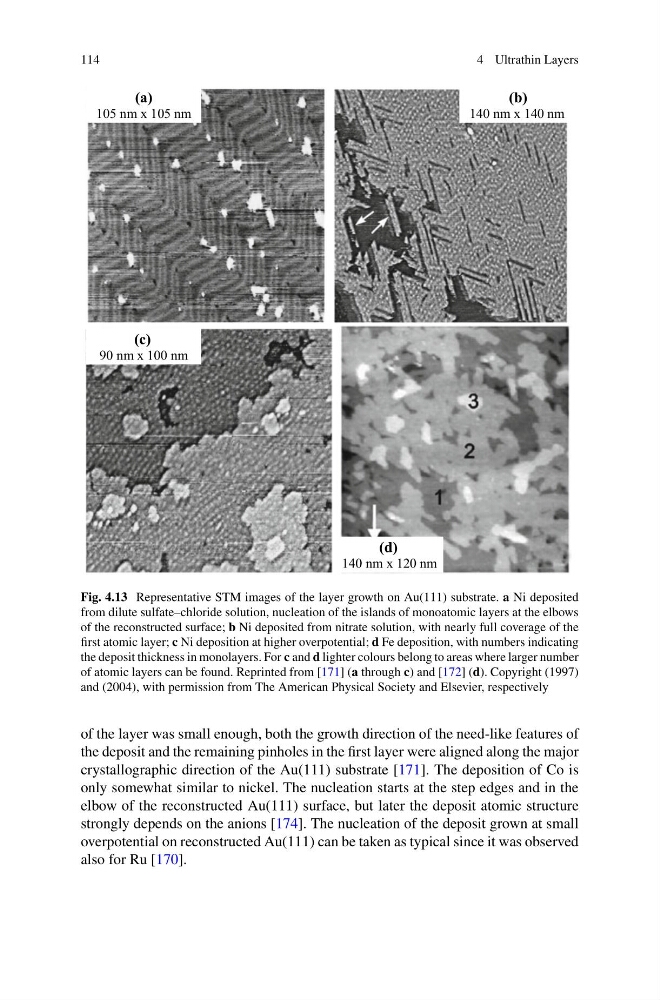
Fig. 4.13 Representative STM images of the layer growth on Au(111) substrate. a Ni deposited
from dilute sulfate–chloride solution, nucleation of the islands of monoatomic layers at the elbows
of the reconstructed surface; b Ni deposited from nitrate solution, with nearly full coverage of the
first atomic layer; c Ni deposition at higher overpotential; d Fe deposition, with numbers indicating
the deposit thickness in monolayers. For c and d lighter colours belong to areas where larger number
of atomic layers can be found. Reprinted from [171] (a through c) and [172] (d). Copyright (1997)
and (2004), with permission from The American Physical Society and Elsevier, respectively
of the layer was small enough, both the growth direction of the need-like features of
the deposit and the remaining pinholes in the first layer were aligned along the major
crystallographic direction of the Au(111) substrate [171]. The deposition of Co is
only somewhat similar to nickel. The nucleation starts at the step edges and in the
elbow of the reconstructed Au(111) surface, but later the deposit atomic structure
strongly depends on the anions [174]. The nucleation of the deposit grown at small
overpotential on reconstructed Au(111) can be taken as typical since it was observed
also for Ru [170].
4 Ultrathin Layers
(a)
105 nm x 105 nm
(b)
140 nm x 140 nm
(c)
90 nm x 100 nm
(d)
140 nm x 120 nm
Fig. 4.13 Representative STM images of the layer growth on Au(111) substrate. a Ni deposited
from dilute sulfate–chloride solution, nucleation of the islands of monoatomic layers at the elbows
of the reconstructed surface; b Ni deposited from nitrate solution, with nearly full coverage of the
first atomic layer; c Ni deposition at higher overpotential; d Fe deposition, with numbers indicating
the deposit thickness in monolayers. For c and d lighter colours belong to areas where larger number
of atomic layers can be found. Reprinted from [171] (a through c) and [172] (d). Copyright (1997)
and (2004), with permission from The American Physical Society and Elsevier, respectively
of the layer was small enough, both the growth direction of the need-like features of
the deposit and the remaining pinholes in the first layer were aligned along the major
crystallographic direction of the Au(111) substrate [171]. The deposition of Co is
only somewhat similar to nickel. The nucleation starts at the step edges and in the
elbow of the reconstructed Au(111) surface, but later the deposit atomic structure
strongly depends on the anions [174]. The nucleation of the deposit grown at small
overpotential on reconstructed Au(111) can be taken as typical since it was observed
also for Ru [170].