

4.2 Combination of UPD with Other Surface-Area-Limited Processes
103
a
b
c
d
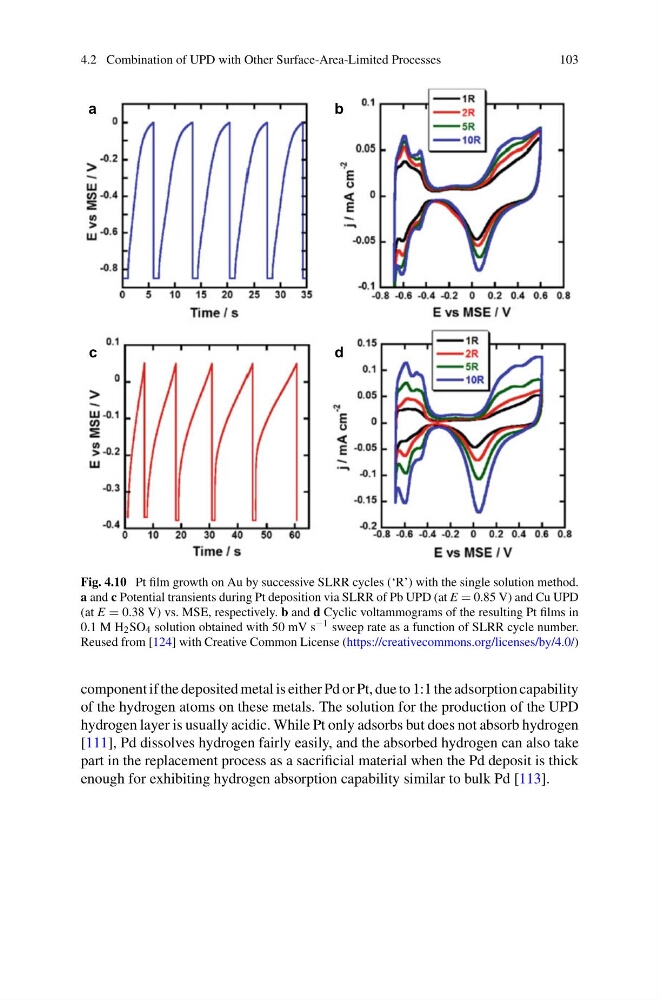
Fig. 4.10 Pt film growth on Au by successive SLRR cycles (‘R’) with the single solution method.
a and c Potential transients during Pt deposition via SLRR of Pb UPD (at E = 0.85 V) and Cu UPD
(at E = 0.38 V) vs. MSE, respectively. b and d Cyclic voltammograms of the resulting Pt films in
0.1 M H 2 SO 4 solution obtained with 50 mV s −1 sweep rate as a function of SLRR cycle number.
Reused from [124] with Creative Common License (https://creativecommons.org/licenses/by/4.0/)
component if the deposited metal is either Pd or Pt, due to 1:1 the adsorption capability
of the hydrogen atoms on these metals. The solution for the production of the UPD
hydrogen layer is usually acidic. While Pt only adsorbs but does not absorb hydrogen
[111], Pd dissolves hydrogen fairly easily, and the absorbed hydrogen can also take
part in the replacement process as a sacrificial material when the Pd deposit is thick
enough for exhibiting hydrogen absorption capability similar to bulk Pd [113].
103
a
b
c
d
Fig. 4.10 Pt film growth on Au by successive SLRR cycles (‘R’) with the single solution method.
a and c Potential transients during Pt deposition via SLRR of Pb UPD (at E = 0.85 V) and Cu UPD
(at E = 0.38 V) vs. MSE, respectively. b and d Cyclic voltammograms of the resulting Pt films in
0.1 M H 2 SO 4 solution obtained with 50 mV s −1 sweep rate as a function of SLRR cycle number.
Reused from [124] with Creative Common License (https://creativecommons.org/licenses/by/4.0/)
component if the deposited metal is either Pd or Pt, due to 1:1 the adsorption capability
of the hydrogen atoms on these metals. The solution for the production of the UPD
hydrogen layer is usually acidic. While Pt only adsorbs but does not absorb hydrogen
[111], Pd dissolves hydrogen fairly easily, and the absorbed hydrogen can also take
part in the replacement process as a sacrificial material when the Pd deposit is thick
enough for exhibiting hydrogen absorption capability similar to bulk Pd [113].