

102
4 Ultrathin Layers
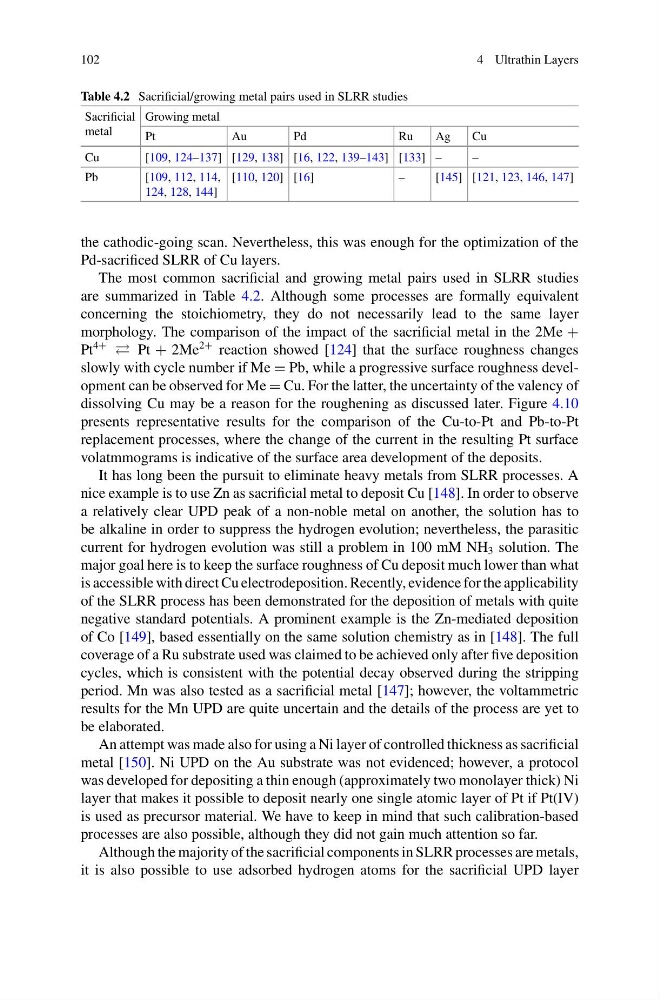
Table 4.2 Sacrificial/growing metal pairs used in SLRR studies
Sacrificial
metal
Growing metal
Pt
Au
Pd
Ru
Ag
Cu
Cu
[109, 124–137] [129, 138] [16, 122, 139–143] [133] –
–
Pb
[109, 112, 114,
124, 128, 144]
[110, 120] [16]
–
[145] [121, 123, 146, 147]
the cathodic-going scan. Nevertheless, this was enough for the optimization of the
Pd-sacrificed SLRR of Cu layers.
The most common sacrificial and growing metal pairs used in SLRR studies
are summarized in Table 4.2. Although some processes are formally equivalent
concerning the stoichiometry, they do not necessarily lead to the same layer
morphology. The comparison of the impact of the sacrificial metal in the 2Me +
Pt
4+
Pt + 2Me
2+ reaction showed [124] that the surface roughness changes
slowly with cycle number if Me = Pb, while a progressive surface roughness development can be observed for Me = Cu. For the latter, the uncertainty of the valency of
dissolving Cu may be a reason for the roughening as discussed later. Figure 4.10
presents representative results for the comparison of the Cu-to-Pt and Pb-to-Pt
replacement processes, where the change of the current in the resulting Pt surface
volatmmograms is indicative of the surface area development of the deposits.
It has long been the pursuit to eliminate heavy metals from SLRR processes. A
nice example is to use Zn as sacrificial metal to deposit Cu [148]. In order to observe
a relatively clear UPD peak of a non-noble metal on another, the solution has to
be alkaline in order to suppress the hydrogen evolution; nevertheless, the parasitic
current for hydrogen evolution was still a problem in 100 mM NH 3 solution. The
major goal here is to keep the surface roughness of Cu deposit much lower than what
is accessible with direct Cu electrodeposition. Recently, evidence for the applicability
of the SLRR process has been demonstrated for the deposition of metals with quite
negative standard potentials. A prominent example is the Zn-mediated deposition
of Co [149], based essentially on the same solution chemistry as in [148]. The full
coverage of a Ru substrate used was claimed to be achieved only after five deposition
cycles, which is consistent with the potential decay observed during the stripping
period. Mn was also tested as a sacrificial metal [147]; however, the voltammetric
results for the Mn UPD are quite uncertain and the details of the process are yet to
be elaborated.
An attempt was made also for using a Ni layer of controlled thickness as sacrificial
metal [150]. Ni UPD on the Au substrate was not evidenced; however, a protocol
was developed for depositing a thin enough (approximately two monolayer thick) Ni
layer that makes it possible to deposit nearly one single atomic layer of Pt if Pt(IV)
is used as precursor material. We have to keep in mind that such calibration-based
processes are also possible, although they did not gain much attention so far.
Although the majority of the sacrificial components in SLRR processes are metals,
it is also possible to use adsorbed hydrogen atoms for the sacrificial UPD layer
4 Ultrathin Layers
Table 4.2 Sacrificial/growing metal pairs used in SLRR studies
Sacrificial
metal
Growing metal
Pt
Au
Pd
Ru
Ag
Cu
Cu
[109, 124–137] [129, 138] [16, 122, 139–143] [133] –
–
Pb
[109, 112, 114,
124, 128, 144]
[110, 120] [16]
–
[145] [121, 123, 146, 147]
the cathodic-going scan. Nevertheless, this was enough for the optimization of the
Pd-sacrificed SLRR of Cu layers.
The most common sacrificial and growing metal pairs used in SLRR studies
are summarized in Table 4.2. Although some processes are formally equivalent
concerning the stoichiometry, they do not necessarily lead to the same layer
morphology. The comparison of the impact of the sacrificial metal in the 2Me +
Pt
4+
Pt + 2Me
2+ reaction showed [124] that the surface roughness changes
slowly with cycle number if Me = Pb, while a progressive surface roughness development can be observed for Me = Cu. For the latter, the uncertainty of the valency of
dissolving Cu may be a reason for the roughening as discussed later. Figure 4.10
presents representative results for the comparison of the Cu-to-Pt and Pb-to-Pt
replacement processes, where the change of the current in the resulting Pt surface
volatmmograms is indicative of the surface area development of the deposits.
It has long been the pursuit to eliminate heavy metals from SLRR processes. A
nice example is to use Zn as sacrificial metal to deposit Cu [148]. In order to observe
a relatively clear UPD peak of a non-noble metal on another, the solution has to
be alkaline in order to suppress the hydrogen evolution; nevertheless, the parasitic
current for hydrogen evolution was still a problem in 100 mM NH 3 solution. The
major goal here is to keep the surface roughness of Cu deposit much lower than what
is accessible with direct Cu electrodeposition. Recently, evidence for the applicability
of the SLRR process has been demonstrated for the deposition of metals with quite
negative standard potentials. A prominent example is the Zn-mediated deposition
of Co [149], based essentially on the same solution chemistry as in [148]. The full
coverage of a Ru substrate used was claimed to be achieved only after five deposition
cycles, which is consistent with the potential decay observed during the stripping
period. Mn was also tested as a sacrificial metal [147]; however, the voltammetric
results for the Mn UPD are quite uncertain and the details of the process are yet to
be elaborated.
An attempt was made also for using a Ni layer of controlled thickness as sacrificial
metal [150]. Ni UPD on the Au substrate was not evidenced; however, a protocol
was developed for depositing a thin enough (approximately two monolayer thick) Ni
layer that makes it possible to deposit nearly one single atomic layer of Pt if Pt(IV)
is used as precursor material. We have to keep in mind that such calibration-based
processes are also possible, although they did not gain much attention so far.
Although the majority of the sacrificial components in SLRR processes are metals,
it is also possible to use adsorbed hydrogen atoms for the sacrificial UPD layer