

104
4 Ultrathin Layers
4.2.3 Structural Aspects of the SLRR Processes
The advantage of the SLRR-based process is obvious for cases when the atomic
layer of the sacrificial metal can be replaced with a similarly even distribution of the
growing metal. If the process cannot be driven along an atom-by-atom replacement
manner, the growing metal will form clusters instead of layers, similarly to the
nucleation-initiated growth during direct deposition (see Fig. 2.15 and the related
discussion), and the advantage of the subtle growth process is hence annulled. It has
to be clearly seen that the displacement of the sacrificial layer can indeed take place
via a so-called local cell mechanism, which means that the location of the oxidation
and reduction process can be well separated due to the conducting nature of the
substrate (as it is nearly exclusively seen for corrosion processes on inhomogeneous
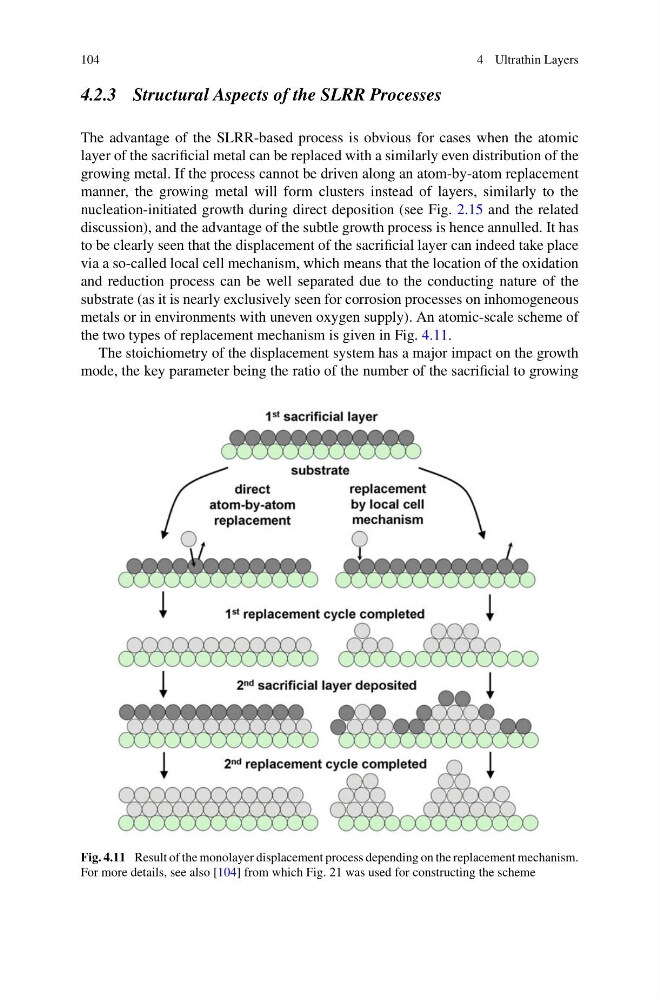
metals or in environments with uneven oxygen supply). An atomic-scale scheme of
the two types of replacement mechanism is given in Fig. 4.11.
The stoichiometry of the displacement system has a major impact on the growth
mode, the key parameter being the ratio of the number of the sacrificial to growing
Fig. 4.11 Result of the monolayer displacement process depending on the replacement mechanism.
For more details, see also [104] from which Fig. 21 was used for constructing the scheme
4 Ultrathin Layers
4.2.3 Structural Aspects of the SLRR Processes
The advantage of the SLRR-based process is obvious for cases when the atomic
layer of the sacrificial metal can be replaced with a similarly even distribution of the
growing metal. If the process cannot be driven along an atom-by-atom replacement
manner, the growing metal will form clusters instead of layers, similarly to the
nucleation-initiated growth during direct deposition (see Fig. 2.15 and the related
discussion), and the advantage of the subtle growth process is hence annulled. It has
to be clearly seen that the displacement of the sacrificial layer can indeed take place
via a so-called local cell mechanism, which means that the location of the oxidation
and reduction process can be well separated due to the conducting nature of the
substrate (as it is nearly exclusively seen for corrosion processes on inhomogeneous
metals or in environments with uneven oxygen supply). An atomic-scale scheme of
the two types of replacement mechanism is given in Fig. 4.11.
The stoichiometry of the displacement system has a major impact on the growth
mode, the key parameter being the ratio of the number of the sacrificial to growing
Fig. 4.11 Result of the monolayer displacement process depending on the replacement mechanism.
For more details, see also [104] from which Fig. 21 was used for constructing the scheme