

88
4 Ultrathin Layers
layer produced in the relevant EC-ALD step cannot lead to a pure metal layer. This is
the case for MoSe 2 when the reduction of the molybdate anion leads to a molybdenum
oxide with lower oxidation state whose reduction to molybdenum and the release of
the residual oxygen takes place during the reductive stripping of the leftover Se [40].
Should the sequential deposition of the atomic layers onto each other be a surfacearea-limited process, the current after the deposition of a complete atomic layer
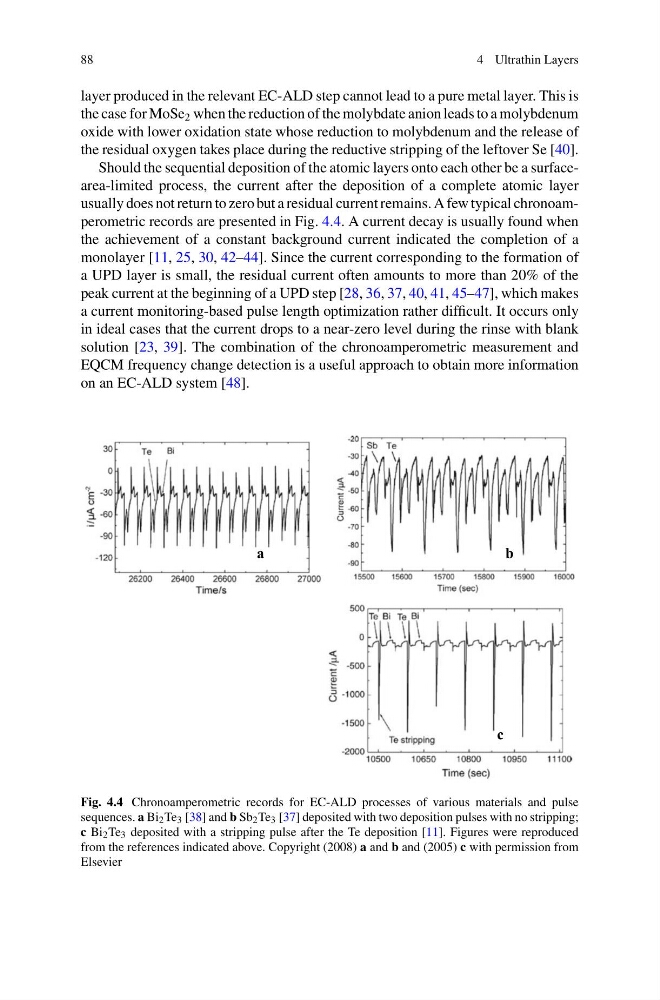
usually does not return to zero but a residual current remains. A few typical chronoamperometric records are presented in Fig. 4.4. A current decay is usually found when
the achievement of a constant background current indicated the completion of a
monolayer [11, 25, 30, 42–44]. Since the current corresponding to the formation of
a UPD layer is small, the residual current often amounts to more than 20% of the
peak current at the beginning of a UPD step [28, 36, 37, 40, 41, 45–47], which makes
a current monitoring-based pulse length optimization rather difficult. It occurs only
in ideal cases that the current drops to a near-zero level during the rinse with blank
solution [23, 39]. The combination of the chronoamperometric measurement and
EQCM frequency change detection is a useful approach to obtain more information
on an EC-ALD system [48].
a
b
c
Fig. 4.4 Chronoamperometric records for EC-ALD processes of various materials and pulse
sequences. a Bi 2 Te 3 [38] and b Sb 2 Te 3 [37] deposited with two deposition pulses with no stripping;
c Bi 2 Te 3 deposited with a stripping pulse after the Te deposition [11]. Figures were reproduced
from the references indicated above. Copyright (2008) a and b and (2005) c with permission from
Elsevier
4 Ultrathin Layers
layer produced in the relevant EC-ALD step cannot lead to a pure metal layer. This is
the case for MoSe 2 when the reduction of the molybdate anion leads to a molybdenum
oxide with lower oxidation state whose reduction to molybdenum and the release of
the residual oxygen takes place during the reductive stripping of the leftover Se [40].
Should the sequential deposition of the atomic layers onto each other be a surfacearea-limited process, the current after the deposition of a complete atomic layer
usually does not return to zero but a residual current remains. A few typical chronoamperometric records are presented in Fig. 4.4. A current decay is usually found when
the achievement of a constant background current indicated the completion of a
monolayer [11, 25, 30, 42–44]. Since the current corresponding to the formation of
a UPD layer is small, the residual current often amounts to more than 20% of the
peak current at the beginning of a UPD step [28, 36, 37, 40, 41, 45–47], which makes
a current monitoring-based pulse length optimization rather difficult. It occurs only
in ideal cases that the current drops to a near-zero level during the rinse with blank
solution [23, 39]. The combination of the chronoamperometric measurement and
EQCM frequency change detection is a useful approach to obtain more information
on an EC-ALD system [48].
a
b
c
Fig. 4.4 Chronoamperometric records for EC-ALD processes of various materials and pulse
sequences. a Bi 2 Te 3 [38] and b Sb 2 Te 3 [37] deposited with two deposition pulses with no stripping;
c Bi 2 Te 3 deposited with a stripping pulse after the Te deposition [11]. Figures were reproduced
from the references indicated above. Copyright (2008) a and b and (2005) c with permission from
Elsevier