

4.1 Layer Preparation Methods Based Solely on UPD Processes
87
of a space charge layer. Based on this concept, Vaidyanathan et al. [34] suggested a
cycle-number-dependent potential programme with successively decreasing deposition potentials. The decrease rate of the deposition potential that was found to lead
to complete monolayers varied from one material to another. For the deposition of
In 2 Se 3 , the deposition potentials were about 400 mV more negative after some 30
cycles than that established for the bare substrate [34] and had to be decreased further
as the deposit grew. The principle of the continuous deposition potential decrease
with cycle number was applied for a variety of compounds. For PbSe, a 100 mV
negative shift in the potential proved to be sufficient after 20 cycles without any
further decrease [35], and a steady-state deposition sequence could also be achieved
for Bi 2 Se 3 [23]. In the case of Sb 2 Te 3 , both negative [22, 36, 37] and positive shifts
[38] in the deposition potential were applied in various works of the same group.
For PbTe, a positive shift of the Te deposition potential was necessary to maintain
a single monolayer per cycle ratio [39]. Although this finding was empirically well
confirmed, no explanation was given why a deposition potential correction of the
opposite direction had to be employed.
If the deposition of one component on the topmost atomic layer of the other
component cannot reliably lead to monolayer coverage but the nucleation of a bulk
material is likely at all possible potentials, then another stripping pulse can be applied.
This case is common when Te is a component of the system to be deposited. In such
a case, one can take advantage of the cathodic stripping of bulk Te. Anodic stripping
of bulk Te may not be possible since this treatment is likely to damage the metal
atom layer underneath. However, the cathodic stripping of Te leading to Te
2− will
surely leave both alternating atom layers underneath and one Te surface monolayer
intact, while the excess of Te is removed. Suitable potential and solution exchange
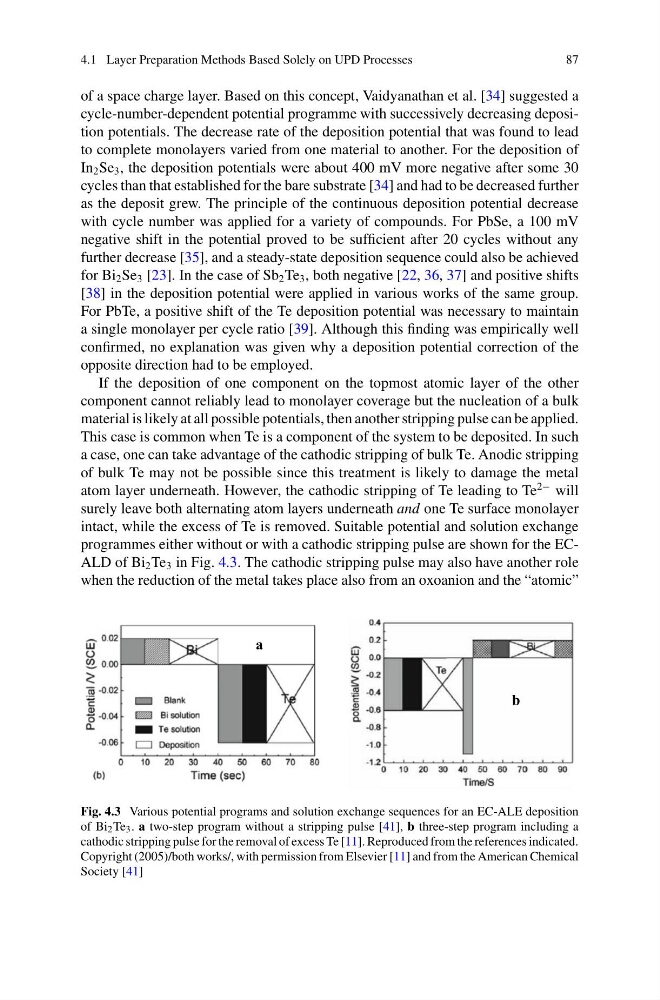
programmes either without or with a cathodic stripping pulse are shown for the ECALD of Bi 2 Te 3 in Fig. 4.3. The cathodic stripping pulse may also have another role
when the reduction of the metal takes place also from an oxoanion and the “atomic”
a
b
Fig. 4.3 Various potential programs and solution exchange sequences for an EC-ALE deposition
of Bi 2 Te 3 . a two-step program without a stripping pulse [41], b three-step program including a
cathodic stripping pulse for the removal of excess Te [11]. Reproduced from the references indicated.
Copyright (2005)/both works/, with permission from Elsevier [11] and from the American Chemical
Society [41]
87
of a space charge layer. Based on this concept, Vaidyanathan et al. [34] suggested a
cycle-number-dependent potential programme with successively decreasing deposition potentials. The decrease rate of the deposition potential that was found to lead
to complete monolayers varied from one material to another. For the deposition of
In 2 Se 3 , the deposition potentials were about 400 mV more negative after some 30
cycles than that established for the bare substrate [34] and had to be decreased further
as the deposit grew. The principle of the continuous deposition potential decrease
with cycle number was applied for a variety of compounds. For PbSe, a 100 mV
negative shift in the potential proved to be sufficient after 20 cycles without any
further decrease [35], and a steady-state deposition sequence could also be achieved
for Bi 2 Se 3 [23]. In the case of Sb 2 Te 3 , both negative [22, 36, 37] and positive shifts
[38] in the deposition potential were applied in various works of the same group.
For PbTe, a positive shift of the Te deposition potential was necessary to maintain
a single monolayer per cycle ratio [39]. Although this finding was empirically well
confirmed, no explanation was given why a deposition potential correction of the
opposite direction had to be employed.
If the deposition of one component on the topmost atomic layer of the other
component cannot reliably lead to monolayer coverage but the nucleation of a bulk
material is likely at all possible potentials, then another stripping pulse can be applied.
This case is common when Te is a component of the system to be deposited. In such
a case, one can take advantage of the cathodic stripping of bulk Te. Anodic stripping
of bulk Te may not be possible since this treatment is likely to damage the metal
atom layer underneath. However, the cathodic stripping of Te leading to Te
2− will
surely leave both alternating atom layers underneath and one Te surface monolayer
intact, while the excess of Te is removed. Suitable potential and solution exchange
programmes either without or with a cathodic stripping pulse are shown for the ECALD of Bi 2 Te 3 in Fig. 4.3. The cathodic stripping pulse may also have another role
when the reduction of the metal takes place also from an oxoanion and the “atomic”
a
b
Fig. 4.3 Various potential programs and solution exchange sequences for an EC-ALE deposition
of Bi 2 Te 3 . a two-step program without a stripping pulse [41], b three-step program including a
cathodic stripping pulse for the removal of excess Te [11]. Reproduced from the references indicated.
Copyright (2005)/both works/, with permission from Elsevier [11] and from the American Chemical
Society [41]