

70
I.-B. Dragna et al.
F p = k p l p
x p−1 − x p
i − y p j
y 2
p +
x p−1 − x p
2
,
(6)
F p+1 = k p+1 l p+1
x p+1 − x p
i + y p+1 j
y
2
p+1 +
x p+1 − x p
2
.
(7)
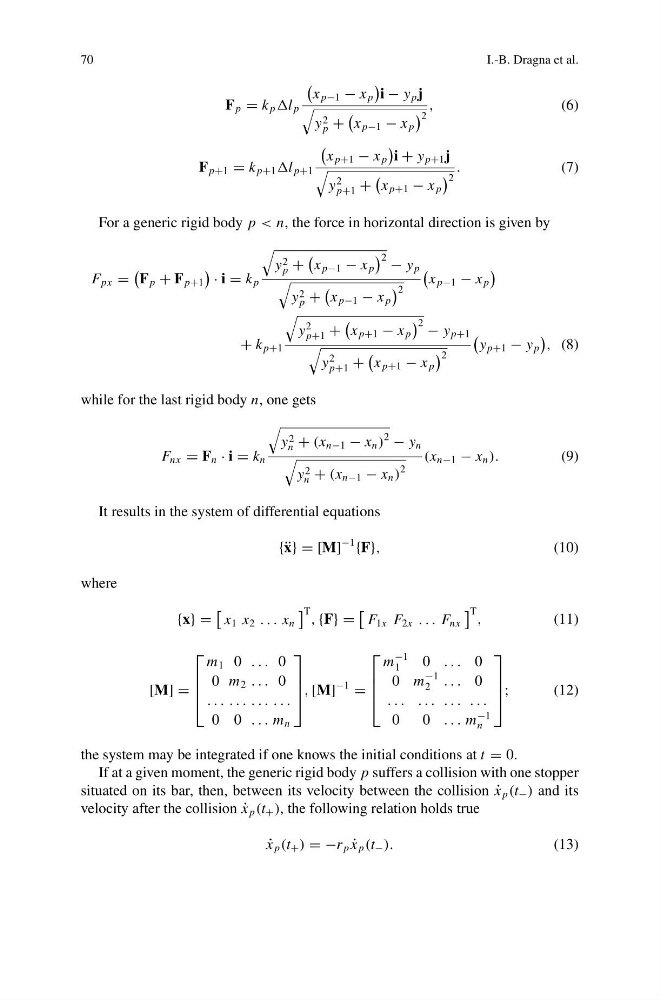
For a generic rigid body p < n, the force in horizontal direction is given by
F px =
F p + F p+1
· i = k p
y 2
p +
x p−1 − x p
2 − y p
y 2
p +
x p−1 − x p
2
x p−1 − x p
+ k p+1
y
2
p+1 +
x p+1 − x p
2 − y p+1
y
2
p+1 +
x p+1 − x p
2
y p+1 − y p
, (8)
while for the last rigid body n, one gets
F nx = F n · i = k n
y 2
n + (x n−1 − x n )
2
− y n
y 2
n + (x n−1 − x n )
2
(x n−1 − x n ).
(9)
It results in the system of differential equations
{¨ x} = [M]
−1
{F},
(10)
where
{x} =
x 1 x 2 . . . x n
T , {F} =
F 1x F 2x . . . F nx
T ,
(11)
[M] =
⎡
⎢
⎢
⎣
m 1 0 . . . 0
0 m 2 . . . 0
. . . . . . . . . . . .
0 0 . . . m n
⎤
⎥
⎥
⎦ , [M]
−1
=
⎡
⎢
⎢
⎣
m
−1
1
0 . . . 0
0 m
−1
2 . . . 0
. . . . . . . . . . . .
0
0 . . . m
−1
n
⎤
⎥
⎥
⎦ ;
(12)
the system may be integrated if one knows the initial conditions at t = 0.
If at a given moment, the generic rigid body p suffers a collision with one stopper
situated on its bar, then, between its velocity between the collision ˙
x p (t − ) and its
velocity after the collision ˙
x p (t + ), the following relation holds true
˙
x p (t + ) = −r p ˙
x p (t − ).
(13)
I.-B. Dragna et al.
F p = k p l p
x p−1 − x p
i − y p j
y 2
p +
x p−1 − x p
2
,
(6)
F p+1 = k p+1 l p+1
x p+1 − x p
i + y p+1 j
y
2
p+1 +
x p+1 − x p
2
.
(7)
For a generic rigid body p < n, the force in horizontal direction is given by
F px =
F p + F p+1
· i = k p
y 2
p +
x p−1 − x p
2 − y p
y 2
p +
x p−1 − x p
2
x p−1 − x p
+ k p+1
y
2
p+1 +
x p+1 − x p
2 − y p+1
y
2
p+1 +
x p+1 − x p
2
y p+1 − y p
, (8)
while for the last rigid body n, one gets
F nx = F n · i = k n
y 2
n + (x n−1 − x n )
2
− y n
y 2
n + (x n−1 − x n )
2
(x n−1 − x n ).
(9)
It results in the system of differential equations
{¨ x} = [M]
−1
{F},
(10)
where
{x} =
x 1 x 2 . . . x n
T , {F} =
F 1x F 2x . . . F nx
T ,
(11)
[M] =
⎡
⎢
⎢
⎣
m 1 0 . . . 0
0 m 2 . . . 0
. . . . . . . . . . . .
0 0 . . . m n
⎤
⎥
⎥
⎦ , [M]
−1
=
⎡
⎢
⎢
⎣
m
−1
1
0 . . . 0
0 m
−1
2 . . . 0
. . . . . . . . . . . .
0
0 . . . m
−1
n
⎤
⎥
⎥
⎦ ;
(12)
the system may be integrated if one knows the initial conditions at t = 0.
If at a given moment, the generic rigid body p suffers a collision with one stopper
situated on its bar, then, between its velocity between the collision ˙
x p (t − ) and its
velocity after the collision ˙
x p (t + ), the following relation holds true
˙
x p (t + ) = −r p ˙
x p (t − ).
(13)