

Study of the Vibrations of a System Consisting …
61
component P 2 = P − P 1 acting upon the second cantilever beam O 2 A. Due to the
action of the transversal force P, the two cantilever beams deform, their new lengths
being L 1 and L 2 . The new position of point A is A
, which implies a horizontal
displacement equal to d, and a vertical displacement equal to h. In the two cantilever
beams appears a horizontal force denoted by H . In addition, the classical hypothesis
of the strength of materials holds true.
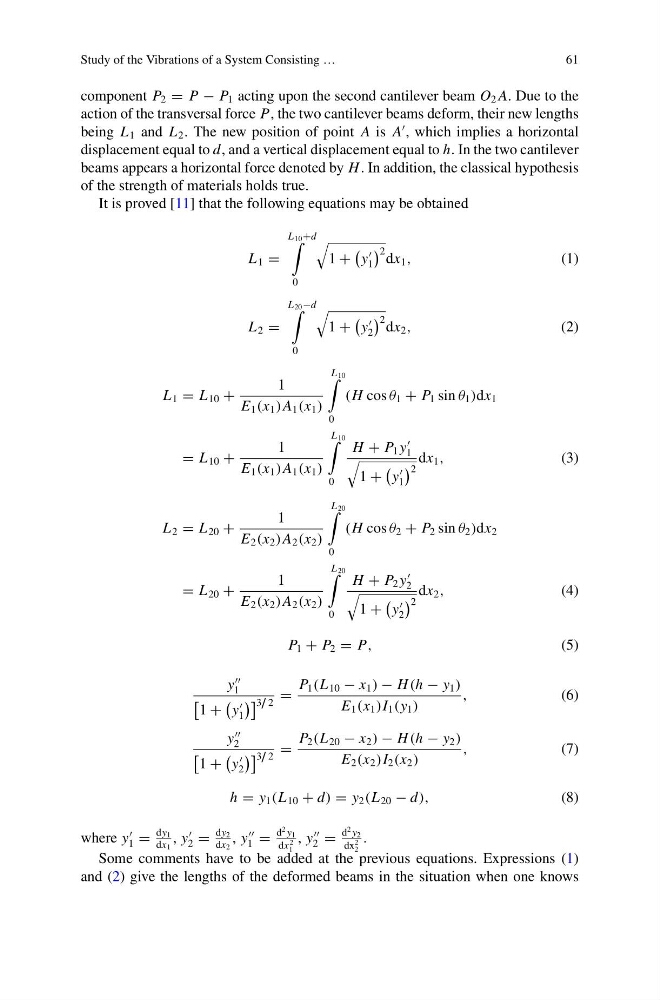
It is proved [11] that the following equations may be obtained
L 1 =
L 10 +d
0
1 +
y
1
2 dx 1 ,
(1)
L 2 =
L 20 −d
0
1 +
y
2
2 dx 2 ,
(2)
L 1 = L 10 +
1
E 1 (x 1 )A 1 (x 1 )
L 10
0
(H cos θ 1 + P 1 sin θ 1 )dx 1
= L 10 +
1
E 1 (x 1 )A 1 (x 1 )
L 10
0
H + P 1 y
1
1 +
y
1
2
dx 1 ,
(3)
L 2 = L 20 +
1
E 2 (x 2 )A 2 (x 2 )
L 20
0
(H cos θ 2 + P 2 sin θ 2 )dx 2
= L 20 +
1
E 2 (x 2 )A 2 (x 2 )
L 20
0
H + P 2 y
2
1 +
y
2
2
dx 2 ,
(4)
P 1 + P 2 = P,
(5)
y
1
1 +
y
1
3 / 2 =
P 1 (L 10 − x 1 ) − H (h − y 1 )
E 1 (x 1 )I 1 (y 1 )
,
(6)
y
2
1 +
y
2
3 / 2 =
P 2 (L 20 − x 2 ) − H (h − y 2 )
E 2 (x 2 )I 2 (x 2 )
,
(7)
h = y 1 (L 10 + d) = y 2 (L 20 − d),
(8)
where y
1 =
dy 1
dx 1
, y
2 =
dy 2
dx 2
, y
1 =
d
2 y 1
dx
2
1
, y
2 =
d
2 y 2
dx
2
2
.
Some comments have to be added at the previous equations. Expressions (1)
and (2) give the lengths of the deformed beams in the situation when one knows
61
component P 2 = P − P 1 acting upon the second cantilever beam O 2 A. Due to the
action of the transversal force P, the two cantilever beams deform, their new lengths
being L 1 and L 2 . The new position of point A is A
, which implies a horizontal
displacement equal to d, and a vertical displacement equal to h. In the two cantilever
beams appears a horizontal force denoted by H . In addition, the classical hypothesis
of the strength of materials holds true.
It is proved [11] that the following equations may be obtained
L 1 =
L 10 +d
0
1 +
y
1
2 dx 1 ,
(1)
L 2 =
L 20 −d
0
1 +
y
2
2 dx 2 ,
(2)
L 1 = L 10 +
1
E 1 (x 1 )A 1 (x 1 )
L 10
0
(H cos θ 1 + P 1 sin θ 1 )dx 1
= L 10 +
1
E 1 (x 1 )A 1 (x 1 )
L 10
0
H + P 1 y
1
1 +
y
1
2
dx 1 ,
(3)
L 2 = L 20 +
1
E 2 (x 2 )A 2 (x 2 )
L 20
0
(H cos θ 2 + P 2 sin θ 2 )dx 2
= L 20 +
1
E 2 (x 2 )A 2 (x 2 )
L 20
0
H + P 2 y
2
1 +
y
2
2
dx 2 ,
(4)
P 1 + P 2 = P,
(5)
y
1
1 +
y
1
3 / 2 =
P 1 (L 10 − x 1 ) − H (h − y 1 )
E 1 (x 1 )I 1 (y 1 )
,
(6)
y
2
1 +
y
2
3 / 2 =
P 2 (L 20 − x 2 ) − H (h − y 2 )
E 2 (x 2 )I 2 (x 2 )
,
(7)
h = y 1 (L 10 + d) = y 2 (L 20 − d),
(8)
where y
1 =
dy 1
dx 1
, y
2 =
dy 2
dx 2
, y
1 =
d
2 y 1
dx
2
1
, y
2 =
d
2 y 2
dx
2
2
.
Some comments have to be added at the previous equations. Expressions (1)
and (2) give the lengths of the deformed beams in the situation when one knows