

62
M.-L. Bes , liu-Gherghescu et al.
the shape of them (y 1 = y 1 (x) and y 2 = y 2 (x)). Equations (3) and (4) offer the
lengths of the deformed beams from the theory of elasticity for a beam which is
longitudinal elongated. Equation (5) is an expression for the decomposition of the
total transversal force P. Expressions (6) and (7) give us the shapes of the beams,
while the last equation (8) shows that the vertical deformations for the two cantilever
beams are equal for them. In addition, (1)–(8) form a system of nonlinear integral
differential equations with eight unknowns (L 1 , L 2 , d, H , y 1 , y 2 , P 1 , and P 2 ).
The solution for the system of (1)–(8) is a very difficult task. One may assume
that y 1 and y 2 may be developed into series,
y 1 (x) = a 0 + a 1 x + a 2 x
2
+ a 3 x
3
+ · · · ,
(9)
y
1 = a 1 + 2a 2 x + 3a 3 x
2
+ · · · ,
(10)
and similar expressions for y 2 . The frontier conditions imply that y 1 (0) = 0 and
y
1 (0) = 0, wherefrom a 0 = 0 and a 1 = 0 (similarly for y 2 (x)), that is,
y 1 (x) = a 2 x
2
+ a 3 x
3
+ a 4 x
4
+ · · · , y 2 (x) = b 2 x
2
+ b 3 x
3
+ b 4 x
4
+ · · · (11)
In this way, one may develop a trial-error procedure for solving the system (1)–(8).
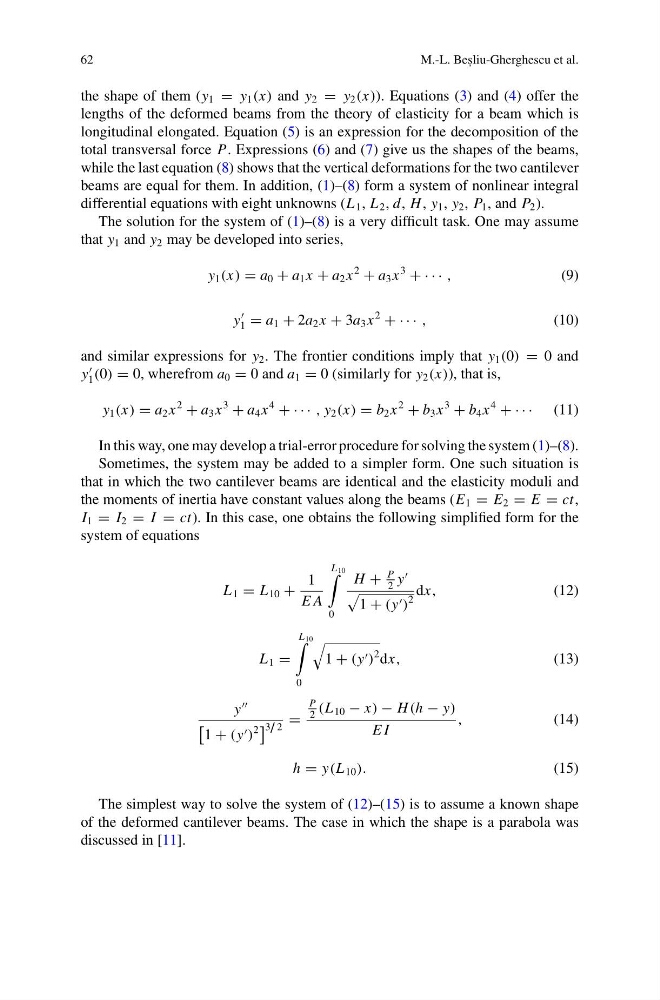
Sometimes, the system may be added to a simpler form. One such situation is
that in which the two cantilever beams are identical and the elasticity moduli and
the moments of inertia have constant values along the beams (E 1 = E 2 = E = ct,
I 1 = I 2 = I = ct). In this case, one obtains the following simplified form for the
system of equations
L 1 = L 10 +
1
E A
L 10
0
H +
P
2
y
1 + (y )
2
dx,
(12)
L 1 =
L 10
0
1 + (y )
2 dx,
(13)
y
1 + (y )
2
3 / 2 =
P
2 (L 10 − x) − H (h − y)
E I
,
(14)
h = y(L 10 ).
(15)
The simplest way to solve the system of (12)–(15) is to assume a known shape
of the deformed cantilever beams. The case in which the shape is a parabola was
discussed in [11].
M.-L. Bes , liu-Gherghescu et al.
the shape of them (y 1 = y 1 (x) and y 2 = y 2 (x)). Equations (3) and (4) offer the
lengths of the deformed beams from the theory of elasticity for a beam which is
longitudinal elongated. Equation (5) is an expression for the decomposition of the
total transversal force P. Expressions (6) and (7) give us the shapes of the beams,
while the last equation (8) shows that the vertical deformations for the two cantilever
beams are equal for them. In addition, (1)–(8) form a system of nonlinear integral
differential equations with eight unknowns (L 1 , L 2 , d, H , y 1 , y 2 , P 1 , and P 2 ).
The solution for the system of (1)–(8) is a very difficult task. One may assume
that y 1 and y 2 may be developed into series,
y 1 (x) = a 0 + a 1 x + a 2 x
2
+ a 3 x
3
+ · · · ,
(9)
y
1 = a 1 + 2a 2 x + 3a 3 x
2
+ · · · ,
(10)
and similar expressions for y 2 . The frontier conditions imply that y 1 (0) = 0 and
y
1 (0) = 0, wherefrom a 0 = 0 and a 1 = 0 (similarly for y 2 (x)), that is,
y 1 (x) = a 2 x
2
+ a 3 x
3
+ a 4 x
4
+ · · · , y 2 (x) = b 2 x
2
+ b 3 x
3
+ b 4 x
4
+ · · · (11)
In this way, one may develop a trial-error procedure for solving the system (1)–(8).
Sometimes, the system may be added to a simpler form. One such situation is
that in which the two cantilever beams are identical and the elasticity moduli and
the moments of inertia have constant values along the beams (E 1 = E 2 = E = ct,
I 1 = I 2 = I = ct). In this case, one obtains the following simplified form for the
system of equations
L 1 = L 10 +
1
E A
L 10
0
H +
P
2
y
1 + (y )
2
dx,
(12)
L 1 =
L 10
0
1 + (y )
2 dx,
(13)
y
1 + (y )
2
3 / 2 =
P
2 (L 10 − x) − H (h − y)
E I
,
(14)
h = y(L 10 ).
(15)
The simplest way to solve the system of (12)–(15) is to assume a known shape
of the deformed cantilever beams. The case in which the shape is a parabola was
discussed in [11].