

56
V. Marinca and N. Herisanu
˜
u(τ ) = u 0 (τ ) + u 1 (τ )
(15)
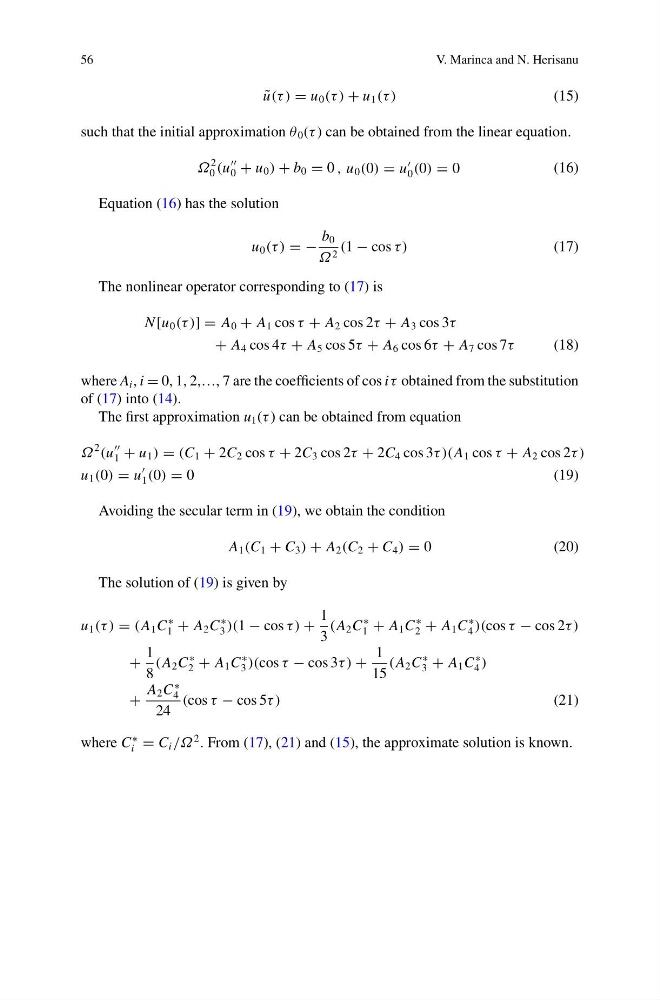
such that the initial approximation θ 0 (τ ) can be obtained from the linear equation.
Ω
2
0 (u
0 + u 0 ) + b 0 = 0 , u 0 (0) = u
0 (0) = 0
(16)
Equation (16) has the solution
u 0 (τ ) = −
b 0
Ω 2 (1 − cos τ )
(17)
The nonlinear operator corresponding to (17) is
N [u 0 (τ )] = A 0 + A 1 cos τ + A 2 cos 2τ + A 3 cos 3τ
+ A 4 cos 4τ + A 5 cos 5τ + A 6 cos 6τ + A 7 cos 7τ
(18)
where A i , i = 0, 1, 2,…, 7 are the coefficients of cos iτ obtained from the substitution
of (17) into (14).
The first approximation u 1 (τ ) can be obtained from equation
Ω
2
(u
1 + u 1 ) = (C 1 + 2C 2 cos τ + 2C 3 cos 2τ + 2C 4 cos 3τ )(A 1 cos τ + A 2 cos 2τ )
u 1 (0) = u
1 (0) = 0
(19)
Avoiding the secular term in (19), we obtain the condition
A 1 (C 1 + C 3 ) + A 2 (C 2 + C 4 ) = 0
( 2 0 )
The solution of (19) is given by
u 1 (τ ) = (A 1 C
∗
1 + A 2 C
∗
3 )(1 − cos τ ) +
1
3
(A 2 C
∗
1 + A 1 C
∗
2 + A 1 C
∗
4 )(cos τ − cos 2τ )
+
1
8
(A 2 C
∗
2 + A 1 C
∗
3 )(cos τ − cos 3τ ) +
1
15
(A 2 C
∗
3 + A 1 C
∗
4 )
+
A 2 C
∗
4
24
(cos τ − cos 5τ )
(21)
where C
∗
i = C i /Ω
2 . From (17), (21) and (15), the approximate solution is known.
V. Marinca and N. Herisanu
˜
u(τ ) = u 0 (τ ) + u 1 (τ )
(15)
such that the initial approximation θ 0 (τ ) can be obtained from the linear equation.
Ω
2
0 (u
0 + u 0 ) + b 0 = 0 , u 0 (0) = u
0 (0) = 0
(16)
Equation (16) has the solution
u 0 (τ ) = −
b 0
Ω 2 (1 − cos τ )
(17)
The nonlinear operator corresponding to (17) is
N [u 0 (τ )] = A 0 + A 1 cos τ + A 2 cos 2τ + A 3 cos 3τ
+ A 4 cos 4τ + A 5 cos 5τ + A 6 cos 6τ + A 7 cos 7τ
(18)
where A i , i = 0, 1, 2,…, 7 are the coefficients of cos iτ obtained from the substitution
of (17) into (14).
The first approximation u 1 (τ ) can be obtained from equation
Ω
2
(u
1 + u 1 ) = (C 1 + 2C 2 cos τ + 2C 3 cos 2τ + 2C 4 cos 3τ )(A 1 cos τ + A 2 cos 2τ )
u 1 (0) = u
1 (0) = 0
(19)
Avoiding the secular term in (19), we obtain the condition
A 1 (C 1 + C 3 ) + A 2 (C 2 + C 4 ) = 0
( 2 0 )
The solution of (19) is given by
u 1 (τ ) = (A 1 C
∗
1 + A 2 C
∗
3 )(1 − cos τ ) +
1
3
(A 2 C
∗
1 + A 1 C
∗
2 + A 1 C
∗
4 )(cos τ − cos 2τ )
+
1
8
(A 2 C
∗
2 + A 1 C
∗
3 )(cos τ − cos 3τ ) +
1
15
(A 2 C
∗
3 + A 1 C
∗
4 )
+
A 2 C
∗
4
24
(cos τ − cos 5τ )
(21)
where C
∗
i = C i /Ω
2 . From (17), (21) and (15), the approximate solution is known.