

Optimal Auxiliary Functions Method for Nonlinear Vibration …
57
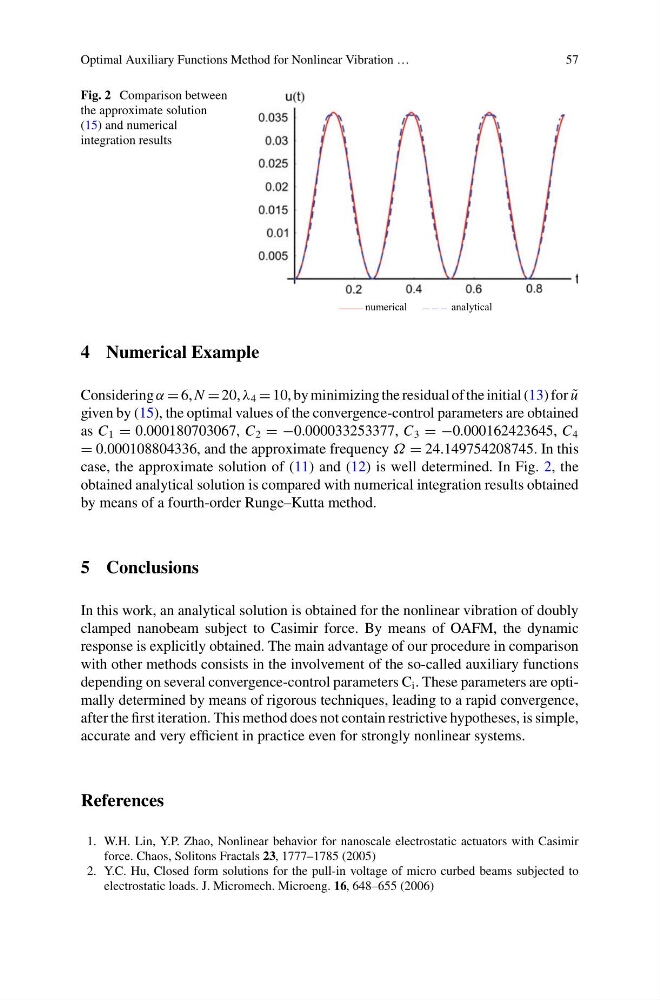
Fig. 2 Comparison between
the approximate solution
(15) and numerical
integration results
____ numerical _ _ _ analytical
4 Numerical Example
Considering α = 6, N = 20, λ 4 = 10, by minimizing the residual of the initial (13) for ˜
u
given by (15), the optimal values of the convergence-control parameters are obtained
as C 1 = 0.000180703067, C 2 = −0.000033253377, C 3 = −0.000162423645, C 4
= 0.000108804336, and the approximate frequency Ω = 24.149754208745. In this
case, the approximate solution of (11) and (12) is well determined. In Fig. 2, the
obtained analytical solution is compared with numerical integration results obtained
by means of a fourth-order Runge–Kutta method.
5 Conclusions
In this work, an analytical solution is obtained for the nonlinear vibration of doubly
clamped nanobeam subject to Casimir force. By means of OAFM, the dynamic
response is explicitly obtained. The main advantage of our procedure in comparison
with other methods consists in the involvement of the so-called auxiliary functions
depending on several convergence-control parameters C i . These parameters are optimally determined by means of rigorous techniques, leading to a rapid convergence,
after the first iteration. This method does not contain restrictive hypotheses, is simple,
accurate and very efficient in practice even for strongly nonlinear systems.
References
1. W.H. Lin, Y.P. Zhao, Nonlinear behavior for nanoscale electrostatic actuators with Casimir
force. Chaos, Solitons Fractals 23, 1777–1785 (2005)
2. Y.C. Hu, Closed form solutions for the pull-in voltage of micro curbed beams subjected to
electrostatic loads. J. Micromech. Microeng. 16, 648–655 (2006)
57
Fig. 2 Comparison between
the approximate solution
(15) and numerical
integration results
____ numerical _ _ _ analytical
4 Numerical Example
Considering α = 6, N = 20, λ 4 = 10, by minimizing the residual of the initial (13) for ˜
u
given by (15), the optimal values of the convergence-control parameters are obtained
as C 1 = 0.000180703067, C 2 = −0.000033253377, C 3 = −0.000162423645, C 4
= 0.000108804336, and the approximate frequency Ω = 24.149754208745. In this
case, the approximate solution of (11) and (12) is well determined. In Fig. 2, the
obtained analytical solution is compared with numerical integration results obtained
by means of a fourth-order Runge–Kutta method.
5 Conclusions
In this work, an analytical solution is obtained for the nonlinear vibration of doubly
clamped nanobeam subject to Casimir force. By means of OAFM, the dynamic
response is explicitly obtained. The main advantage of our procedure in comparison
with other methods consists in the involvement of the so-called auxiliary functions
depending on several convergence-control parameters C i . These parameters are optimally determined by means of rigorous techniques, leading to a rapid convergence,
after the first iteration. This method does not contain restrictive hypotheses, is simple,
accurate and very efficient in practice even for strongly nonlinear systems.
References
1. W.H. Lin, Y.P. Zhao, Nonlinear behavior for nanoscale electrostatic actuators with Casimir
force. Chaos, Solitons Fractals 23, 1777–1785 (2005)
2. Y.C. Hu, Closed form solutions for the pull-in voltage of micro curbed beams subjected to
electrostatic loads. J. Micromech. Microeng. 16, 648–655 (2006)