

The Influence of the Mesh Element Size …
531
Table 2 Four natural frequencies of the rotor–shaft in two planes
No. mode Four natural
frequencies in
OXY plane [Hz]
Critical speeds in
OXY plane [rpm]
Four natural
frequencies in OXZ
plane [Hz]
Critical speeds in
OXZ plane [rpm]
1
594.51
35,670.6
595.42
35,725.2
2
1152.3
69.138
1155.2
69.312
3
2551.7
153.102
2553.3
153.198
4
3723.4
223.404
3723.7
223.422
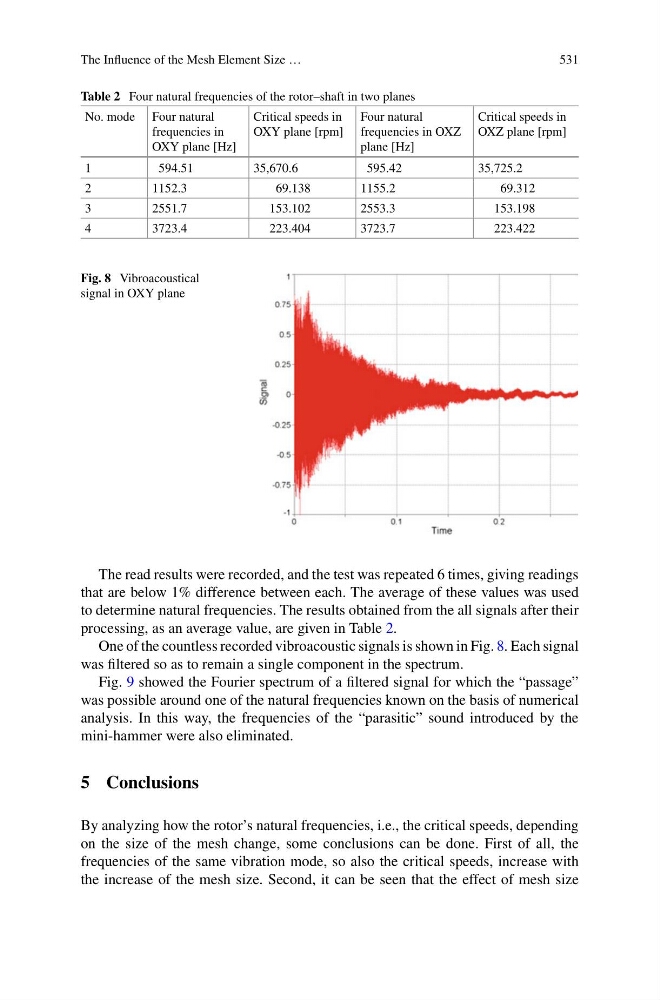
Fig. 8 Vibroacoustical
signal in OXY plane
The read results were recorded, and the test was repeated 6 times, giving readings
that are below 1% difference between each. The average of these values was used
to determine natural frequencies. The results obtained from the all signals after their
processing, as an average value, are given in Table 2.
One of the countless recorded vibroacoustic signals is shown in Fig. 8. Each signal
was filtered so as to remain a single component in the spectrum.
Fig. 9 showed the Fourier spectrum of a filtered signal for which the “passage”
was possible around one of the natural frequencies known on the basis of numerical
analysis. In this way, the frequencies of the “parasitic” sound introduced by the
mini-hammer were also eliminated.
5 Conclusions
By analyzing how the rotor’s natural frequencies, i.e., the critical speeds, depending
on the size of the mesh change, some conclusions can be done. First of all, the
frequencies of the same vibration mode, so also the critical speeds, increase with
the increase of the mesh size. Second, it can be seen that the effect of mesh size
531
Table 2 Four natural frequencies of the rotor–shaft in two planes
No. mode Four natural
frequencies in
OXY plane [Hz]
Critical speeds in
OXY plane [rpm]
Four natural
frequencies in OXZ
plane [Hz]
Critical speeds in
OXZ plane [rpm]
1
594.51
35,670.6
595.42
35,725.2
2
1152.3
69.138
1155.2
69.312
3
2551.7
153.102
2553.3
153.198
4
3723.4
223.404
3723.7
223.422
Fig. 8 Vibroacoustical
signal in OXY plane
The read results were recorded, and the test was repeated 6 times, giving readings
that are below 1% difference between each. The average of these values was used
to determine natural frequencies. The results obtained from the all signals after their
processing, as an average value, are given in Table 2.
One of the countless recorded vibroacoustic signals is shown in Fig. 8. Each signal
was filtered so as to remain a single component in the spectrum.
Fig. 9 showed the Fourier spectrum of a filtered signal for which the “passage”
was possible around one of the natural frequencies known on the basis of numerical
analysis. In this way, the frequencies of the “parasitic” sound introduced by the
mini-hammer were also eliminated.
5 Conclusions
By analyzing how the rotor’s natural frequencies, i.e., the critical speeds, depending
on the size of the mesh change, some conclusions can be done. First of all, the
frequencies of the same vibration mode, so also the critical speeds, increase with
the increase of the mesh size. Second, it can be seen that the effect of mesh size