

532
I. Cr⸠stiu et al.
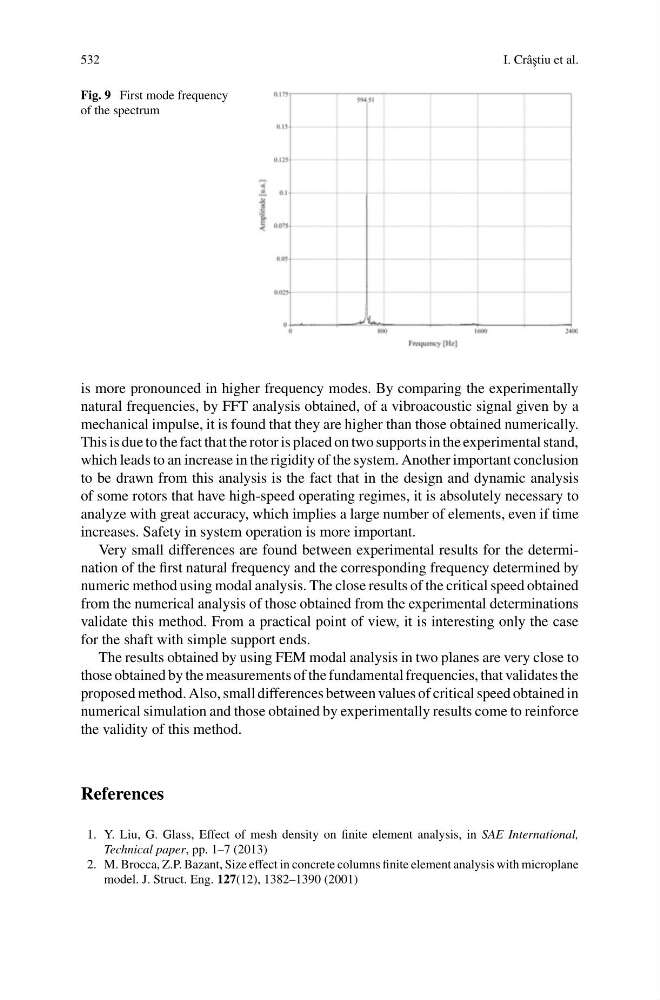
Fig. 9 First mode frequency
of the spectrum
is more pronounced in higher frequency modes. By comparing the experimentally
natural frequencies, by FFT analysis obtained, of a vibroacoustic signal given by a
mechanical impulse, it is found that they are higher than those obtained numerically.
This is due to the fact that the rotor is placed on two supports in the experimental stand,
which leads to an increase in the rigidity of the system. Another important conclusion
to be drawn from this analysis is the fact that in the design and dynamic analysis
of some rotors that have high-speed operating regimes, it is absolutely necessary to
analyze with great accuracy, which implies a large number of elements, even if time
increases. Safety in system operation is more important.
Very small differences are found between experimental results for the determination of the first natural frequency and the corresponding frequency determined by
numeric method using modal analysis. The close results of the critical speed obtained
from the numerical analysis of those obtained from the experimental determinations
validate this method. From a practical point of view, it is interesting only the case
for the shaft with simple support ends.
The results obtained by using FEM modal analysis in two planes are very close to
those obtained by the measurements of the fundamental frequencies, that validates the
proposed method. Also, small differences between values of critical speed obtained in
numerical simulation and those obtained by experimentally results come to reinforce
the validity of this method.
References
1. Y. Liu, G. Glass, Effect of mesh density on finite element analysis, in SAE International,
Technical paper, pp. 1–7 (2013)
2. M. Brocca, Z.P. Bazant, Size effect in concrete columns finite element analysis with microplane
model. J. Struct. Eng. 127(12), 1382–1390 (2001)
I. Cr⸠stiu et al.
Fig. 9 First mode frequency
of the spectrum
is more pronounced in higher frequency modes. By comparing the experimentally
natural frequencies, by FFT analysis obtained, of a vibroacoustic signal given by a
mechanical impulse, it is found that they are higher than those obtained numerically.
This is due to the fact that the rotor is placed on two supports in the experimental stand,
which leads to an increase in the rigidity of the system. Another important conclusion
to be drawn from this analysis is the fact that in the design and dynamic analysis
of some rotors that have high-speed operating regimes, it is absolutely necessary to
analyze with great accuracy, which implies a large number of elements, even if time
increases. Safety in system operation is more important.
Very small differences are found between experimental results for the determination of the first natural frequency and the corresponding frequency determined by
numeric method using modal analysis. The close results of the critical speed obtained
from the numerical analysis of those obtained from the experimental determinations
validate this method. From a practical point of view, it is interesting only the case
for the shaft with simple support ends.
The results obtained by using FEM modal analysis in two planes are very close to
those obtained by the measurements of the fundamental frequencies, that validates the
proposed method. Also, small differences between values of critical speed obtained in
numerical simulation and those obtained by experimentally results come to reinforce
the validity of this method.
References
1. Y. Liu, G. Glass, Effect of mesh density on finite element analysis, in SAE International,
Technical paper, pp. 1–7 (2013)
2. M. Brocca, Z.P. Bazant, Size effect in concrete columns finite element analysis with microplane
model. J. Struct. Eng. 127(12), 1382–1390 (2001)