

Research of Acoustic Metamaterials at the University of Szeged …
493
gripping part of the periodically excited m 1 mass can be determined. Of course the
s 1 , k 1 parameters have to be measured without the m 2 mass, and the s 2 , k 2 parameters
can be found with fixed m 1 mass position, at excited m 2 mass.
As a plan of the future research the displacement should be measured too (with
laser or inductive displacement transducer), than the measurement of the parameters
will become much easier, and with laser measurement the problem of the mass of
measuring elements will not appear at all.
4 “Wallpaper-like” Metamaterial
The design of the metamaterial being developed is similar to a wall-paper and its
application is planned to be as same as a wall-paper: stuck on the wall. From the
point of view of producibility no more then 4–5 attached masses can be considered.
With well-set parameters the natural frequencies of the different attached masses are
uniformly distributed within a relatively wide (600–800 Hz) frequency range thus
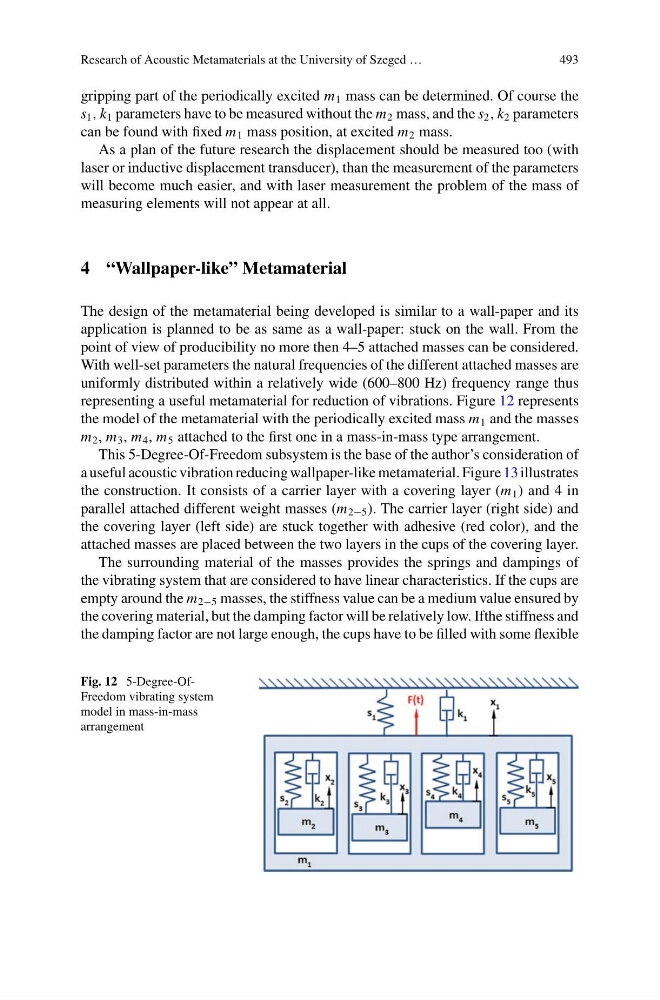
representing a useful metamaterial for reduction of vibrations. Figure 12 represents
the model of the metamaterial with the periodically excited mass m 1 and the masses
m 2 , m 3 , m 4 , m 5 attached to the first one in a mass-in-mass type arrangement.
This 5-Degree-Of-Freedom subsystem is the base of the author’s consideration of
a useful acoustic vibration reducing wallpaper-like metamaterial. Figure 13 illustrates
the construction. It consists of a carrier layer with a covering layer (m 1 ) and 4 in
parallel attached different weight masses (m 2−5 ). The carrier layer (right side) and
the covering layer (left side) are stuck together with adhesive (red color), and the
attached masses are placed between the two layers in the cups of the covering layer.
The surrounding material of the masses provides the springs and dampings of
the vibrating system that are considered to have linear characteristics. If the cups are
empty around the m 2−5 masses, the stiffness value can be a medium value ensured by
the covering material, but the damping factor will be relatively low. Ifthe stiffness and
the damping factor are not large enough, the cups have to be filled with some flexible
Fig. 12 5-Degree-OfFreedom vibrating system
model in mass-in-mass
arrangement
493
gripping part of the periodically excited m 1 mass can be determined. Of course the
s 1 , k 1 parameters have to be measured without the m 2 mass, and the s 2 , k 2 parameters
can be found with fixed m 1 mass position, at excited m 2 mass.
As a plan of the future research the displacement should be measured too (with
laser or inductive displacement transducer), than the measurement of the parameters
will become much easier, and with laser measurement the problem of the mass of
measuring elements will not appear at all.
4 “Wallpaper-like” Metamaterial
The design of the metamaterial being developed is similar to a wall-paper and its
application is planned to be as same as a wall-paper: stuck on the wall. From the
point of view of producibility no more then 4–5 attached masses can be considered.
With well-set parameters the natural frequencies of the different attached masses are
uniformly distributed within a relatively wide (600–800 Hz) frequency range thus
representing a useful metamaterial for reduction of vibrations. Figure 12 represents
the model of the metamaterial with the periodically excited mass m 1 and the masses
m 2 , m 3 , m 4 , m 5 attached to the first one in a mass-in-mass type arrangement.
This 5-Degree-Of-Freedom subsystem is the base of the author’s consideration of
a useful acoustic vibration reducing wallpaper-like metamaterial. Figure 13 illustrates
the construction. It consists of a carrier layer with a covering layer (m 1 ) and 4 in
parallel attached different weight masses (m 2−5 ). The carrier layer (right side) and
the covering layer (left side) are stuck together with adhesive (red color), and the
attached masses are placed between the two layers in the cups of the covering layer.
The surrounding material of the masses provides the springs and dampings of
the vibrating system that are considered to have linear characteristics. If the cups are
empty around the m 2−5 masses, the stiffness value can be a medium value ensured by
the covering material, but the damping factor will be relatively low. Ifthe stiffness and
the damping factor are not large enough, the cups have to be filled with some flexible
Fig. 12 5-Degree-OfFreedom vibrating system
model in mass-in-mass
arrangement