

492
P. Szuchy
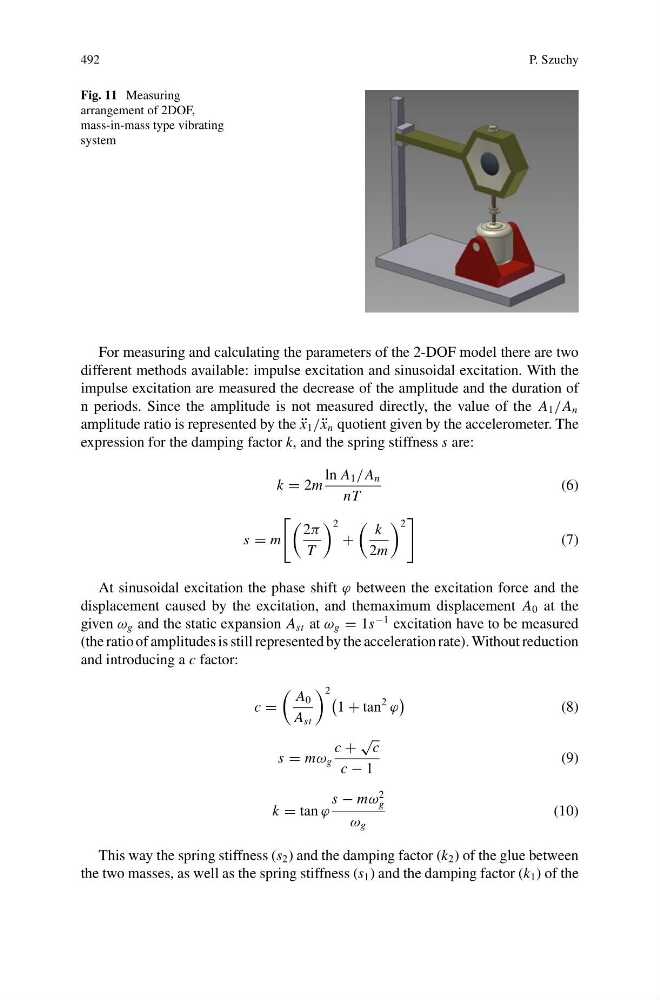
Fig. 11 Measuring
arrangement of 2DOF,
mass-in-mass type vibrating
system
For measuring and calculating the parameters of the 2-DOF model there are two
different methods available: impulse excitation and sinusoidal excitation. With the
impulse excitation are measured the decrease of the amplitude and the duration of
n periods. Since the amplitude is not measured directly, the value of the A 1 /A n
amplitude ratio is represented by the ¨
x 1 / ¨
x n quotient given by the accelerometer. The
expression for the damping factor k, and the spring stiffness s are:
k = 2m
ln A 1 /A n
nT
(6)
s = m
2π
T
2
+
k
2m
2
(7)
At sinusoidal excitation the phase shift ϕ between the excitation force and the
displacement caused by the excitation, and themaximum displacement A 0 at the
given ω g and the static expansion A st at ω g = 1s
−1 excitation have to be measured
(the ratio of amplitudes is still represented by the acceleration rate). Without reduction
and introducing a c factor:
c =
A 0
A st
2
1 + tan
2
ϕ
(8)
s = mω g
c +
√
c
c − 1
(9)
k = tan ϕ
s − mω
2
g
ω g
(10)
This way the spring stiffness (s 2 ) and the damping factor (k 2 ) of the glue between
the two masses, as well as the spring stiffness (s 1 ) and the damping factor (k 1 ) of the
P. Szuchy
Fig. 11 Measuring
arrangement of 2DOF,
mass-in-mass type vibrating
system
For measuring and calculating the parameters of the 2-DOF model there are two
different methods available: impulse excitation and sinusoidal excitation. With the
impulse excitation are measured the decrease of the amplitude and the duration of
n periods. Since the amplitude is not measured directly, the value of the A 1 /A n
amplitude ratio is represented by the ¨
x 1 / ¨
x n quotient given by the accelerometer. The
expression for the damping factor k, and the spring stiffness s are:
k = 2m
ln A 1 /A n
nT
(6)
s = m
2π
T
2
+
k
2m
2
(7)
At sinusoidal excitation the phase shift ϕ between the excitation force and the
displacement caused by the excitation, and themaximum displacement A 0 at the
given ω g and the static expansion A st at ω g = 1s
−1 excitation have to be measured
(the ratio of amplitudes is still represented by the acceleration rate). Without reduction
and introducing a c factor:
c =
A 0
A st
2
1 + tan
2
ϕ
(8)
s = mω g
c +
√
c
c − 1
(9)
k = tan ϕ
s − mω
2
g
ω g
(10)
This way the spring stiffness (s 2 ) and the damping factor (k 2 ) of the glue between
the two masses, as well as the spring stiffness (s 1 ) and the damping factor (k 1 ) of the