

Research of Acoustic Metamaterials at the University of Szeged …
487
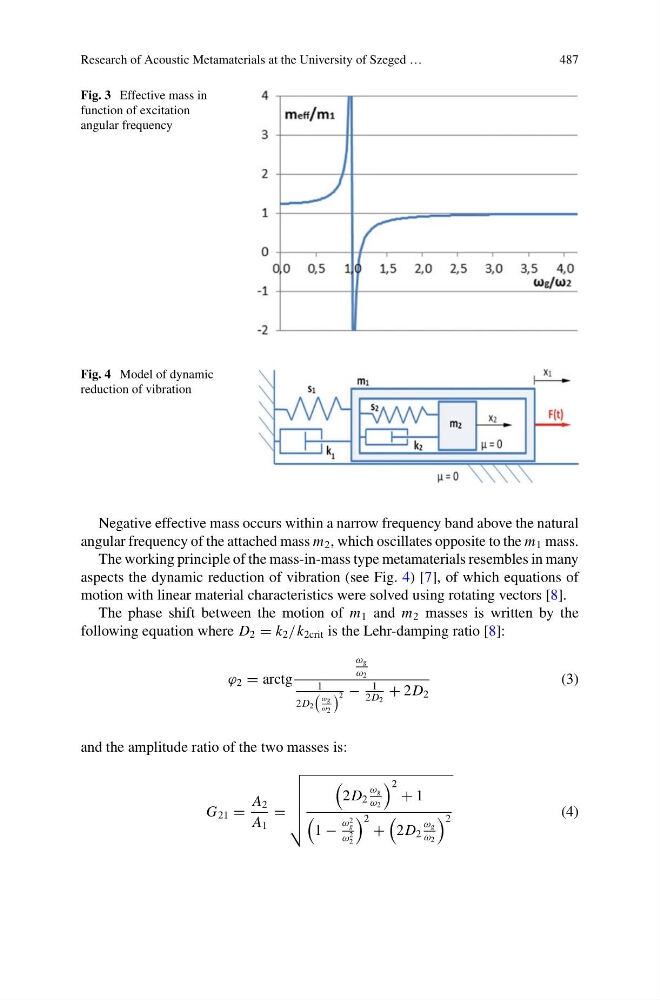
Fig. 3 Effective mass in
function of excitation
angular frequency
Fig. 4 Model of dynamic
reduction of vibration
Negative effective mass occurs within a narrow frequency band above the natural
angular frequency of the attached mass m 2 , which oscillates opposite to the m 1 mass.
The working principle of the mass-in-mass type metamaterials resembles in many
aspects the dynamic reduction of vibration (see Fig. 4) [7], of which equations of
motion with linear material characteristics were solved using rotating vectors [8].
The phase shift between the motion of m 1 and m 2 masses is written by the
following equation where D 2 = k 2 /k 2crit is the Lehr-damping ratio [8]:
ϕ 2 = arctg
ω g
ω 2
1
2D 2
ωg
ω 2
2 −
1
2D 2
+ 2D 2
(3)
and the amplitude ratio of the two masses is:
G 21 =
A 2
A 1
=
2D 2
ω g
ω 2
2 + 1
1 −
ω 2
g
ω
2
2
2 +
2D 2
ω g
ω 2
2
(4)
487
Fig. 3 Effective mass in
function of excitation
angular frequency
Fig. 4 Model of dynamic
reduction of vibration
Negative effective mass occurs within a narrow frequency band above the natural
angular frequency of the attached mass m 2 , which oscillates opposite to the m 1 mass.
The working principle of the mass-in-mass type metamaterials resembles in many
aspects the dynamic reduction of vibration (see Fig. 4) [7], of which equations of
motion with linear material characteristics were solved using rotating vectors [8].
The phase shift between the motion of m 1 and m 2 masses is written by the
following equation where D 2 = k 2 /k 2crit is the Lehr-damping ratio [8]:
ϕ 2 = arctg
ω g
ω 2
1
2D 2
ωg
ω 2
2 −
1
2D 2
+ 2D 2
(3)
and the amplitude ratio of the two masses is:
G 21 =
A 2
A 1
=
2D 2
ω g
ω 2
2 + 1
1 −
ω 2
g
ω
2
2
2 +
2D 2
ω g
ω 2
2
(4)