

488
P. Szuchy
If the spring and damping forces change linear with the displacement and velocity,
than the equations of motion of the harmonic oscillation can be solved analytically,
but in non-linear case there are only approximate solutions.
The equation of motion of progressive characteristic spring, linear viscous
damping, one-degree-of freedom oscillation was written and solved by G. Duffing
in 1918 [9]:
¨
x(t) + ax(t) + μx
3
(t) + λ ˙
x(t) = F(t)
(5)
The non-linear characteristic was described by cubic function.
In rotating vector presentation the Duffing equation contains such a member that
rotates not together with the other vectors’ angular frequency, but three times faster.
Therefore the phase shifts among the excitation force, displacement, velocity and
acceleration vectors are not stationary, they vary during a period of motion.
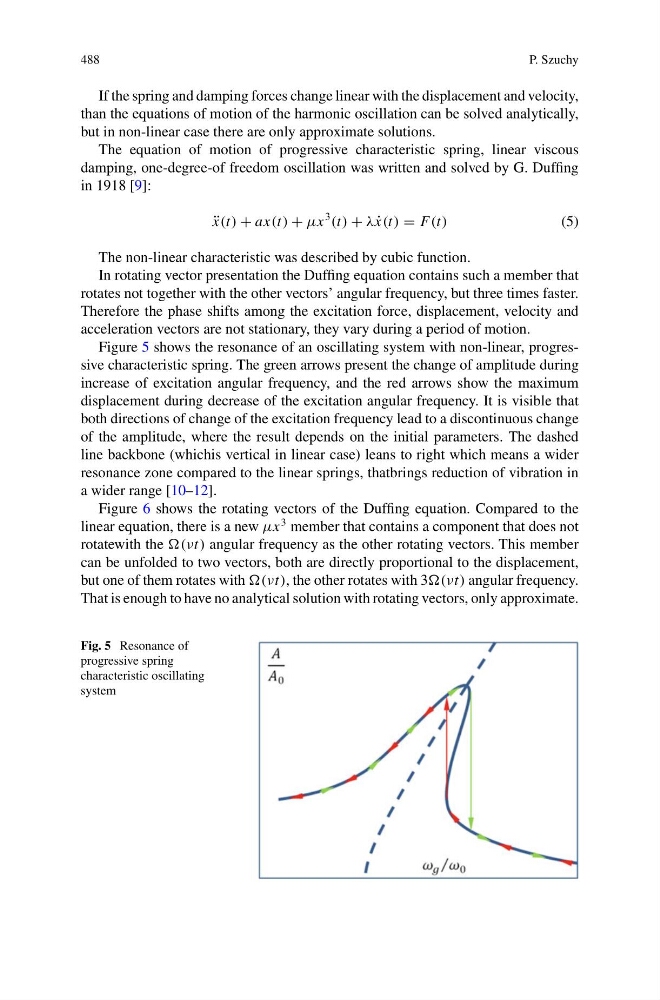
Figure 5 shows the resonance of an oscillating system with non-linear, progressive characteristic spring. The green arrows present the change of amplitude during
increase of excitation angular frequency, and the red arrows show the maximum
displacement during decrease of the excitation angular frequency. It is visible that
both directions of change of the excitation frequency lead to a discontinuous change
of the amplitude, where the result depends on the initial parameters. The dashed
line backbone (whichis vertical in linear case) leans to right which means a wider
resonance zone compared to the linear springs, thatbrings reduction of vibration in
a wider range [10–12].
Figure 6 shows the rotating vectors of the Duffing equation. Compared to the
linear equation, there is a new μx
3 member that contains a component that does not
rotatewith the (νt) angular frequency as the other rotating vectors. This member
can be unfolded to two vectors, both are directly proportional to the displacement,
but one of them rotates with (νt), the other rotates with 3(νt) angular frequency.
That is enough to have no analytical solution with rotating vectors, only approximate.
Fig. 5 Resonance of
progressive spring
characteristic oscillating
system
P. Szuchy
If the spring and damping forces change linear with the displacement and velocity,
than the equations of motion of the harmonic oscillation can be solved analytically,
but in non-linear case there are only approximate solutions.
The equation of motion of progressive characteristic spring, linear viscous
damping, one-degree-of freedom oscillation was written and solved by G. Duffing
in 1918 [9]:
¨
x(t) + ax(t) + μx
3
(t) + λ ˙
x(t) = F(t)
(5)
The non-linear characteristic was described by cubic function.
In rotating vector presentation the Duffing equation contains such a member that
rotates not together with the other vectors’ angular frequency, but three times faster.
Therefore the phase shifts among the excitation force, displacement, velocity and
acceleration vectors are not stationary, they vary during a period of motion.
Figure 5 shows the resonance of an oscillating system with non-linear, progressive characteristic spring. The green arrows present the change of amplitude during
increase of excitation angular frequency, and the red arrows show the maximum
displacement during decrease of the excitation angular frequency. It is visible that
both directions of change of the excitation frequency lead to a discontinuous change
of the amplitude, where the result depends on the initial parameters. The dashed
line backbone (whichis vertical in linear case) leans to right which means a wider
resonance zone compared to the linear springs, thatbrings reduction of vibration in
a wider range [10–12].
Figure 6 shows the rotating vectors of the Duffing equation. Compared to the
linear equation, there is a new μx
3 member that contains a component that does not
rotatewith the (νt) angular frequency as the other rotating vectors. This member
can be unfolded to two vectors, both are directly proportional to the displacement,
but one of them rotates with (νt), the other rotates with 3(νt) angular frequency.
That is enough to have no analytical solution with rotating vectors, only approximate.
Fig. 5 Resonance of
progressive spring
characteristic oscillating
system