

486
P. Szuchy
of the absorber has to be multiplied to thirty-two times [1]:
Transmission Loss = 10 log 10
1 +
πρh f
cρ α
2
(1)
where ρ is the density of absorber, h is the layer thickness of the absorber, f is the
frequency, ρ α is the density of air, c is the sound propagation speed in air [1]. It is for
that reason the research of alternative sound-proof materials, including such materials
which revealing features are terminated by their inner structure rather than their
material quality (metamaterials) has been highly increased during the last decade.
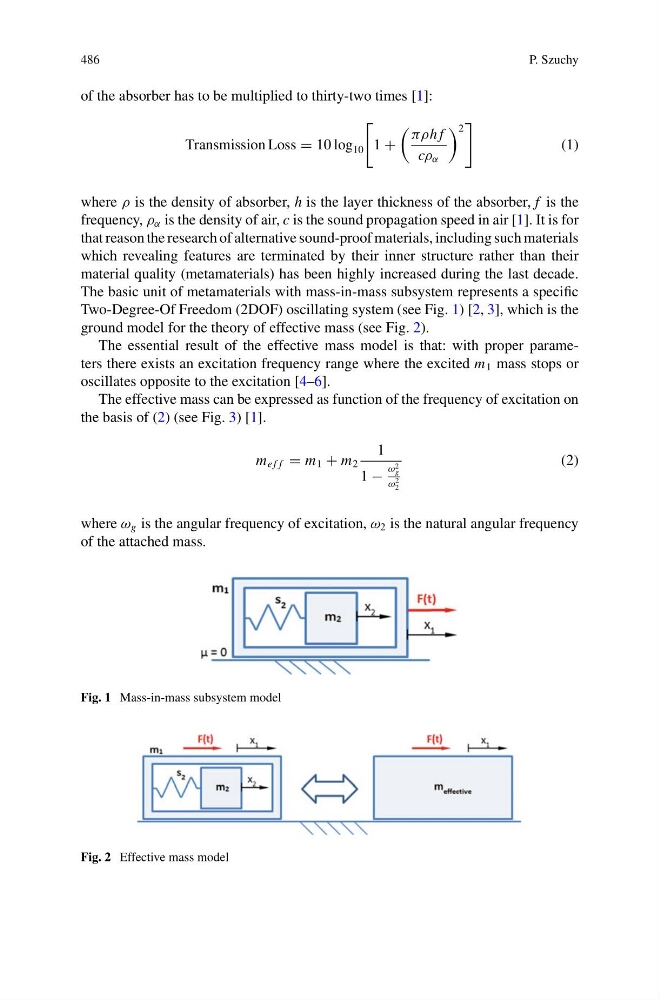
The basic unit of metamaterials with mass-in-mass subsystem represents a specific
Two-Degree-Of Freedom (2DOF) oscillating system (see Fig. 1) [2, 3], which is the
ground model for the theory of effective mass (see Fig. 2).
The essential result of the effective mass model is that: with proper parameters there exists an excitation frequency range where the excited m 1 mass stops or
oscillates opposite to the excitation [4–6].
The effective mass can be expressed as function of the frequency of excitation on
the basis of (2) (see Fig. 3) [1].
m e f f = m 1 + m 2
1
1 −
ω 2
g
ω
2
2
(2)
where ω g is the angular frequency of excitation, ω 2 is the natural angular frequency
of the attached mass.
Fig. 1 Mass-in-mass subsystem model
Fig. 2 Effective mass model
P. Szuchy
of the absorber has to be multiplied to thirty-two times [1]:
Transmission Loss = 10 log 10
1 +
πρh f
cρ α
2
(1)
where ρ is the density of absorber, h is the layer thickness of the absorber, f is the
frequency, ρ α is the density of air, c is the sound propagation speed in air [1]. It is for
that reason the research of alternative sound-proof materials, including such materials
which revealing features are terminated by their inner structure rather than their
material quality (metamaterials) has been highly increased during the last decade.
The basic unit of metamaterials with mass-in-mass subsystem represents a specific
Two-Degree-Of Freedom (2DOF) oscillating system (see Fig. 1) [2, 3], which is the
ground model for the theory of effective mass (see Fig. 2).
The essential result of the effective mass model is that: with proper parameters there exists an excitation frequency range where the excited m 1 mass stops or
oscillates opposite to the excitation [4–6].
The effective mass can be expressed as function of the frequency of excitation on
the basis of (2) (see Fig. 3) [1].
m e f f = m 1 + m 2
1
1 −
ω 2
g
ω
2
2
(2)
where ω g is the angular frequency of excitation, ω 2 is the natural angular frequency
of the attached mass.
Fig. 1 Mass-in-mass subsystem model
Fig. 2 Effective mass model