

Vibration Analysis of High-Pressure Pneumatic Compressor
405
piston in cylinder causes rise in pressure and temperature. Reciprocating compressors are capable of giving large pressure ratios but the mass handling capacity is
limited or small, often ending in destroying an undersized actuator or transmission.
During the development of our high-pressure compressor, a number of failures
occurred: some due to undersized actuators, some to poorly treated transmission
systems. Overcoming these, there was still the problem of destruction of parts inside
the compressor case: piston-cylinder assembly and piping. Throughout the life of the
compressor, these elements are subjected to fatigue at a high ratio, thus prompting
us to perform overall vibration analysis.
For the analysis of the compressor, it was tested at pressures of 10 through 40 bar,
both in single-stage mode and overcharged (two stages) from an external compressor
at 2 bar. This relatively safe value of 2 bar was set in order to limit the intake pressure
inside the primary compressors housing which acted as a buffer chamber and was
used as a multiplier for the system produced pressure.
3 Data Acquisition
The acquisition system used was a Bruel & Kjaer PULSE Machine Diagnostics
Toolbox Type 9727 and the two accelerometers were Type 4513. These have a wide
frequency range, low noise-to-signal ratio, and sensitivity from 1 to 50 mV/m/s
2 .
The Type 4513 accelerometer is a piezoelectric Shear accelerometer with integral
electronics. The transducers have a high resolution, giving an excellent signal-tonoise ratio.
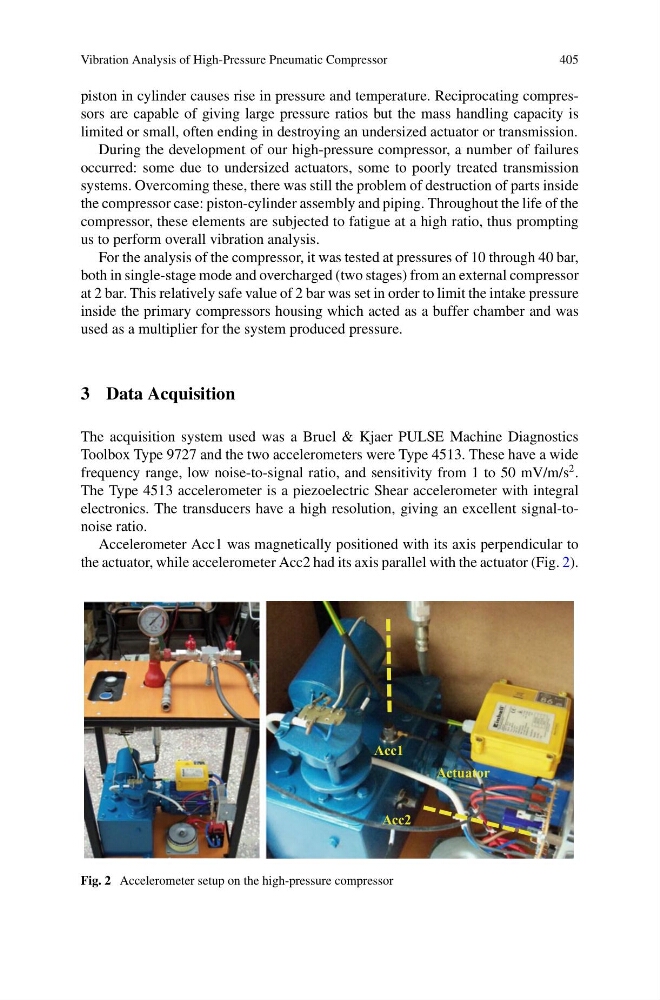
Accelerometer Acc1 was magnetically positioned with its axis perpendicular to
the actuator, while accelerometer Acc2 had its axis parallel with the actuator (Fig. 2).
Acc1
Acc2
Actuator
Fig. 2 Accelerometer setup on the high-pressure compressor
405
piston in cylinder causes rise in pressure and temperature. Reciprocating compressors are capable of giving large pressure ratios but the mass handling capacity is
limited or small, often ending in destroying an undersized actuator or transmission.
During the development of our high-pressure compressor, a number of failures
occurred: some due to undersized actuators, some to poorly treated transmission
systems. Overcoming these, there was still the problem of destruction of parts inside
the compressor case: piston-cylinder assembly and piping. Throughout the life of the
compressor, these elements are subjected to fatigue at a high ratio, thus prompting
us to perform overall vibration analysis.
For the analysis of the compressor, it was tested at pressures of 10 through 40 bar,
both in single-stage mode and overcharged (two stages) from an external compressor
at 2 bar. This relatively safe value of 2 bar was set in order to limit the intake pressure
inside the primary compressors housing which acted as a buffer chamber and was
used as a multiplier for the system produced pressure.
3 Data Acquisition
The acquisition system used was a Bruel & Kjaer PULSE Machine Diagnostics
Toolbox Type 9727 and the two accelerometers were Type 4513. These have a wide
frequency range, low noise-to-signal ratio, and sensitivity from 1 to 50 mV/m/s
2 .
The Type 4513 accelerometer is a piezoelectric Shear accelerometer with integral
electronics. The transducers have a high resolution, giving an excellent signal-tonoise ratio.
Accelerometer Acc1 was magnetically positioned with its axis perpendicular to
the actuator, while accelerometer Acc2 had its axis parallel with the actuator (Fig. 2).
Acc1
Acc2
Actuator
Fig. 2 Accelerometer setup on the high-pressure compressor