

390
A.-I. Berariu et al.
in order to correctly simulate the material cutting some thickness needs to be added.
To complete the mechanical system the bottom part is fixed representing the material
continuum. The last assumption used is the dry cutting condition.
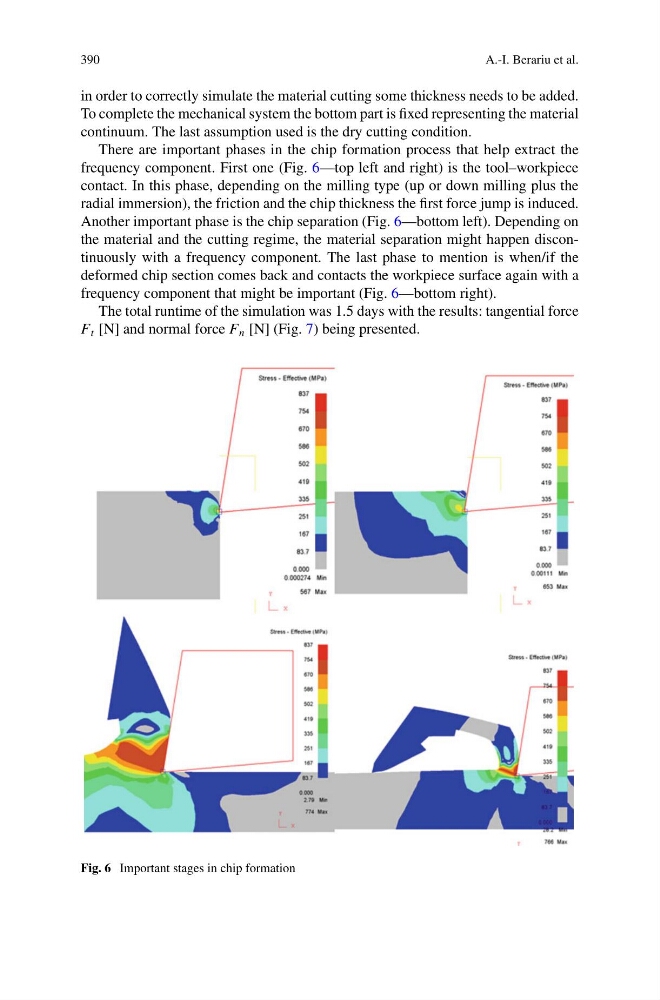
There are important phases in the chip formation process that help extract the
frequency component. First one (Fig. 6—top left and right) is the tool–workpiece
contact. In this phase, depending on the milling type (up or down milling plus the
radial immersion), the friction and the chip thickness the first force jump is induced.
Another important phase is the chip separation (Fig. 6—bottom left). Depending on
the material and the cutting regime, the material separation might happen discontinuously with a frequency component. The last phase to mention is when/if the
deformed chip section comes back and contacts the workpiece surface again with a
frequency component that might be important (Fig. 6—bottom right).
The total runtime of the simulation was 1.5 days with the results: tangential force
F t [N] and normal force F n [N] (Fig. 7) being presented.
Fig. 6 Important stages in chip formation
A.-I. Berariu et al.
in order to correctly simulate the material cutting some thickness needs to be added.
To complete the mechanical system the bottom part is fixed representing the material
continuum. The last assumption used is the dry cutting condition.
There are important phases in the chip formation process that help extract the
frequency component. First one (Fig. 6—top left and right) is the tool–workpiece
contact. In this phase, depending on the milling type (up or down milling plus the
radial immersion), the friction and the chip thickness the first force jump is induced.
Another important phase is the chip separation (Fig. 6—bottom left). Depending on
the material and the cutting regime, the material separation might happen discontinuously with a frequency component. The last phase to mention is when/if the
deformed chip section comes back and contacts the workpiece surface again with a
frequency component that might be important (Fig. 6—bottom right).
The total runtime of the simulation was 1.5 days with the results: tangential force
F t [N] and normal force F n [N] (Fig. 7) being presented.
Fig. 6 Important stages in chip formation