

ANN Samples Generation Using 2D Dynamic …
387
where k t and k n are the tangential and normal components of the specific force K s ,
θ [°] is the angle between F n and the resulting total force and h [mm] is the chip
thickness.
The number of teeth, Z, will directly influence the periodic impulses train caused
by partial immersion (up and down milling). The number of teeth dictates the passing
frequency that can be easily associated with the same phenomena for one tooth
but with a Z-dependent phase shift. The aim is to extract the harmonics caused
by the tooth passing frequency, using the Spindle speed N in order to apply the
Fourier transformation, that can be used later to validate the method. Normally,
these frequencies should be confirmed in the obtained spectrum alongside other
frequencies caused by various nonlinear phenomena related to chip formation [5].
3 3D to 2D Conversion of Milling Dynamics
Obtaining the unwrapped chip of two consecutive teeth A novelty method which
computes the chip thickness value as a function of angle h(ø) [mm] is presented in
this chapter, allowing the unwrapping of the complicated polar cutting problem for
a more simple 2D linear problem. The method is geometric in nature and Python™
is used as the programming language of choice.
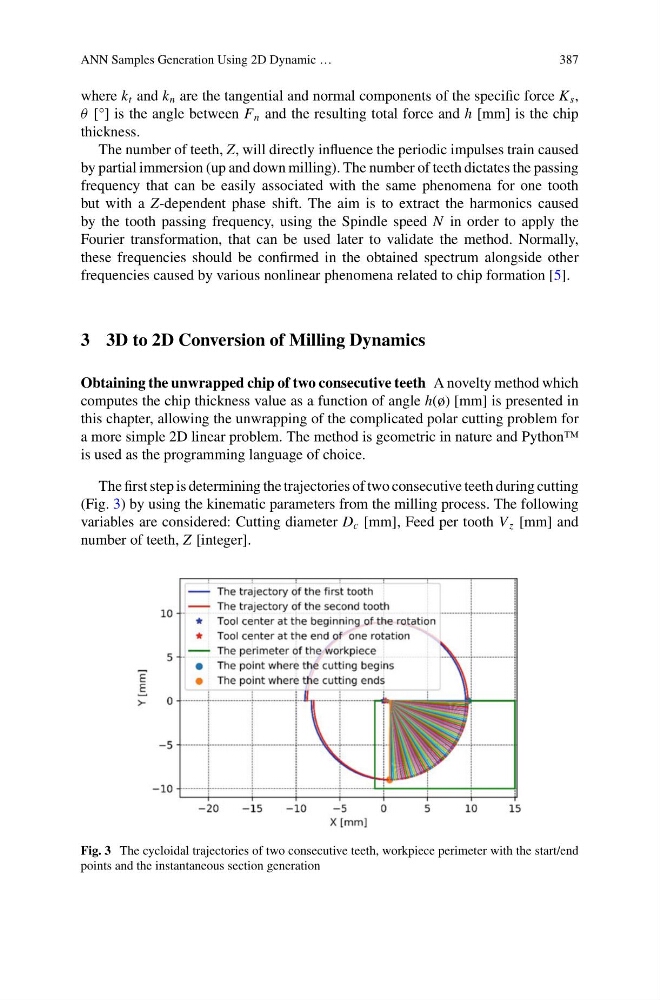
The first step is determining the trajectories of two consecutive teeth during cutting
(Fig. 3) by using the kinematic parameters from the milling process. The following
variables are considered: Cutting diameter D c [mm], Feed per tooth V z [mm] and
number of teeth, Z [integer].
Fig. 3 The cycloidal trajectories of two consecutive teeth, workpiece perimeter with the start/end
points and the instantaneous section generation
387
where k t and k n are the tangential and normal components of the specific force K s ,
θ [°] is the angle between F n and the resulting total force and h [mm] is the chip
thickness.
The number of teeth, Z, will directly influence the periodic impulses train caused
by partial immersion (up and down milling). The number of teeth dictates the passing
frequency that can be easily associated with the same phenomena for one tooth
but with a Z-dependent phase shift. The aim is to extract the harmonics caused
by the tooth passing frequency, using the Spindle speed N in order to apply the
Fourier transformation, that can be used later to validate the method. Normally,
these frequencies should be confirmed in the obtained spectrum alongside other
frequencies caused by various nonlinear phenomena related to chip formation [5].
3 3D to 2D Conversion of Milling Dynamics
Obtaining the unwrapped chip of two consecutive teeth A novelty method which
computes the chip thickness value as a function of angle h(ø) [mm] is presented in
this chapter, allowing the unwrapping of the complicated polar cutting problem for
a more simple 2D linear problem. The method is geometric in nature and Python™
is used as the programming language of choice.
The first step is determining the trajectories of two consecutive teeth during cutting
(Fig. 3) by using the kinematic parameters from the milling process. The following
variables are considered: Cutting diameter D c [mm], Feed per tooth V z [mm] and
number of teeth, Z [integer].
Fig. 3 The cycloidal trajectories of two consecutive teeth, workpiece perimeter with the start/end
points and the instantaneous section generation