

Dynamics of the Impact with Benson Friction Model
19
3 Application and Results
For the numerical application, a rigid link in pure rotation is considered. The link has
the following characteristics: the length is L = 0.30 m, the diameter is d = 0.05 m,
the radius is R = d/2, the density is ρ = 7800 kg/m
3 , the mass is m = π R
2 L ρ,
and the mass moment of inertia about C is I C = m (L
2
+ 3 R
2
)/12 kg m
2 .
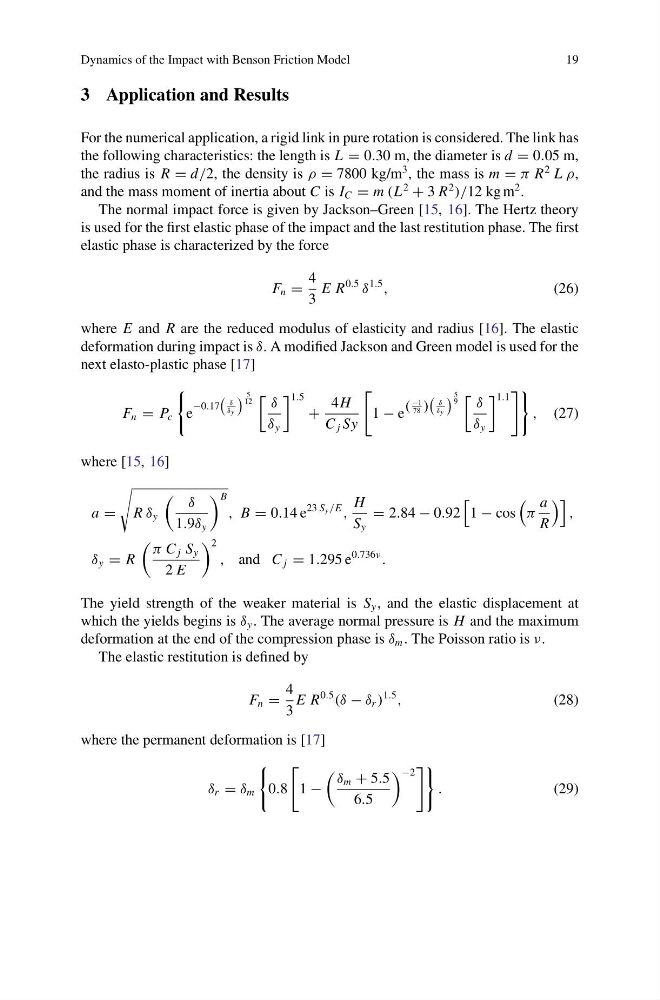
The normal impact force is given by Jackson–Green [15, 16]. The Hertz theory
is used for the first elastic phase of the impact and the last restitution phase. The first
elastic phase is characterized by the force
F n =
4
3
E R
0.5
δ
1.5
,
(26)
where E and R are the reduced modulus of elasticity and radius [16]. The elastic
deformation during impact is δ. A modified Jackson and Green model is used for the
next elasto-plastic phase [17]
F n = P c
e
−0.17
δ
δy
5
12
δ
δ y
1.5
+
4H
C j Sy
1 − e (
−1
78 )
δ
δy
5
9
δ
δ y
1.1
, (27)
where [15, 16]
a =
R δ y
δ
1.9δ y
B
, B = 0.14 e
23 S y /E
,
H
S y
= 2.84 − 0.92
1 − cos
π
a
R
,
δ y = R
π C j S y
2 E
2
, and C j = 1.295 e
0.736ν
.
The yield strength of the weaker material is S y , and the elastic displacement at
which the yields begins is δ y . The average normal pressure is H and the maximum
deformation at the end of the compression phase is δ m . The Poisson ratio is ν.
The elastic restitution is defined by
F n =
4
3
E R
0.5
(δ − δ r )
1.5
,
(28)
where the permanent deformation is [17]
δ r = δ m
0.8
1 −
δ m + 5.5
6.5
−2
.
(29)
19
3 Application and Results
For the numerical application, a rigid link in pure rotation is considered. The link has
the following characteristics: the length is L = 0.30 m, the diameter is d = 0.05 m,
the radius is R = d/2, the density is ρ = 7800 kg/m
3 , the mass is m = π R
2 L ρ,
and the mass moment of inertia about C is I C = m (L
2
+ 3 R
2
)/12 kg m
2 .
The normal impact force is given by Jackson–Green [15, 16]. The Hertz theory
is used for the first elastic phase of the impact and the last restitution phase. The first
elastic phase is characterized by the force
F n =
4
3
E R
0.5
δ
1.5
,
(26)
where E and R are the reduced modulus of elasticity and radius [16]. The elastic
deformation during impact is δ. A modified Jackson and Green model is used for the
next elasto-plastic phase [17]
F n = P c
e
−0.17
δ
δy
5
12
δ
δ y
1.5
+
4H
C j Sy
1 − e (
−1
78 )
δ
δy
5
9
δ
δ y
1.1
, (27)
where [15, 16]
a =
R δ y
δ
1.9δ y
B
, B = 0.14 e
23 S y /E
,
H
S y
= 2.84 − 0.92
1 − cos
π
a
R
,
δ y = R
π C j S y
2 E
2
, and C j = 1.295 e
0.736ν
.
The yield strength of the weaker material is S y , and the elastic displacement at
which the yields begins is δ y . The average normal pressure is H and the maximum
deformation at the end of the compression phase is δ m . The Poisson ratio is ν.
The elastic restitution is defined by
F n =
4
3
E R
0.5
(δ − δ r )
1.5
,
(28)
where the permanent deformation is [17]
δ r = δ m
0.8
1 −
δ m + 5.5
6.5
−2
.
(29)