

Dynamics of the Impact with Benson Friction Model
17
and the velocity of C 1 in reference frame (0) is
v C 1 =
d
dt
r C 1 =
(1) d
dt
r C 1 + ω 10 × r C 1 .
(12)
The position vector of C 2 , the mass center of link 2, is
r C 2 = 2 L 1 ı 1 + L 2 ı 2 .
(13)
The velocity of C 2 in reference frame (0) is
v C 2 =
d
dt
r C 2 =
(2) d
dt
r C 2 + ω 20 × r C 2 .
(14)
The acceleration of C 1 is
a C 1 =
d
dt
v C 1 =
(1) d
dt
v C 1 + ω 10 × v C 1 .
(15)
The acceleration of C 2 is
a C 2 =
d
dt
v C 2 =
(2) d
dt
v C 2 + ω 20 × v C 2 .
(16)
2.2 Generalized Active Forces
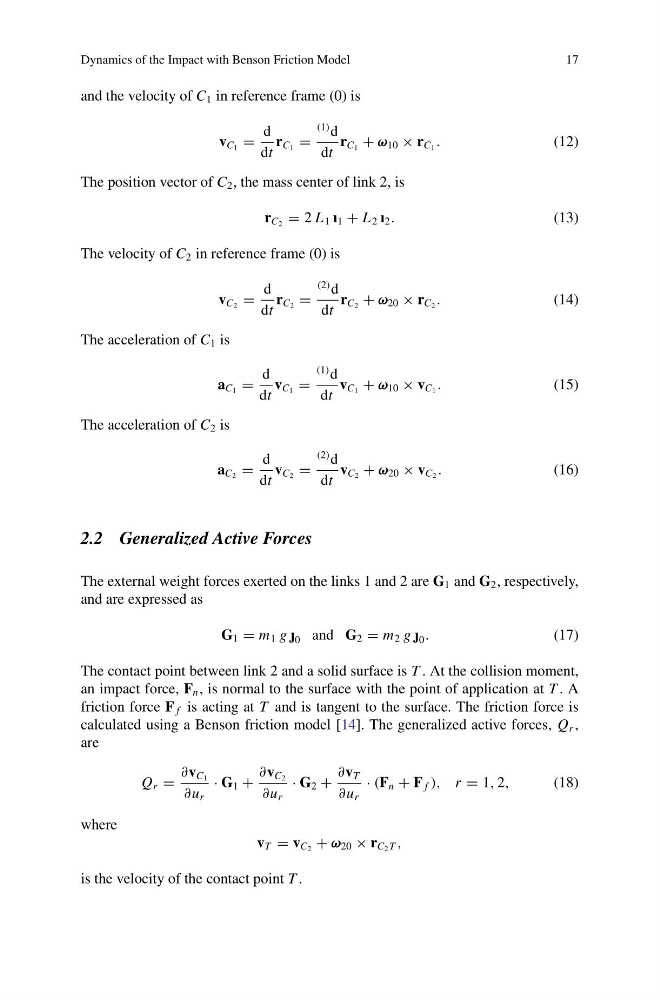
The external weight forces exerted on the links 1 and 2 are G 1 and G 2 , respectively,
and are expressed as
G 1 = m 1 g j 0 and G 2 = m 2 g j 0 .
(17)
The contact point between link 2 and a solid surface is T . At the collision moment,
an impact force, F n , is normal to the surface with the point of application at T . A
friction force F f is acting at T and is tangent to the surface. The friction force is
calculated using a Benson friction model [14]. The generalized active forces, Q r ,
are
Q r =
∂v C 1
∂u r
· G 1 +
∂v C 2
∂u r
· G 2 +
∂v T
∂u r
· (F n + F f ), r = 1, 2,
(18)
where
v T = v C 2 + ω 20 × r C 2 T ,
is the velocity of the contact point T .
17
and the velocity of C 1 in reference frame (0) is
v C 1 =
d
dt
r C 1 =
(1) d
dt
r C 1 + ω 10 × r C 1 .
(12)
The position vector of C 2 , the mass center of link 2, is
r C 2 = 2 L 1 ı 1 + L 2 ı 2 .
(13)
The velocity of C 2 in reference frame (0) is
v C 2 =
d
dt
r C 2 =
(2) d
dt
r C 2 + ω 20 × r C 2 .
(14)
The acceleration of C 1 is
a C 1 =
d
dt
v C 1 =
(1) d
dt
v C 1 + ω 10 × v C 1 .
(15)
The acceleration of C 2 is
a C 2 =
d
dt
v C 2 =
(2) d
dt
v C 2 + ω 20 × v C 2 .
(16)
2.2 Generalized Active Forces
The external weight forces exerted on the links 1 and 2 are G 1 and G 2 , respectively,
and are expressed as
G 1 = m 1 g j 0 and G 2 = m 2 g j 0 .
(17)
The contact point between link 2 and a solid surface is T . At the collision moment,
an impact force, F n , is normal to the surface with the point of application at T . A
friction force F f is acting at T and is tangent to the surface. The friction force is
calculated using a Benson friction model [14]. The generalized active forces, Q r ,
are
Q r =
∂v C 1
∂u r
· G 1 +
∂v C 2
∂u r
· G 2 +
∂v T
∂u r
· (F n + F f ), r = 1, 2,
(18)
where
v T = v C 2 + ω 20 × r C 2 T ,
is the velocity of the contact point T .