

Experimental Analysis of Noise and Chatter Detection in Milling …
337
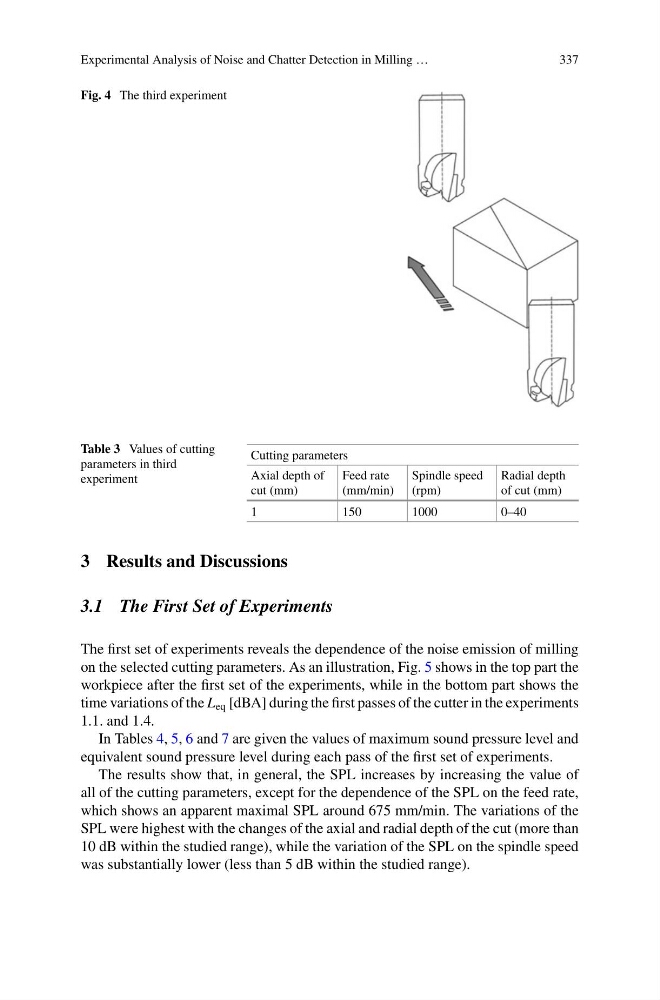
Fig. 4 The third experiment
Table 3 Values of cutting
parameters in third
experiment
Cutting parameters
Axial depth of
cut (mm)
Feed rate
(mm/min)
Spindle speed
(rpm)
Radial depth
of cut (mm)
1
150
1000
0–40
3 Results and Discussions
3.1 The First Set of Experiments
The first set of experiments reveals the dependence of the noise emission of milling
on the selected cutting parameters. As an illustration, Fig. 5 shows in the top part the
workpiece after the first set of the experiments, while in the bottom part shows the
time variations of the L eq [dBA] during the first passes of the cutter in the experiments
1.1. and 1.4.
In Tables 4, 5, 6 and 7 are given the values of maximum sound pressure level and
equivalent sound pressure level during each pass of the first set of experiments.
The results show that, in general, the SPL increases by increasing the value of
all of the cutting parameters, except for the dependence of the SPL on the feed rate,
which shows an apparent maximal SPL around 675 mm/min. The variations of the
SPL were highest with the changes of the axial and radial depth of the cut (more than
10 dB within the studied range), while the variation of the SPL on the spindle speed
was substantially lower (less than 5 dB within the studied range).
337
Fig. 4 The third experiment
Table 3 Values of cutting
parameters in third
experiment
Cutting parameters
Axial depth of
cut (mm)
Feed rate
(mm/min)
Spindle speed
(rpm)
Radial depth
of cut (mm)
1
150
1000
0–40
3 Results and Discussions
3.1 The First Set of Experiments
The first set of experiments reveals the dependence of the noise emission of milling
on the selected cutting parameters. As an illustration, Fig. 5 shows in the top part the
workpiece after the first set of the experiments, while in the bottom part shows the
time variations of the L eq [dBA] during the first passes of the cutter in the experiments
1.1. and 1.4.
In Tables 4, 5, 6 and 7 are given the values of maximum sound pressure level and
equivalent sound pressure level during each pass of the first set of experiments.
The results show that, in general, the SPL increases by increasing the value of
all of the cutting parameters, except for the dependence of the SPL on the feed rate,
which shows an apparent maximal SPL around 675 mm/min. The variations of the
SPL were highest with the changes of the axial and radial depth of the cut (more than
10 dB within the studied range), while the variation of the SPL on the spindle speed
was substantially lower (less than 5 dB within the studied range).