

Parameter Optimization for Biocompatible Polyamide Used …
325
Table 1 Manufacturing parameters and levels
Control factors
Symbol
Level/value
0
1
2
Energy density (J/mm 2 )
E
0.0732
0.0502
0.0346
Orientation (deg)
θ
0
30
45
Temperature (°C)
T
169.5
170.0
170.5
Table 2 Experiment
orthogonal (L9) array
Experiment
Factor/level
E
θ
T
First
0
0
0
Second
0
1
1
Third
0
2
2
Fourth
1
0
1
Fifth
1
1
2
Sixth
1
2
0
Seventh
2
0
2
Eighth
2
1
0
Nineth
2
2
1
by the manufacturer are: average grain size 56 µm; density of 0.45 g/cm
3 ; melting
point 172–180 °C; tensile strength 48 MPa.
The manufacturing process was conducted on EOS Formiga P100 machine that
uses selective laser sintering for bonding layer by layer the powder material to a solid
compact form. The powder is heated up using an electrical heater, while additional
energy required for sinterization is provided by a 30 W CO 2 laser.
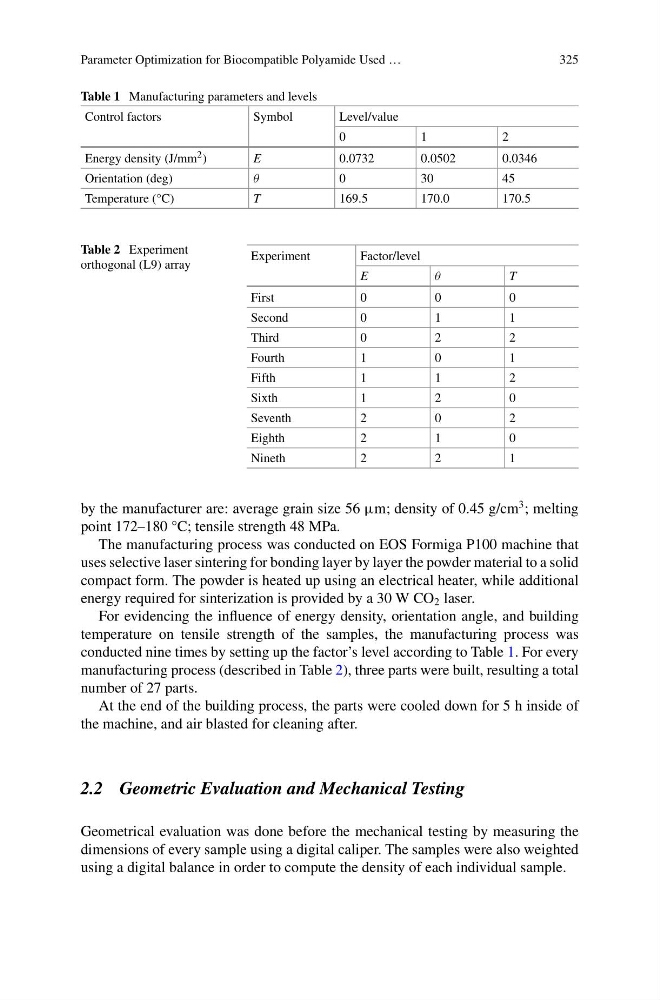
For evidencing the influence of energy density, orientation angle, and building
temperature on tensile strength of the samples, the manufacturing process was
conducted nine times by setting up the factor’s level according to Table 1. For every
manufacturing process (described in Table 2), three parts were built, resulting a total
number of 27 parts.
At the end of the building process, the parts were cooled down for 5 h inside of
the machine, and air blasted for cleaning after.
2.2 Geometric Evaluation and Mechanical Testing
Geometrical evaluation was done before the mechanical testing by measuring the
dimensions of every sample using a digital caliper. The samples were also weighted
using a digital balance in order to compute the density of each individual sample.
325
Table 1 Manufacturing parameters and levels
Control factors
Symbol
Level/value
0
1
2
Energy density (J/mm 2 )
E
0.0732
0.0502
0.0346
Orientation (deg)
θ
0
30
45
Temperature (°C)
T
169.5
170.0
170.5
Table 2 Experiment
orthogonal (L9) array
Experiment
Factor/level
E
θ
T
First
0
0
0
Second
0
1
1
Third
0
2
2
Fourth
1
0
1
Fifth
1
1
2
Sixth
1
2
0
Seventh
2
0
2
Eighth
2
1
0
Nineth
2
2
1
by the manufacturer are: average grain size 56 µm; density of 0.45 g/cm
3 ; melting
point 172–180 °C; tensile strength 48 MPa.
The manufacturing process was conducted on EOS Formiga P100 machine that
uses selective laser sintering for bonding layer by layer the powder material to a solid
compact form. The powder is heated up using an electrical heater, while additional
energy required for sinterization is provided by a 30 W CO 2 laser.
For evidencing the influence of energy density, orientation angle, and building
temperature on tensile strength of the samples, the manufacturing process was
conducted nine times by setting up the factor’s level according to Table 1. For every
manufacturing process (described in Table 2), three parts were built, resulting a total
number of 27 parts.
At the end of the building process, the parts were cooled down for 5 h inside of
the machine, and air blasted for cleaning after.
2.2 Geometric Evaluation and Mechanical Testing
Geometrical evaluation was done before the mechanical testing by measuring the
dimensions of every sample using a digital caliper. The samples were also weighted
using a digital balance in order to compute the density of each individual sample.