

324
D. I. Stoia et al.
achieving complex geometrical shapes that can be used in a variety of applications
[4–7] make this class of technologies very attractive.
According to the technology type, the process variables are different. In selective
laser sintering (SLS), the main process parameters that directly influence the quality
of the products are: chamber temperatures, exposure parameters, layer thickness,
geometry of the part, position and orientation, material type, and quality [8–10].
Taking into account the number of variables that influence the quality of the final
product, and the fact that they can be set within a range of values, process optimization
using design of experiments (DOE) can be used [11, 12].
Taguchi’s approach is an effective tool used by engineers in all classes of manufacturing processes [13, 14]. Efforts in optimizing additive manufacturing processes
using Taguchi’s design method have been made in the past, showing that the quality
of a product can be quantified based on noise and signal factors. Maximizing the
signal-to-noise ratio will lead most of the times to an optimal parameter setup [15, 16].
The purpose of the paper is to use the Taguchi method as an optimization tool
toward the goal of achieving the highest mechanical strength of polyamide PA2200
samples, manufactured by SLS.
2 Materials and Methods
2.1 Sample Design and Fabrication
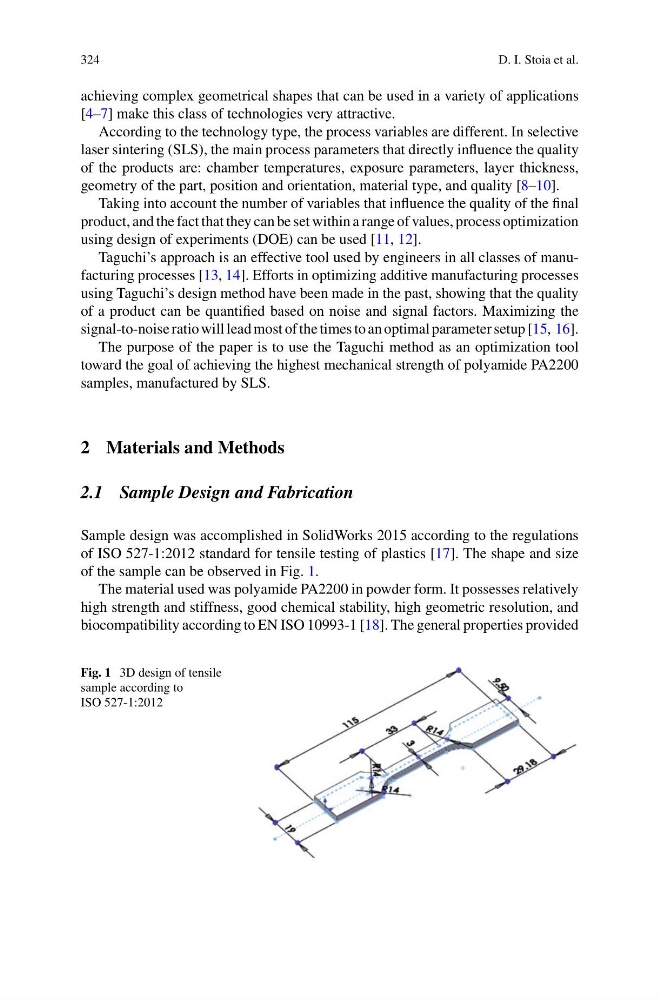
Sample design was accomplished in SolidWorks 2015 according to the regulations
of ISO 527-1:2012 standard for tensile testing of plastics [17]. The shape and size
of the sample can be observed in Fig. 1.
The material used was polyamide PA2200 in powder form. It possesses relatively
high strength and stiffness, good chemical stability, high geometric resolution, and
biocompatibility according to EN ISO 10993-1 [18]. The general properties provided
Fig. 1 3D design of tensile
sample according to
ISO 527-1:2012
D. I. Stoia et al.
achieving complex geometrical shapes that can be used in a variety of applications
[4–7] make this class of technologies very attractive.
According to the technology type, the process variables are different. In selective
laser sintering (SLS), the main process parameters that directly influence the quality
of the products are: chamber temperatures, exposure parameters, layer thickness,
geometry of the part, position and orientation, material type, and quality [8–10].
Taking into account the number of variables that influence the quality of the final
product, and the fact that they can be set within a range of values, process optimization
using design of experiments (DOE) can be used [11, 12].
Taguchi’s approach is an effective tool used by engineers in all classes of manufacturing processes [13, 14]. Efforts in optimizing additive manufacturing processes
using Taguchi’s design method have been made in the past, showing that the quality
of a product can be quantified based on noise and signal factors. Maximizing the
signal-to-noise ratio will lead most of the times to an optimal parameter setup [15, 16].
The purpose of the paper is to use the Taguchi method as an optimization tool
toward the goal of achieving the highest mechanical strength of polyamide PA2200
samples, manufactured by SLS.
2 Materials and Methods
2.1 Sample Design and Fabrication
Sample design was accomplished in SolidWorks 2015 according to the regulations
of ISO 527-1:2012 standard for tensile testing of plastics [17]. The shape and size
of the sample can be observed in Fig. 1.
The material used was polyamide PA2200 in powder form. It possesses relatively
high strength and stiffness, good chemical stability, high geometric resolution, and
biocompatibility according to EN ISO 10993-1 [18]. The general properties provided
Fig. 1 3D design of tensile
sample according to
ISO 527-1:2012