

10
J. Awrejcewicz and G. Kudra
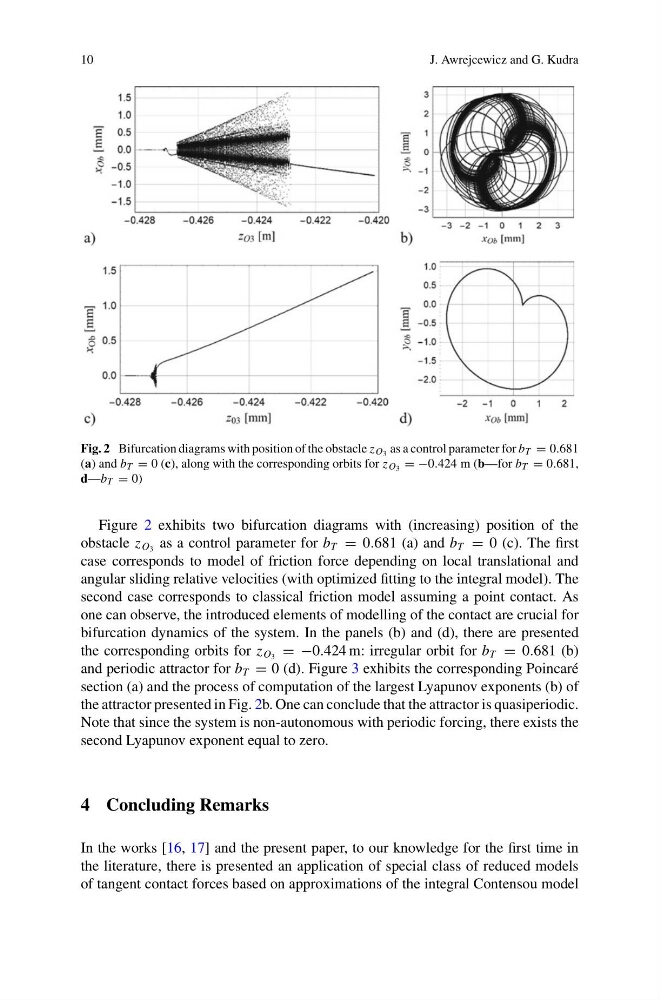
Fig. 2 Bifurcation diagrams with position of the obstacle z O3 as a control parameter for b T = 0.681
(a) and b T = 0 (c), along with the corresponding orbits for z O3 = −0.424 m (b—for b T = 0.681,
d—b T = 0)
Figure 2 exhibits two bifurcation diagrams with (increasing) position of the
obstacle z O 3 as a control parameter for b T = 0.681 (a) and b T = 0 (c). The first
case corresponds to model of friction force depending on local translational and
angular sliding relative velocities (with optimized fitting to the integral model). The
second case corresponds to classical friction model assuming a point contact. As
one can observe, the introduced elements of modelling of the contact are crucial for
bifurcation dynamics of the system. In the panels (b) and (d), there are presented
the corresponding orbits for z O 3 = −0.424 m: irregular orbit for b T = 0.681 (b)
and periodic attractor for b T = 0 (d). Figure 3 exhibits the corresponding Poincaré
section (a) and the process of computation of the largest Lyapunov exponents (b) of
the attractor presented in Fig. 2b. One can conclude that the attractor is quasiperiodic.
Note that since the system is non-autonomous with periodic forcing, there exists the
second Lyapunov exponent equal to zero.
4 Concluding Remarks
In the works [16, 17] and the present paper, to our knowledge for the first time in
the literature, there is presented an application of special class of reduced models
of tangent contact forces based on approximations of the integral Contensou model
J. Awrejcewicz and G. Kudra
Fig. 2 Bifurcation diagrams with position of the obstacle z O3 as a control parameter for b T = 0.681
(a) and b T = 0 (c), along with the corresponding orbits for z O3 = −0.424 m (b—for b T = 0.681,
d—b T = 0)
Figure 2 exhibits two bifurcation diagrams with (increasing) position of the
obstacle z O 3 as a control parameter for b T = 0.681 (a) and b T = 0 (c). The first
case corresponds to model of friction force depending on local translational and
angular sliding relative velocities (with optimized fitting to the integral model). The
second case corresponds to classical friction model assuming a point contact. As
one can observe, the introduced elements of modelling of the contact are crucial for
bifurcation dynamics of the system. In the panels (b) and (d), there are presented
the corresponding orbits for z O 3 = −0.424 m: irregular orbit for b T = 0.681 (b)
and periodic attractor for b T = 0 (d). Figure 3 exhibits the corresponding Poincaré
section (a) and the process of computation of the largest Lyapunov exponents (b) of
the attractor presented in Fig. 2b. One can conclude that the attractor is quasiperiodic.
Note that since the system is non-autonomous with periodic forcing, there exists the
second Lyapunov exponent equal to zero.
4 Concluding Remarks
In the works [16, 17] and the present paper, to our knowledge for the first time in
the literature, there is presented an application of special class of reduced models
of tangent contact forces based on approximations of the integral Contensou model