

8
J. Awrejcewicz and G. Kudra
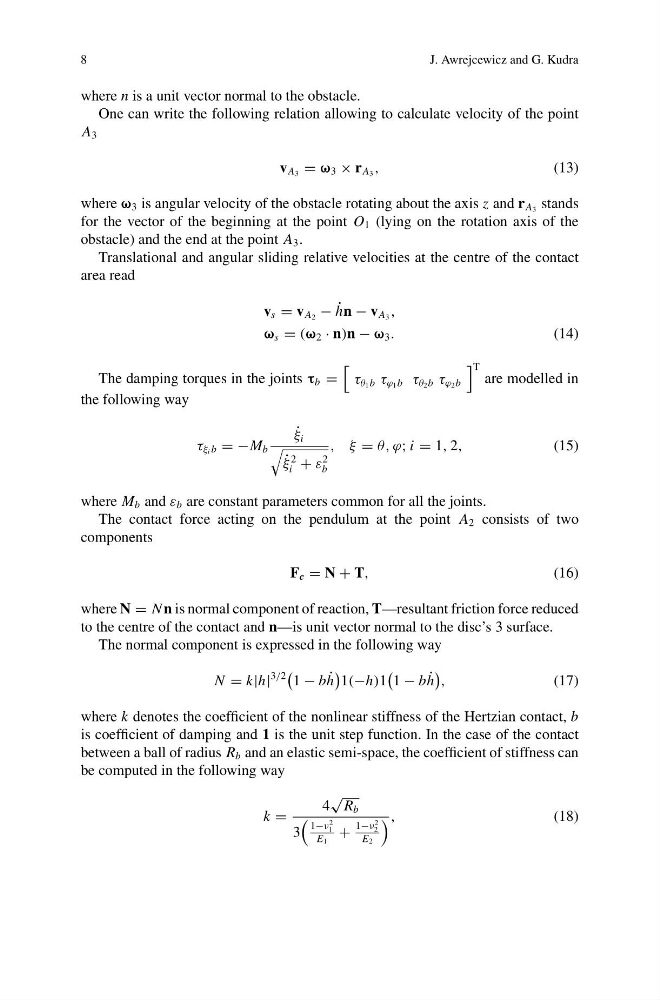
where n is a unit vector normal to the obstacle.
One can write the following relation allowing to calculate velocity of the point
A 3
v A 3 = ω 3 × r A 3 ,
(13)
where ω 3 is angular velocity of the obstacle rotating about the axis z and r A 3 stands
for the vector of the beginning at the point O 1 (lying on the rotation axis of the
obstacle) and the end at the point A 3 .
Translational and angular sliding relative velocities at the centre of the contact
area read
v s = v A 2 − ˙
hn − v A 3 ,
ω s = (ω 2 · n)n − ω 3 .
(14)
The damping torques in the joints τ b =
τ θ 1 b τ ϕ 1 b τ θ 2 b τ ϕ 2 b
T
are modelled in
the following way
τ ξ i b = −M b
˙
ξ i
˙
ξ
2
i + ε
2
b
, ξ = θ, ϕ; i = 1, 2,
(15)
where M b and ε b are constant parameters common for all the joints.
The contact force acting on the pendulum at the point A 2 consists of two
components
F c = N + T,
(16)
where N = N n is normal component of reaction, T—resultant friction force reduced
to the centre of the contact and n—is unit vector normal to the disc’s 3 surface.
The normal component is expressed in the following way
N = k|h|
3/2
1 − b ˙
h
1(−h)1
1 − b ˙
h
,
(17)
where k denotes the coefficient of the nonlinear stiffness of the Hertzian contact, b
is coefficient of damping and 1 is the unit step function. In the case of the contact
between a ball of radius R b and an elastic semi-space, the coefficient of stiffness can
be computed in the following way
k =
4
√
R b
3
1−ν
2
1
E 1
+
1−ν
2
2
E 2
,
(18)
J. Awrejcewicz and G. Kudra
where n is a unit vector normal to the obstacle.
One can write the following relation allowing to calculate velocity of the point
A 3
v A 3 = ω 3 × r A 3 ,
(13)
where ω 3 is angular velocity of the obstacle rotating about the axis z and r A 3 stands
for the vector of the beginning at the point O 1 (lying on the rotation axis of the
obstacle) and the end at the point A 3 .
Translational and angular sliding relative velocities at the centre of the contact
area read
v s = v A 2 − ˙
hn − v A 3 ,
ω s = (ω 2 · n)n − ω 3 .
(14)
The damping torques in the joints τ b =
τ θ 1 b τ ϕ 1 b τ θ 2 b τ ϕ 2 b
T
are modelled in
the following way
τ ξ i b = −M b
˙
ξ i
˙
ξ
2
i + ε
2
b
, ξ = θ, ϕ; i = 1, 2,
(15)
where M b and ε b are constant parameters common for all the joints.
The contact force acting on the pendulum at the point A 2 consists of two
components
F c = N + T,
(16)
where N = N n is normal component of reaction, T—resultant friction force reduced
to the centre of the contact and n—is unit vector normal to the disc’s 3 surface.
The normal component is expressed in the following way
N = k|h|
3/2
1 − b ˙
h
1(−h)1
1 − b ˙
h
,
(17)
where k denotes the coefficient of the nonlinear stiffness of the Hertzian contact, b
is coefficient of damping and 1 is the unit step function. In the case of the contact
between a ball of radius R b and an elastic semi-space, the coefficient of stiffness can
be computed in the following way
k =
4
√
R b
3
1−ν
2
1
E 1
+
1−ν
2
2
E 2
,
(18)