

Modelling of Frictional Contacts in 3D Dynamics …
7
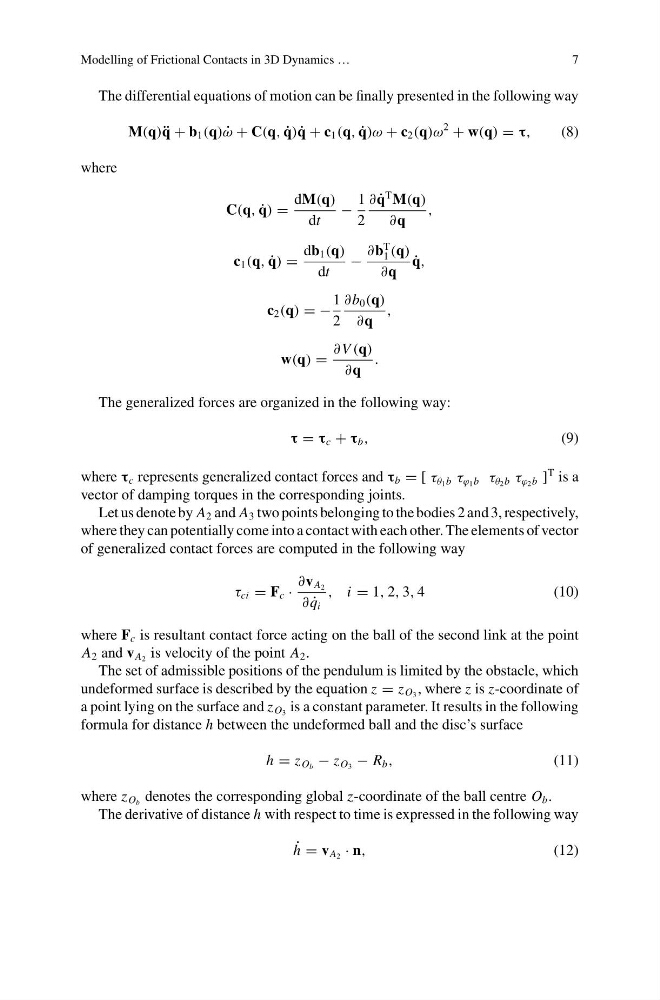
The differential equations of motion can be finally presented in the following way
M(q) ¨
q + b 1 (q) ˙
ω + C(q, ˙
q) ˙
q + c 1 (q, ˙
q)ω + c 2 (q)ω
2
+ w(q) = τ,
(8)
where
C(q, ˙
q) =
dM(q)
dt
−
1
2
∂ ˙
q
T M(q)
∂q
,
c 1 (q, ˙
q) =
db 1 (q)
dt
−
∂b
T
1 (q)
∂q
˙
q,
c 2 (q) = −
1
2
∂b 0 (q)
∂q
,
w(q) =
∂ V (q)
∂q
.
The generalized forces are organized in the following way:
τ = τ c + τ b ,
(9)
where τ c represents generalized contact forces and τ b = [ τ θ 1 b τ ϕ 1 b τ θ 2 b τ ϕ 2 b ]
T is a
vector of damping torques in the corresponding joints.
Let us denote by A 2 and A 3 two points belonging to the bodies 2 and 3, respectively,
where they can potentially come into a contact with each other. The elements of vector
of generalized contact forces are computed in the following way
τ ci = F c ·
∂v A 2
∂ ˙
q i
, i = 1, 2, 3, 4
( 1 0 )
where F c is resultant contact force acting on the ball of the second link at the point
A 2 and v A 2 is velocity of the point A 2 .
The set of admissible positions of the pendulum is limited by the obstacle, which
undeformed surface is described by the equation z = z O 3 , where z is z-coordinate of
a point lying on the surface and z O 3 is a constant parameter. It results in the following
formula for distance h between the undeformed ball and the disc’s surface
h = z O b − z O 3 − R b ,
(11)
where z O b denotes the corresponding global z-coordinate of the ball centre O b .
The derivative of distance h with respect to time is expressed in the following way
˙
h = v A 2 · n,
(12)
7
The differential equations of motion can be finally presented in the following way
M(q) ¨
q + b 1 (q) ˙
ω + C(q, ˙
q) ˙
q + c 1 (q, ˙
q)ω + c 2 (q)ω
2
+ w(q) = τ,
(8)
where
C(q, ˙
q) =
dM(q)
dt
−
1
2
∂ ˙
q
T M(q)
∂q
,
c 1 (q, ˙
q) =
db 1 (q)
dt
−
∂b
T
1 (q)
∂q
˙
q,
c 2 (q) = −
1
2
∂b 0 (q)
∂q
,
w(q) =
∂ V (q)
∂q
.
The generalized forces are organized in the following way:
τ = τ c + τ b ,
(9)
where τ c represents generalized contact forces and τ b = [ τ θ 1 b τ ϕ 1 b τ θ 2 b τ ϕ 2 b ]
T is a
vector of damping torques in the corresponding joints.
Let us denote by A 2 and A 3 two points belonging to the bodies 2 and 3, respectively,
where they can potentially come into a contact with each other. The elements of vector
of generalized contact forces are computed in the following way
τ ci = F c ·
∂v A 2
∂ ˙
q i
, i = 1, 2, 3, 4
( 1 0 )
where F c is resultant contact force acting on the ball of the second link at the point
A 2 and v A 2 is velocity of the point A 2 .
The set of admissible positions of the pendulum is limited by the obstacle, which
undeformed surface is described by the equation z = z O 3 , where z is z-coordinate of
a point lying on the surface and z O 3 is a constant parameter. It results in the following
formula for distance h between the undeformed ball and the disc’s surface
h = z O b − z O 3 − R b ,
(11)
where z O b denotes the corresponding global z-coordinate of the ball centre O b .
The derivative of distance h with respect to time is expressed in the following way
˙
h = v A 2 · n,
(12)