

6
J. Awrejcewicz and G. Kudra
in the vicinity of the contact is assumed to not influence global geometry of the system
in a significant way.
Angular velocity ω = dψ 1 /dt of the body 0 is assumed to be the following
function of time
ω(t) = ω 0 + q cos Ωt,
(1)
where ω 0 , q and Ω are parameters representing its constant component, amplitude
and frequency.
The governing equations of motion are expressed using the Lagrange’s formalism:
d
dt
∂ T
∂ ˙
q i
−
∂ T
∂q i
+
∂ V
∂q i
= τ i , i = 1, 2, 3, 4
( 2 )
where q i is the ith generalized coordinate and element of the following vector
q =
q 1 q 2 q 3 q 4
T =
θ 1 ϕ 1 θ 2 ϕ 2
T
(3)
and T —is kinetic energy, V —potential energy of gravity forces, τ i —is the ith
generalized force and the element of the following vector
τ =
τ 1 τ 2 τ 3 τ 4
T =
τ θ 1 τ ϕ 1 τ θ 2 τ ϕ 2
T .
(4)
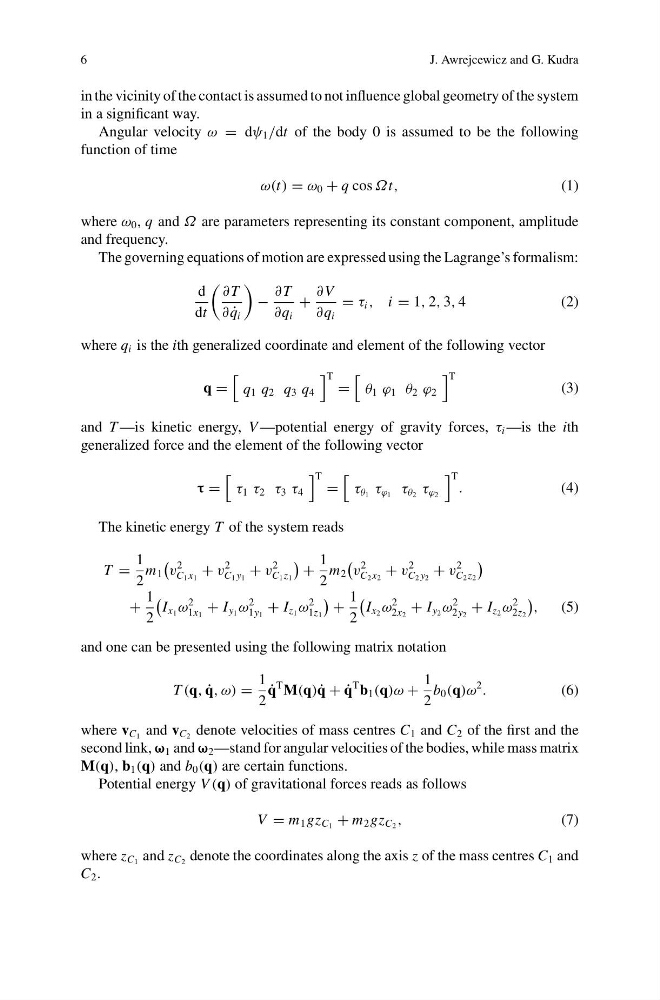
The kinetic energy T of the system reads
T =
1
2
m 1
v
2
C 1 x 1
+ v
2
C 1 y 1
+ v
2
C 1 z 1
+
1
2
m 2
v
2
C 2 x 2
+ v
2
C 2 y 2
+ v
2
C 2 z 2
+
1
2
I x 1 ω
2
1x 1
+ I y 1 ω
2
1y 1
+ I z 1 ω
2
1z 1
+
1
2
I x 2 ω
2
2x 2
+ I y 2 ω
2
2y 2
+ I z 2 ω
2
2z 2
,
(5)
and one can be presented using the following matrix notation
T (q, ˙
q, ω) =
1
2
˙
q
T M(q) ˙
q + ˙
q
T b 1 (q)ω +
1
2
b 0 (q)ω
2
.
(6)
where v C 1 and v C 2 denote velocities of mass centres C 1 and C 2 of the first and the
second link, ω 1 and ω 2 —stand for angular velocities of the bodies, while mass matrix
M(q), b 1 (q) and b 0 (q) are certain functions.
Potential energy V (q) of gravitational forces reads as follows
V = m 1 gz C 1 + m 2 gz C 2 ,
(7)
where z C 1 and z C 2 denote the coordinates along the axis z of the mass centres C 1 and
C 2 .
J. Awrejcewicz and G. Kudra
in the vicinity of the contact is assumed to not influence global geometry of the system
in a significant way.
Angular velocity ω = dψ 1 /dt of the body 0 is assumed to be the following
function of time
ω(t) = ω 0 + q cos Ωt,
(1)
where ω 0 , q and Ω are parameters representing its constant component, amplitude
and frequency.
The governing equations of motion are expressed using the Lagrange’s formalism:
d
dt
∂ T
∂ ˙
q i
−
∂ T
∂q i
+
∂ V
∂q i
= τ i , i = 1, 2, 3, 4
( 2 )
where q i is the ith generalized coordinate and element of the following vector
q =
q 1 q 2 q 3 q 4
T =
θ 1 ϕ 1 θ 2 ϕ 2
T
(3)
and T —is kinetic energy, V —potential energy of gravity forces, τ i —is the ith
generalized force and the element of the following vector
τ =
τ 1 τ 2 τ 3 τ 4
T =
τ θ 1 τ ϕ 1 τ θ 2 τ ϕ 2
T .
(4)
The kinetic energy T of the system reads
T =
1
2
m 1
v
2
C 1 x 1
+ v
2
C 1 y 1
+ v
2
C 1 z 1
+
1
2
m 2
v
2
C 2 x 2
+ v
2
C 2 y 2
+ v
2
C 2 z 2
+
1
2
I x 1 ω
2
1x 1
+ I y 1 ω
2
1y 1
+ I z 1 ω
2
1z 1
+
1
2
I x 2 ω
2
2x 2
+ I y 2 ω
2
2y 2
+ I z 2 ω
2
2z 2
,
(5)
and one can be presented using the following matrix notation
T (q, ˙
q, ω) =
1
2
˙
q
T M(q) ˙
q + ˙
q
T b 1 (q)ω +
1
2
b 0 (q)ω
2
.
(6)
where v C 1 and v C 2 denote velocities of mass centres C 1 and C 2 of the first and the
second link, ω 1 and ω 2 —stand for angular velocities of the bodies, while mass matrix
M(q), b 1 (q) and b 0 (q) are certain functions.
Potential energy V (q) of gravitational forces reads as follows
V = m 1 gz C 1 + m 2 gz C 2 ,
(7)
where z C 1 and z C 2 denote the coordinates along the axis z of the mass centres C 1 and
C 2 .