

254
A. Totorean et al.
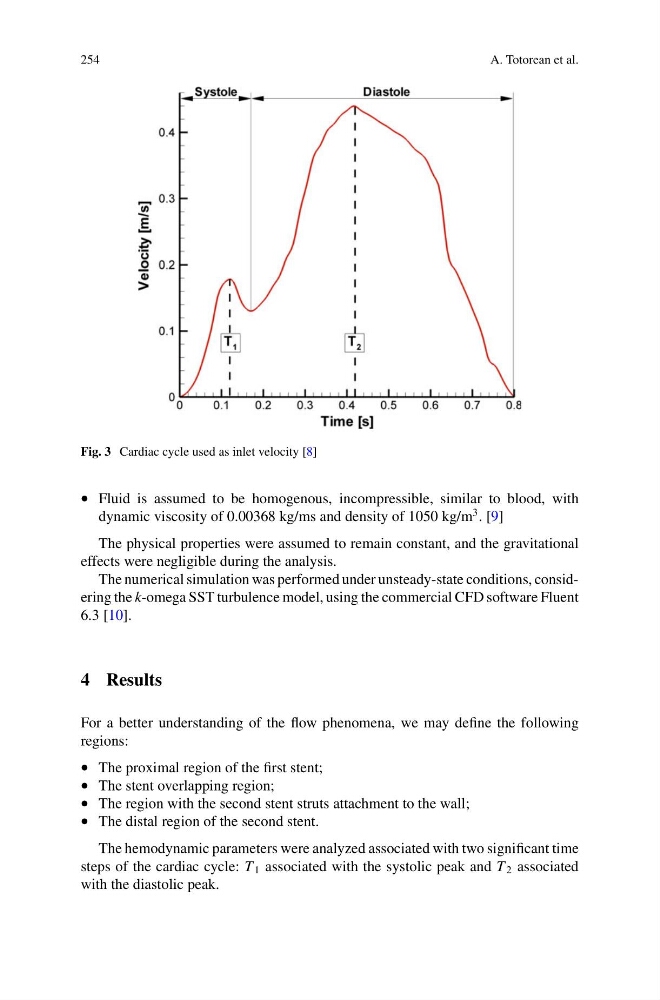
Fig. 3 Cardiac cycle used as inlet velocity [8]
• Fluid is assumed to be homogenous, incompressible, similar to blood, with
dynamic viscosity of 0.00368 kg/ms and density of 1050 kg/m
3 . [9]
The physical properties were assumed to remain constant, and the gravitational
effects were negligible during the analysis.
The numerical simulation was performed under unsteady-state conditions, considering the k-omega SST turbulence model, using the commercial CFD software Fluent
6.3 [10].
4 Results
For a better understanding of the flow phenomena, we may define the following
regions:
• The proximal region of the first stent;
• The stent overlapping region;
• The region with the second stent struts attachment to the wall;
• The distal region of the second stent.
The hemodynamic parameters were analyzed associated with two significant time
steps of the cardiac cycle: T 1 associated with the systolic peak and T 2 associated
with the diastolic peak.
A. Totorean et al.
Fig. 3 Cardiac cycle used as inlet velocity [8]
• Fluid is assumed to be homogenous, incompressible, similar to blood, with
dynamic viscosity of 0.00368 kg/ms and density of 1050 kg/m
3 . [9]
The physical properties were assumed to remain constant, and the gravitational
effects were negligible during the analysis.
The numerical simulation was performed under unsteady-state conditions, considering the k-omega SST turbulence model, using the commercial CFD software Fluent
6.3 [10].
4 Results
For a better understanding of the flow phenomena, we may define the following
regions:
• The proximal region of the first stent;
• The stent overlapping region;
• The region with the second stent struts attachment to the wall;
• The distal region of the second stent.
The hemodynamic parameters were analyzed associated with two significant time
steps of the cardiac cycle: T 1 associated with the systolic peak and T 2 associated
with the diastolic peak.