

238
M. I. Baritz and A. M.Lazar
the frame of a special eyewear designed for this activity. This camera, equipped with
image processing software, locates and identifies the reflection of the cornea and
the center of the pupil to be able to analyze the eyeball trajectory and evaluate the
preferences of visual interest in site images [4, 5]. The optical and video means used
in the visual system analysis are the myGaze device, along with the related software.
MyGaze-n system is designed to be used with the myGaze software SDK and to
create applications based on the visual system and its motor features but is limited
to laptop or display attachment systems and cannot be used wirelessly, mobile on a
glasses frame [6].
2 Experimental Setup
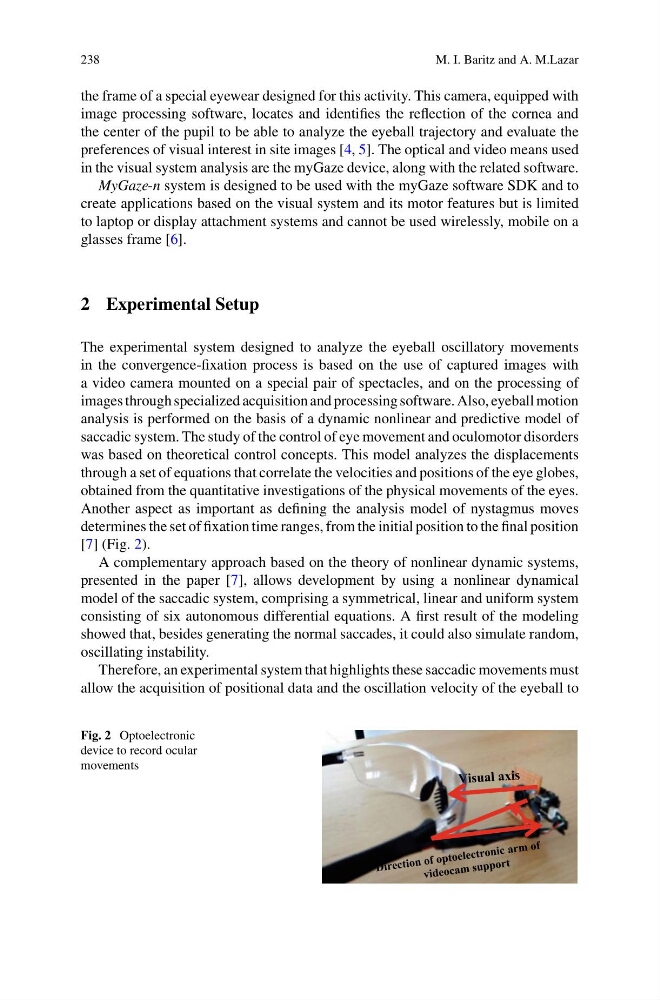
The experimental system designed to analyze the eyeball oscillatory movements
in the convergence-fixation process is based on the use of captured images with
a video camera mounted on a special pair of spectacles, and on the processing of
images through specialized acquisition and processing software. Also, eyeball motion
analysis is performed on the basis of a dynamic nonlinear and predictive model of
saccadic system. The study of the control of eye movement and oculomotor disorders
was based on theoretical control concepts. This model analyzes the displacements
through a set of equations that correlate the velocities and positions of the eye globes,
obtained from the quantitative investigations of the physical movements of the eyes.
Another aspect as important as defining the analysis model of nystagmus moves
determines the set of fixation time ranges, from the initial position to the final position
[7] (Fig. 2).
A complementary approach based on the theory of nonlinear dynamic systems,
presented in the paper [7], allows development by using a nonlinear dynamical
model of the saccadic system, comprising a symmetrical, linear and uniform system
consisting of six autonomous differential equations. A first result of the modeling
showed that, besides generating the normal saccades, it could also simulate random,
oscillating instability.
Therefore, an experimental system that highlights these saccadic movements must
allow the acquisition of positional data and the oscillation velocity of the eyeball to
Fig. 2 Optoelectronic
device to record ocular
movements
M. I. Baritz and A. M.Lazar
the frame of a special eyewear designed for this activity. This camera, equipped with
image processing software, locates and identifies the reflection of the cornea and
the center of the pupil to be able to analyze the eyeball trajectory and evaluate the
preferences of visual interest in site images [4, 5]. The optical and video means used
in the visual system analysis are the myGaze device, along with the related software.
MyGaze-n system is designed to be used with the myGaze software SDK and to
create applications based on the visual system and its motor features but is limited
to laptop or display attachment systems and cannot be used wirelessly, mobile on a
glasses frame [6].
2 Experimental Setup
The experimental system designed to analyze the eyeball oscillatory movements
in the convergence-fixation process is based on the use of captured images with
a video camera mounted on a special pair of spectacles, and on the processing of
images through specialized acquisition and processing software. Also, eyeball motion
analysis is performed on the basis of a dynamic nonlinear and predictive model of
saccadic system. The study of the control of eye movement and oculomotor disorders
was based on theoretical control concepts. This model analyzes the displacements
through a set of equations that correlate the velocities and positions of the eye globes,
obtained from the quantitative investigations of the physical movements of the eyes.
Another aspect as important as defining the analysis model of nystagmus moves
determines the set of fixation time ranges, from the initial position to the final position
[7] (Fig. 2).
A complementary approach based on the theory of nonlinear dynamic systems,
presented in the paper [7], allows development by using a nonlinear dynamical
model of the saccadic system, comprising a symmetrical, linear and uniform system
consisting of six autonomous differential equations. A first result of the modeling
showed that, besides generating the normal saccades, it could also simulate random,
oscillating instability.
Therefore, an experimental system that highlights these saccadic movements must
allow the acquisition of positional data and the oscillation velocity of the eyeball to
Fig. 2 Optoelectronic
device to record ocular
movements