

Analysis of Oscillatory Eye Movements as a Nystagmus, Manifested …
237
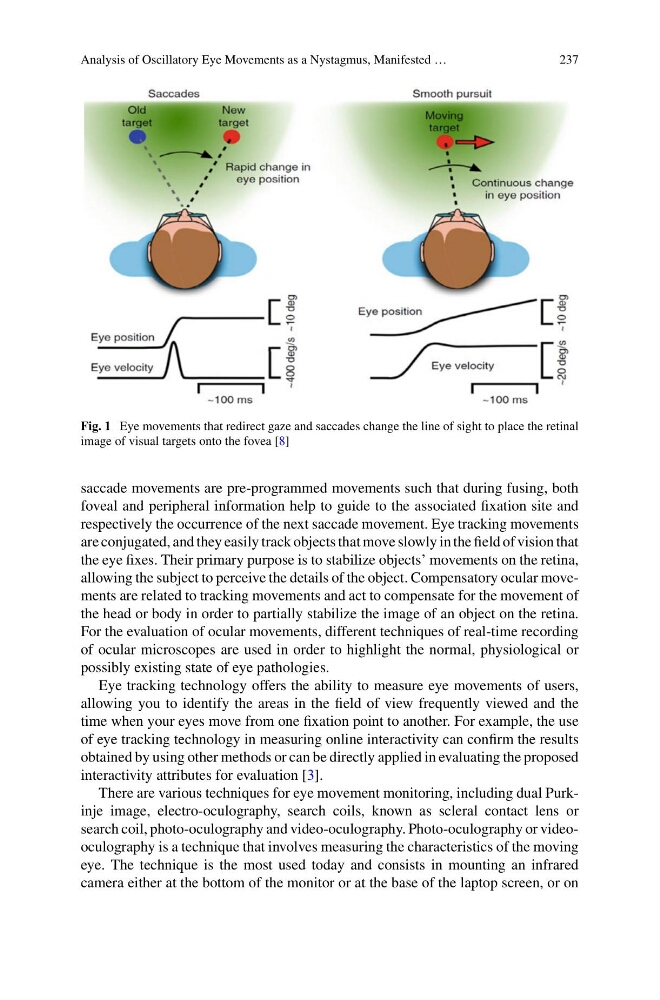
Fig. 1 Eye movements that redirect gaze and saccades change the line of sight to place the retinal
image of visual targets onto the fovea [8]
saccade movements are pre-programmed movements such that during fusing, both
foveal and peripheral information help to guide to the associated fixation site and
respectively the occurrence of the next saccade movement. Eye tracking movements
are conjugated, and they easily track objects that move slowly in the field of vision that
the eye fixes. Their primary purpose is to stabilize objects’ movements on the retina,
allowing the subject to perceive the details of the object. Compensatory ocular movements are related to tracking movements and act to compensate for the movement of
the head or body in order to partially stabilize the image of an object on the retina.
For the evaluation of ocular movements, different techniques of real-time recording
of ocular microscopes are used in order to highlight the normal, physiological or
possibly existing state of eye pathologies.
Eye tracking technology offers the ability to measure eye movements of users,
allowing you to identify the areas in the field of view frequently viewed and the
time when your eyes move from one fixation point to another. For example, the use
of eye tracking technology in measuring online interactivity can confirm the results
obtained by using other methods or can be directly applied in evaluating the proposed
interactivity attributes for evaluation [3].
There are various techniques for eye movement monitoring, including dual Purkinje image, electro-oculography, search coils, known as scleral contact lens or
search coil, photo-oculography and video-oculography. Photo-oculography or videooculography is a technique that involves measuring the characteristics of the moving
eye. The technique is the most used today and consists in mounting an infrared
camera either at the bottom of the monitor or at the base of the laptop screen, or on
237
Fig. 1 Eye movements that redirect gaze and saccades change the line of sight to place the retinal
image of visual targets onto the fovea [8]
saccade movements are pre-programmed movements such that during fusing, both
foveal and peripheral information help to guide to the associated fixation site and
respectively the occurrence of the next saccade movement. Eye tracking movements
are conjugated, and they easily track objects that move slowly in the field of vision that
the eye fixes. Their primary purpose is to stabilize objects’ movements on the retina,
allowing the subject to perceive the details of the object. Compensatory ocular movements are related to tracking movements and act to compensate for the movement of
the head or body in order to partially stabilize the image of an object on the retina.
For the evaluation of ocular movements, different techniques of real-time recording
of ocular microscopes are used in order to highlight the normal, physiological or
possibly existing state of eye pathologies.
Eye tracking technology offers the ability to measure eye movements of users,
allowing you to identify the areas in the field of view frequently viewed and the
time when your eyes move from one fixation point to another. For example, the use
of eye tracking technology in measuring online interactivity can confirm the results
obtained by using other methods or can be directly applied in evaluating the proposed
interactivity attributes for evaluation [3].
There are various techniques for eye movement monitoring, including dual Purkinje image, electro-oculography, search coils, known as scleral contact lens or
search coil, photo-oculography and video-oculography. Photo-oculography or videooculography is a technique that involves measuring the characteristics of the moving
eye. The technique is the most used today and consists in mounting an infrared
camera either at the bottom of the monitor or at the base of the laptop screen, or on