

Analysis of Oscillatory Eye Movements as a Nystagmus, Manifested …
239
Videocam
Special
spectacles
Target at 5 m/40 cm
Computer
Arduino board
Eye fixation direction
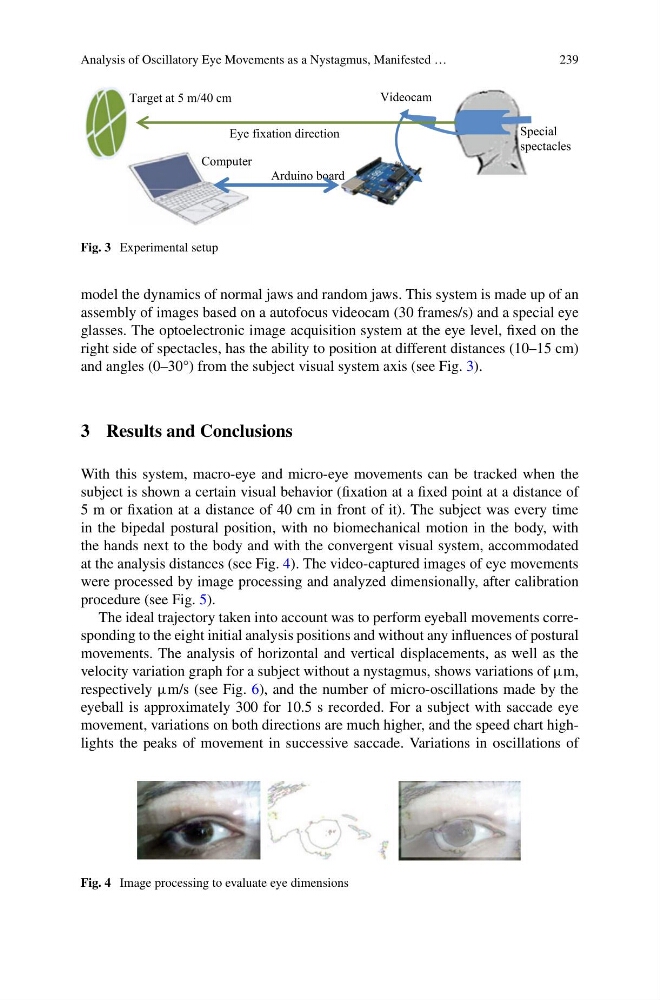
Fig. 3 Experimental setup
model the dynamics of normal jaws and random jaws. This system is made up of an
assembly of images based on a autofocus videocam (30 frames/s) and a special eye
glasses. The optoelectronic image acquisition system at the eye level, fixed on the
right side of spectacles, has the ability to position at different distances (10–15 cm)
and angles (0–30°) from the subject visual system axis (see Fig. 3).
3 Results and Conclusions
With this system, macro-eye and micro-eye movements can be tracked when the
subject is shown a certain visual behavior (fixation at a fixed point at a distance of
5 m or fixation at a distance of 40 cm in front of it). The subject was every time
in the bipedal postural position, with no biomechanical motion in the body, with
the hands next to the body and with the convergent visual system, accommodated
at the analysis distances (see Fig. 4). The video-captured images of eye movements
were processed by image processing and analyzed dimensionally, after calibration
procedure (see Fig. 5).
The ideal trajectory taken into account was to perform eyeball movements corresponding to the eight initial analysis positions and without any influences of postural
movements. The analysis of horizontal and vertical displacements, as well as the
velocity variation graph for a subject without a nystagmus, shows variations of µm,
respectively µm/s (see Fig. 6), and the number of micro-oscillations made by the
eyeball is approximately 300 for 10.5 s recorded. For a subject with saccade eye
movement, variations on both directions are much higher, and the speed chart highlights the peaks of movement in successive saccade. Variations in oscillations of
Fig. 4 Image processing to evaluate eye dimensions
239
Videocam
Special
spectacles
Target at 5 m/40 cm
Computer
Arduino board
Eye fixation direction
Fig. 3 Experimental setup
model the dynamics of normal jaws and random jaws. This system is made up of an
assembly of images based on a autofocus videocam (30 frames/s) and a special eye
glasses. The optoelectronic image acquisition system at the eye level, fixed on the
right side of spectacles, has the ability to position at different distances (10–15 cm)
and angles (0–30°) from the subject visual system axis (see Fig. 3).
3 Results and Conclusions
With this system, macro-eye and micro-eye movements can be tracked when the
subject is shown a certain visual behavior (fixation at a fixed point at a distance of
5 m or fixation at a distance of 40 cm in front of it). The subject was every time
in the bipedal postural position, with no biomechanical motion in the body, with
the hands next to the body and with the convergent visual system, accommodated
at the analysis distances (see Fig. 4). The video-captured images of eye movements
were processed by image processing and analyzed dimensionally, after calibration
procedure (see Fig. 5).
The ideal trajectory taken into account was to perform eyeball movements corresponding to the eight initial analysis positions and without any influences of postural
movements. The analysis of horizontal and vertical displacements, as well as the
velocity variation graph for a subject without a nystagmus, shows variations of µm,
respectively µm/s (see Fig. 6), and the number of micro-oscillations made by the
eyeball is approximately 300 for 10.5 s recorded. For a subject with saccade eye
movement, variations on both directions are much higher, and the speed chart highlights the peaks of movement in successive saccade. Variations in oscillations of
Fig. 4 Image processing to evaluate eye dimensions