

Coefficient of Sound Absorption of Polyamide PA12 Samples …
159
3 Empirical Model for Estimation of the Acoustic
Properties
According to Delany and Bazley [8], the propagation of sound in an isotropic homogeneous material can be represented by the characteristic impedance Z c and the
sound propagation constant γ of the absorption material.
Zc = R + j X
(1)
γ = α + jβ
(2)
Furthermore, relying on the empirical considerations from the Delany and Bazley
research [8], the characteristic impedance and sound propagation coefficients may
be calculated using the following relations:
R = ρ 0 c 0
1 + C 1
ρ 0 f
r
−C 2
(3)
X = −ρ 0 c 0
C 3
ρ 0 f
r
−C 4
(4)
α =
2π f
c 0
C 5
ρ 0 f
r
−C 6
(5)
β =
2π f
c 0
1 + C 7
ρ 0 f
r
−C 8
(6)
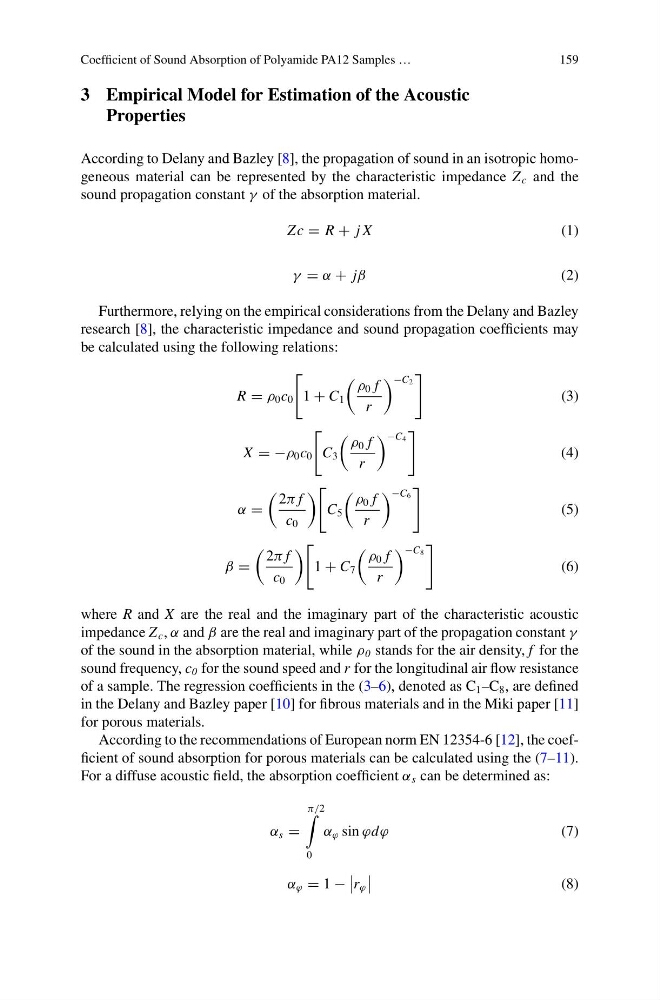
where R and X are the real and the imaginary part of the characteristic acoustic
impedance Z c , α and β are the real and imaginary part of the propagation constant γ
of the sound in the absorption material, while ρ 0 stands for the air density, f for the
sound frequency, c 0 for the sound speed and r for the longitudinal air flow resistance
of a sample. The regression coefficients in the (3–6), denoted as C 1 –C 8 , are defined
in the Delany and Bazley paper [10] for fibrous materials and in the Miki paper [11]
for porous materials.
According to the recommendations of European norm EN 12354-6 [12], the coefficient of sound absorption for porous materials can be calculated using the (7–11).
For a diffuse acoustic field, the absorption coefficient α s can be determined as:
α s =
π/2
0
α ϕ sin ϕdϕ
(7)
α ϕ = 1 −
r ϕ
(8)
159
3 Empirical Model for Estimation of the Acoustic
Properties
According to Delany and Bazley [8], the propagation of sound in an isotropic homogeneous material can be represented by the characteristic impedance Z c and the
sound propagation constant γ of the absorption material.
Zc = R + j X
(1)
γ = α + jβ
(2)
Furthermore, relying on the empirical considerations from the Delany and Bazley
research [8], the characteristic impedance and sound propagation coefficients may
be calculated using the following relations:
R = ρ 0 c 0
1 + C 1
ρ 0 f
r
−C 2
(3)
X = −ρ 0 c 0
C 3
ρ 0 f
r
−C 4
(4)
α =
2π f
c 0
C 5
ρ 0 f
r
−C 6
(5)
β =
2π f
c 0
1 + C 7
ρ 0 f
r
−C 8
(6)
where R and X are the real and the imaginary part of the characteristic acoustic
impedance Z c , α and β are the real and imaginary part of the propagation constant γ
of the sound in the absorption material, while ρ 0 stands for the air density, f for the
sound frequency, c 0 for the sound speed and r for the longitudinal air flow resistance
of a sample. The regression coefficients in the (3–6), denoted as C 1 –C 8 , are defined
in the Delany and Bazley paper [10] for fibrous materials and in the Miki paper [11]
for porous materials.
According to the recommendations of European norm EN 12354-6 [12], the coefficient of sound absorption for porous materials can be calculated using the (7–11).
For a diffuse acoustic field, the absorption coefficient α s can be determined as:
α s =
π/2
0
α ϕ sin ϕdϕ
(7)
α ϕ = 1 −
r ϕ
(8)