

158
N. Bogojevi´ c et al.
velocity of 0.4 × 10
−3 m/s through the measurement cell, which completely corresponds to the recommendations of the standard SRPS ISO 9053, where the air flow
should be below the 0.5 × 10
−3 m/s. The difference between the pressures on two
sides of the sample has been measured by differential pressure gauge TESTO 512.
The measurement range of this instrument is from 0 to 200 Pa, with resolution of
0.1 Pa. Therefore, the experimental setup used for the measurements is capable of
measuring the airflow resistances below 60 MPa s/m
3 .
2.2 Specimens
For the purposes of the study, 40 samples were made from PA12 during a single
production process using the SLS technology. All specimens are produced using an
EOS P100 machine from the PA12 powder with trade name PA2200. As explained
in the previous section, the samples had the shape of a disc with diameter of 100 mm.
The thickness of the samples was selected to study the effects of the porosity
and layered structure of the material, characteristic for the SLS technology, to its
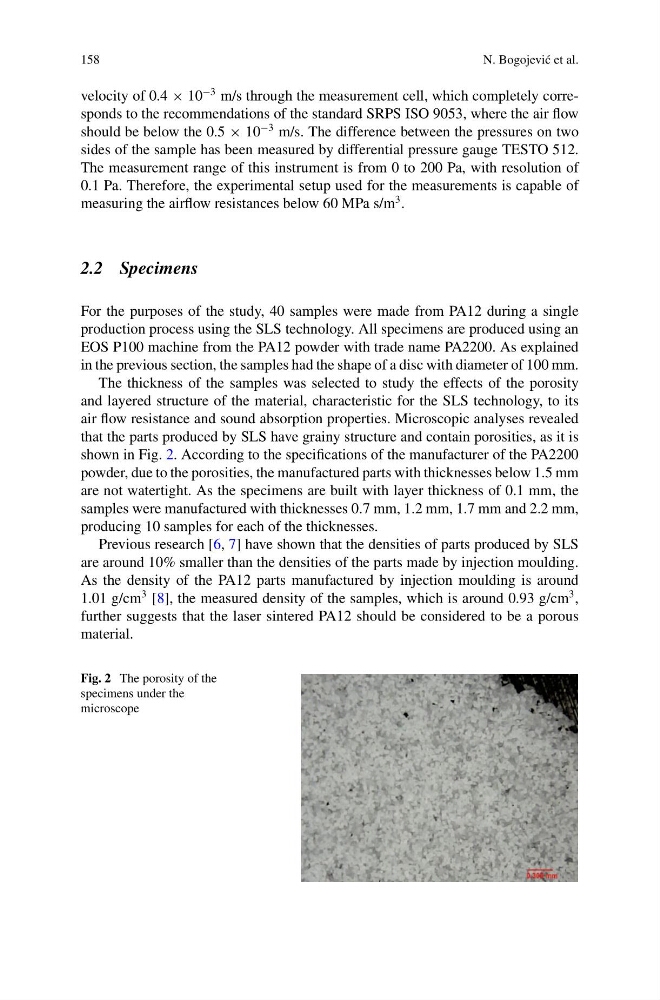
air flow resistance and sound absorption properties. Microscopic analyses revealed
that the parts produced by SLS have grainy structure and contain porosities, as it is
shown in Fig. 2. According to the specifications of the manufacturer of the PA2200
powder, due to the porosities, the manufactured parts with thicknesses below 1.5 mm
are not watertight. As the specimens are built with layer thickness of 0.1 mm, the
samples were manufactured with thicknesses 0.7 mm, 1.2 mm, 1.7 mm and 2.2 mm,
producing 10 samples for each of the thicknesses.
Previous research [6, 7] have shown that the densities of parts produced by SLS
are around 10% smaller than the densities of the parts made by injection moulding.
As the density of the PA12 parts manufactured by injection moulding is around
1.01 g/cm
3 [8], the measured density of the samples, which is around 0.93 g/cm
3 ,
further suggests that the laser sintered PA12 should be considered to be a porous
material.
Fig. 2 The porosity of the
specimens under the
microscope
N. Bogojevi´ c et al.
velocity of 0.4 × 10
−3 m/s through the measurement cell, which completely corresponds to the recommendations of the standard SRPS ISO 9053, where the air flow
should be below the 0.5 × 10
−3 m/s. The difference between the pressures on two
sides of the sample has been measured by differential pressure gauge TESTO 512.
The measurement range of this instrument is from 0 to 200 Pa, with resolution of
0.1 Pa. Therefore, the experimental setup used for the measurements is capable of
measuring the airflow resistances below 60 MPa s/m
3 .
2.2 Specimens
For the purposes of the study, 40 samples were made from PA12 during a single
production process using the SLS technology. All specimens are produced using an
EOS P100 machine from the PA12 powder with trade name PA2200. As explained
in the previous section, the samples had the shape of a disc with diameter of 100 mm.
The thickness of the samples was selected to study the effects of the porosity
and layered structure of the material, characteristic for the SLS technology, to its
air flow resistance and sound absorption properties. Microscopic analyses revealed
that the parts produced by SLS have grainy structure and contain porosities, as it is
shown in Fig. 2. According to the specifications of the manufacturer of the PA2200
powder, due to the porosities, the manufactured parts with thicknesses below 1.5 mm
are not watertight. As the specimens are built with layer thickness of 0.1 mm, the
samples were manufactured with thicknesses 0.7 mm, 1.2 mm, 1.7 mm and 2.2 mm,
producing 10 samples for each of the thicknesses.
Previous research [6, 7] have shown that the densities of parts produced by SLS
are around 10% smaller than the densities of the parts made by injection moulding.
As the density of the PA12 parts manufactured by injection moulding is around
1.01 g/cm
3 [8], the measured density of the samples, which is around 0.93 g/cm
3 ,
further suggests that the laser sintered PA12 should be considered to be a porous
material.
Fig. 2 The porosity of the
specimens under the
microscope