

Coefficient of Sound Absorption of Polyamide PA12 Samples …
157
2 Methods
The coefficient of absorption was determined on the basis of measurements of air
flow resistance, which was measured according to SRPS ISO 9053 standard, using
steady state air flow method.
2.1 Measurement Setup and Theoretical Background
Air resistance is one of the main non-acoustic parameters that shows the behaviour of
porous materials used in sound absorption systems. The standard SRPS ISO 9053 [9]
specifies two methods for measuring airflow resistance: a steady state airflow method
and an alternating airflow method. The paper presents the results of measurements
using the method of constant air flow.
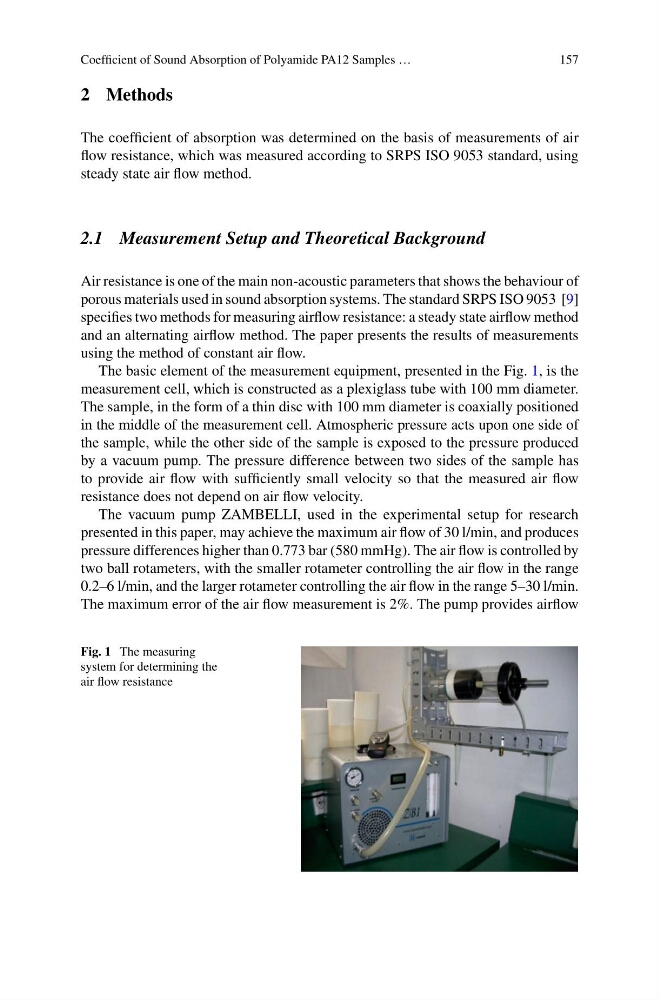
The basic element of the measurement equipment, presented in the Fig. 1, is the
measurement cell, which is constructed as a plexiglass tube with 100 mm diameter.
The sample, in the form of a thin disc with 100 mm diameter is coaxially positioned
in the middle of the measurement cell. Atmospheric pressure acts upon one side of
the sample, while the other side of the sample is exposed to the pressure produced
by a vacuum pump. The pressure difference between two sides of the sample has
to provide air flow with sufficiently small velocity so that the measured air flow
resistance does not depend on air flow velocity.
The vacuum pump ZAMBELLI, used in the experimental setup for research
presented in this paper, may achieve the maximum air flow of 30 l/min, and produces
pressure differences higher than 0.773 bar (580 mmHg). The air flow is controlled by
two ball rotameters, with the smaller rotameter controlling the air flow in the range
0.2–6 l/min, and the larger rotameter controlling the air flow in the range 5–30 l/min.
The maximum error of the air flow measurement is 2%. The pump provides airflow
Fig. 1 The measuring
system for determining the
air flow resistance
157
2 Methods
The coefficient of absorption was determined on the basis of measurements of air
flow resistance, which was measured according to SRPS ISO 9053 standard, using
steady state air flow method.
2.1 Measurement Setup and Theoretical Background
Air resistance is one of the main non-acoustic parameters that shows the behaviour of
porous materials used in sound absorption systems. The standard SRPS ISO 9053 [9]
specifies two methods for measuring airflow resistance: a steady state airflow method
and an alternating airflow method. The paper presents the results of measurements
using the method of constant air flow.
The basic element of the measurement equipment, presented in the Fig. 1, is the
measurement cell, which is constructed as a plexiglass tube with 100 mm diameter.
The sample, in the form of a thin disc with 100 mm diameter is coaxially positioned
in the middle of the measurement cell. Atmospheric pressure acts upon one side of
the sample, while the other side of the sample is exposed to the pressure produced
by a vacuum pump. The pressure difference between two sides of the sample has
to provide air flow with sufficiently small velocity so that the measured air flow
resistance does not depend on air flow velocity.
The vacuum pump ZAMBELLI, used in the experimental setup for research
presented in this paper, may achieve the maximum air flow of 30 l/min, and produces
pressure differences higher than 0.773 bar (580 mmHg). The air flow is controlled by
two ball rotameters, with the smaller rotameter controlling the air flow in the range
0.2–6 l/min, and the larger rotameter controlling the air flow in the range 5–30 l/min.
The maximum error of the air flow measurement is 2%. The pump provides airflow
Fig. 1 The measuring
system for determining the
air flow resistance