

107
intramolecular ligand should therefore have a Kd of 10 μM or
lower, so that the closed state of the sensor is favored over the open
state by at least a factor of 10 when the analyte is not present. Since
the analyte competes with the intramolecular ligand for binding to
the same site, the apparent affinity of the sensor for the analyte is
inversely proportional to its affinity for the intramolecular ligand.
In this way, the response range of the sensor can be tuned to the
desired concentration. However, if the intramolecular ligand’s Kd
value is very low, its unbinding kinetics tend to be slow, which
limits the sensor’s temporal resolution.
To achieve a large dynamic range, the RET efficiency should be
high in the closed state and low in the open state of the sensor.
Since the RET efficiency depends strongly on distance, this can be
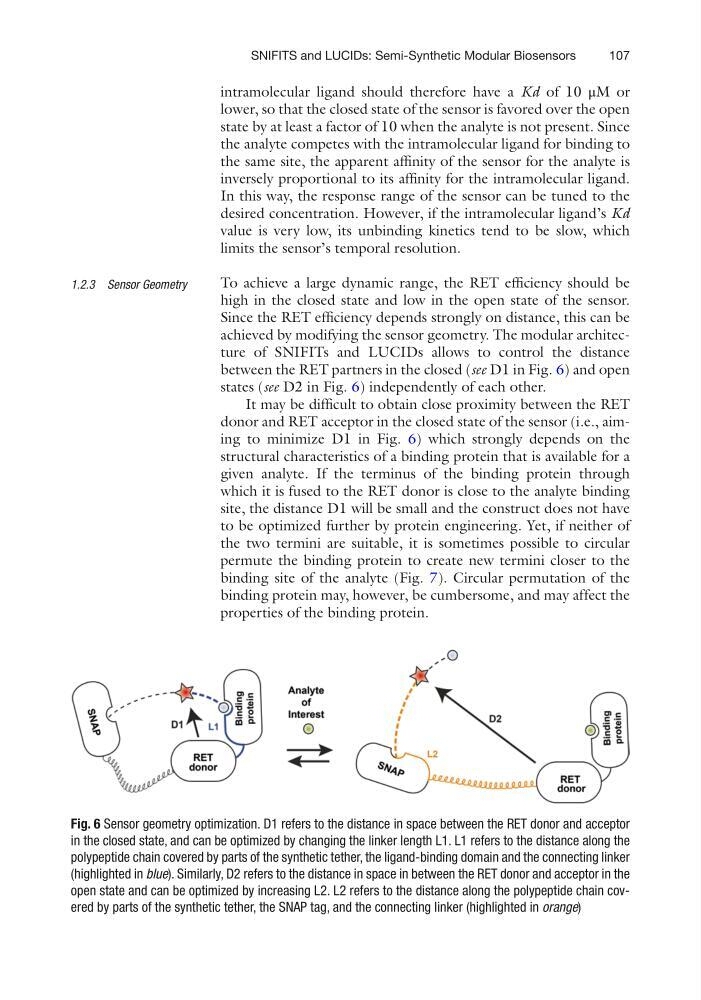
achieved by modifying the sensor geometry. The modular architecture of SNIFITs and LUCIDs allows to control the distance
between the RET partners in the closed (see D1 in Fig. 6) and open
states (see D2 in Fig. 6) independently of each other.
It may be difficult to obtain close proximity between the RET
donor and RET acceptor in the closed state of the sensor (i.e., aiming to minimize D1 in Fig. 6) which strongly depends on the
structural characteristics of a binding protein that is available for a
given analyte. If the terminus of the binding protein through
which it is fused to the RET donor is close to the analyte binding
site, the distance D1 will be small and the construct does not have
to be optimized further by protein engineering. Yet, if neither of
the two termini are suitable, it is sometimes possible to circular
permute the binding protein to create new termini closer to the
binding site of the analyte (Fig. 7). Circular permutation of the
binding protein may, however, be cumbersome, and may affect the
properties of the binding protein.
1.2.3 Sensor Geometry
Fig. 6 Sensor geometry optimization. D1 refers to the distance in space between the RET donor and acceptor
in the closed state, and can be optimized by changing the linker length L1. L1 refers to the distance along the
polypeptide chain covered by parts of the synthetic tether, the ligand-binding domain and the connecting linker
(highlighted in blue). Similarly, D2 refers to the distance in space in between the RET donor and acceptor in the
open state and can be optimized by increasing L2. L2 refers to the distance along the polypeptide chain covered by parts of the synthetic tether, the SNAP tag, and the connecting linker (highlighted in orange)
SNIFITS and LUCIDs: Semi-Synthetic Modular Biosensors
intramolecular ligand should therefore have a Kd of 10 μM or
lower, so that the closed state of the sensor is favored over the open
state by at least a factor of 10 when the analyte is not present. Since
the analyte competes with the intramolecular ligand for binding to
the same site, the apparent affinity of the sensor for the analyte is
inversely proportional to its affinity for the intramolecular ligand.
In this way, the response range of the sensor can be tuned to the
desired concentration. However, if the intramolecular ligand’s Kd
value is very low, its unbinding kinetics tend to be slow, which
limits the sensor’s temporal resolution.
To achieve a large dynamic range, the RET efficiency should be
high in the closed state and low in the open state of the sensor.
Since the RET efficiency depends strongly on distance, this can be
achieved by modifying the sensor geometry. The modular architecture of SNIFITs and LUCIDs allows to control the distance
between the RET partners in the closed (see D1 in Fig. 6) and open
states (see D2 in Fig. 6) independently of each other.
It may be difficult to obtain close proximity between the RET
donor and RET acceptor in the closed state of the sensor (i.e., aiming to minimize D1 in Fig. 6) which strongly depends on the
structural characteristics of a binding protein that is available for a
given analyte. If the terminus of the binding protein through
which it is fused to the RET donor is close to the analyte binding
site, the distance D1 will be small and the construct does not have
to be optimized further by protein engineering. Yet, if neither of
the two termini are suitable, it is sometimes possible to circular
permute the binding protein to create new termini closer to the
binding site of the analyte (Fig. 7). Circular permutation of the
binding protein may, however, be cumbersome, and may affect the
properties of the binding protein.
1.2.3 Sensor Geometry
Fig. 6 Sensor geometry optimization. D1 refers to the distance in space between the RET donor and acceptor
in the closed state, and can be optimized by changing the linker length L1. L1 refers to the distance along the
polypeptide chain covered by parts of the synthetic tether, the ligand-binding domain and the connecting linker
(highlighted in blue). Similarly, D2 refers to the distance in space in between the RET donor and acceptor in the
open state and can be optimized by increasing L2. L2 refers to the distance along the polypeptide chain covered by parts of the synthetic tether, the SNAP tag, and the connecting linker (highlighted in orange)
SNIFITS and LUCIDs: Semi-Synthetic Modular Biosensors