

103
The intramolecular tether is covalently attached to the recombinant fusion protein via an SLP. SLPs, such as SNAP-tag [9, 10],
CLIP-tag [11], and Halo-tag [12], react selectively with various
bio-orthogonal chemical groups for applications in imaging, as
well as for purifying proteins and modifying protein function [13–
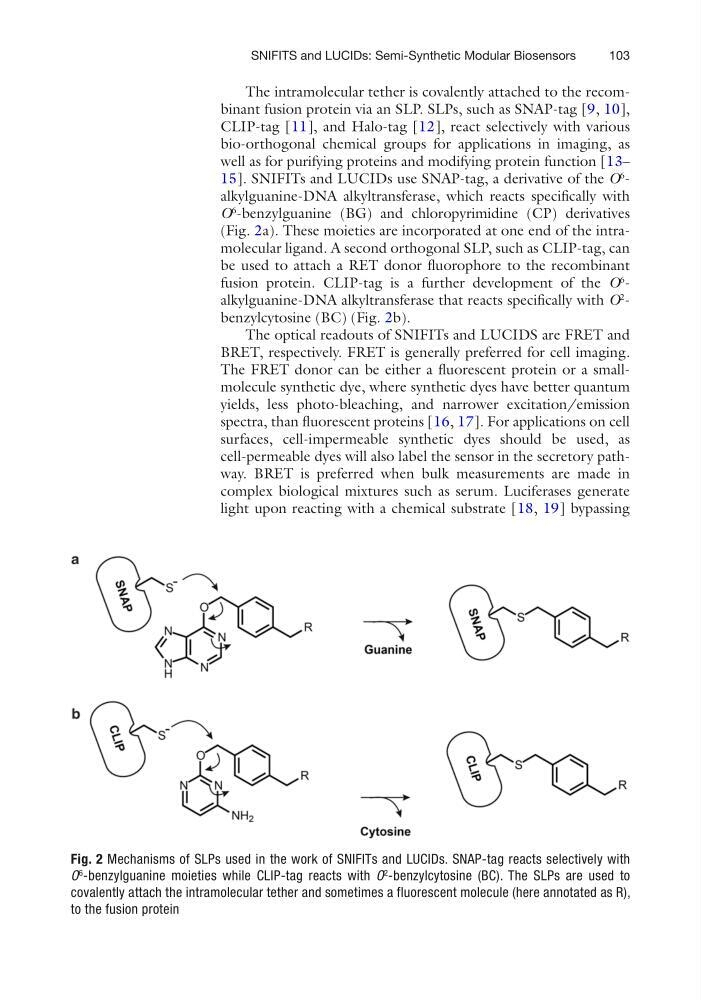
15]. SNIFITs and LUCIDs use SNAP-tag, a derivative of the O
6
-
alkylguanine- DNA alkyltransferase, which reacts specifically with
O
6
-benzylguanine (BG) and chloropyrimidine (CP) derivatives
(Fig. 2a). These moieties are incorporated at one end of the intramolecular ligand. A second orthogonal SLP, such as CLIP-tag, can
be used to attach a RET donor fluorophore to the recombinant
fusion protein. CLIP-tag is a further development of the O
6
-
alkylguanine- DNA alkyltransferase that reacts specifically with O
2
-
benzylcytosine (BC) (Fig. 2b).
The optical readouts of SNIFITs and LUCIDS are FRET and
BRET, respectively. FRET is generally preferred for cell imaging.
The FRET donor can be either a fluorescent protein or a smallmolecule synthetic dye, where synthetic dyes have better quantum
yields, less photo-bleaching, and narrower excitation/emission
spectra, than fluorescent proteins [16, 17]. For applications on cell
surfaces, cell-impermeable synthetic dyes should be used, as
cell- permeable dyes will also label the sensor in the secretory pathway. BRET is preferred when bulk measurements are made in
complex biological mixtures such as serum. Luciferases generate
light upon reacting with a chemical substrate [18, 19] bypassing
Fig. 2 Mechanisms of SLPs used in the work of SNIFITs and LUCIDs. SNAP-tag reacts selectively with
O
6
- benzylguanine moieties while CLIP-tag reacts with O
2
-benzylcytosine (BC). The SLPs are used to
covalently attach the intramolecular tether and sometimes a fluorescent molecule (here annotated as R),
to the fusion protein
SNIFITS and LUCIDs: Semi-Synthetic Modular Biosensors
The intramolecular tether is covalently attached to the recombinant fusion protein via an SLP. SLPs, such as SNAP-tag [9, 10],
CLIP-tag [11], and Halo-tag [12], react selectively with various
bio-orthogonal chemical groups for applications in imaging, as
well as for purifying proteins and modifying protein function [13–
15]. SNIFITs and LUCIDs use SNAP-tag, a derivative of the O
6
-
alkylguanine- DNA alkyltransferase, which reacts specifically with
O
6
-benzylguanine (BG) and chloropyrimidine (CP) derivatives
(Fig. 2a). These moieties are incorporated at one end of the intramolecular ligand. A second orthogonal SLP, such as CLIP-tag, can
be used to attach a RET donor fluorophore to the recombinant
fusion protein. CLIP-tag is a further development of the O
6
-
alkylguanine- DNA alkyltransferase that reacts specifically with O
2
-
benzylcytosine (BC) (Fig. 2b).
The optical readouts of SNIFITs and LUCIDS are FRET and
BRET, respectively. FRET is generally preferred for cell imaging.
The FRET donor can be either a fluorescent protein or a smallmolecule synthetic dye, where synthetic dyes have better quantum
yields, less photo-bleaching, and narrower excitation/emission
spectra, than fluorescent proteins [16, 17]. For applications on cell
surfaces, cell-impermeable synthetic dyes should be used, as
cell- permeable dyes will also label the sensor in the secretory pathway. BRET is preferred when bulk measurements are made in
complex biological mixtures such as serum. Luciferases generate
light upon reacting with a chemical substrate [18, 19] bypassing
Fig. 2 Mechanisms of SLPs used in the work of SNIFITs and LUCIDs. SNAP-tag reacts selectively with
O
6
- benzylguanine moieties while CLIP-tag reacts with O
2
-benzylcytosine (BC). The SLPs are used to
covalently attach the intramolecular tether and sometimes a fluorescent molecule (here annotated as R),
to the fusion protein
SNIFITS and LUCIDs: Semi-Synthetic Modular Biosensors