

Human Endogenous Natural Products
329
4.2 Trimethylamine Oxide and Atherosclerosis
While the deficiency of hormone steroids will cause steroidogenic inherited diseases,
the abnormal production of trimethylamine oxide is known to be a reason for the
increased risk of atherosclerosis as well. One of the best examples of host–microbe
co-metabolism-related disease is atherosclerosis. As previously described, the cometabolism of choline by both the liver and the gut microbiota generates trimethylamine oxide (TMAO). Using metabolomics, it has been discovered further that high
TMAO levels correlate with a high risk for cardiovascular diseases, and the mechanism involved is that TMAO promotes the upregulation of multiple macrophage scavenger receptors as atherosclerosis biomarkers. In addition, antibiotics and TMAOmimetic enzyme inhibitors are bioactive in terms of reversing atherosclerosis, which
has the potential to be developed as translational therapy for the gut microbiota [24].
5 Techniques for the Identification of Metabolites
Our human metabolomic profile is far more complex when compared to that of the
human genome: the human genome contains approximately 20,000 protein-coding
genes, but the human metabolomic profile consists of more than 500,000 compounds
(identified so far) and each class of compounds has a high level of diversity [25].
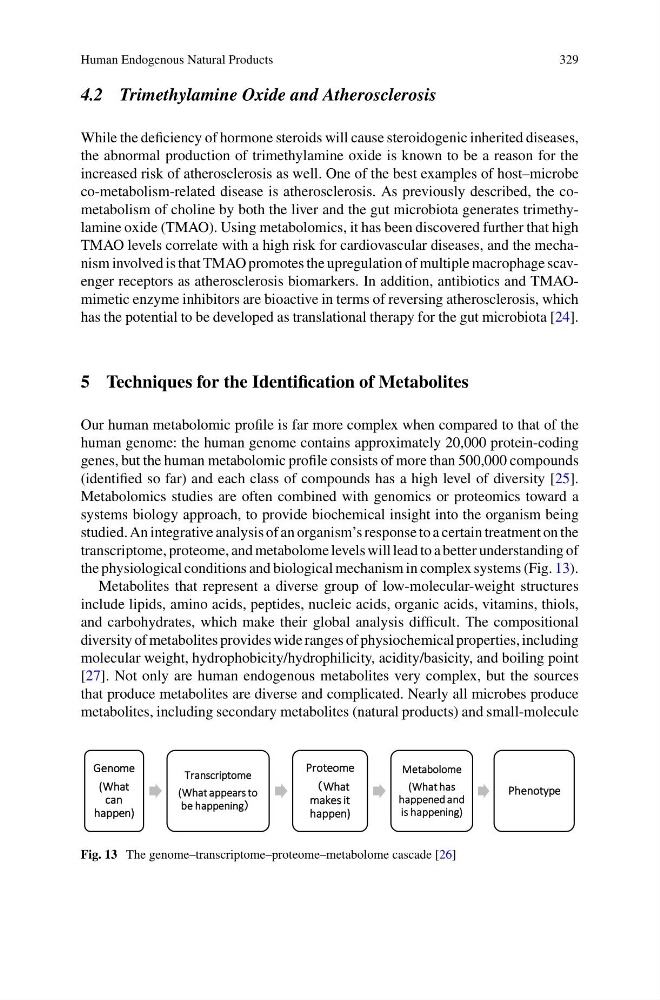
Metabolomics studies are often combined with genomics or proteomics toward a
systems biology approach, to provide biochemical insight into the organism being
studied. An integrative analysis of an organism’s response to a certain treatment on the
transcriptome, proteome, and metabolome levels will lead to a better understanding of
the physiological conditions and biological mechanism in complex systems (Fig. 13).
Metabolites that represent a diverse group of low-molecular-weight structures
include lipids, amino acids, peptides, nucleic acids, organic acids, vitamins, thiols,
and carbohydrates, which make their global analysis difficult. The compositional
diversity of metabolites provides wide ranges of physiochemical properties, including
molecular weight, hydrophobicity/hydrophilicity, acidity/basicity, and boiling point
[27]. Not only are human endogenous metabolites very complex, but the sources
that produce metabolites are diverse and complicated. Nearly all microbes produce
metabolites, including secondary metabolites (natural products) and small-molecule
Fig. 13 The genome–transcriptome–proteome–metabolome cascade [26]
329
4.2 Trimethylamine Oxide and Atherosclerosis
While the deficiency of hormone steroids will cause steroidogenic inherited diseases,
the abnormal production of trimethylamine oxide is known to be a reason for the
increased risk of atherosclerosis as well. One of the best examples of host–microbe
co-metabolism-related disease is atherosclerosis. As previously described, the cometabolism of choline by both the liver and the gut microbiota generates trimethylamine oxide (TMAO). Using metabolomics, it has been discovered further that high
TMAO levels correlate with a high risk for cardiovascular diseases, and the mechanism involved is that TMAO promotes the upregulation of multiple macrophage scavenger receptors as atherosclerosis biomarkers. In addition, antibiotics and TMAOmimetic enzyme inhibitors are bioactive in terms of reversing atherosclerosis, which
has the potential to be developed as translational therapy for the gut microbiota [24].
5 Techniques for the Identification of Metabolites
Our human metabolomic profile is far more complex when compared to that of the
human genome: the human genome contains approximately 20,000 protein-coding
genes, but the human metabolomic profile consists of more than 500,000 compounds
(identified so far) and each class of compounds has a high level of diversity [25].
Metabolomics studies are often combined with genomics or proteomics toward a
systems biology approach, to provide biochemical insight into the organism being
studied. An integrative analysis of an organism’s response to a certain treatment on the
transcriptome, proteome, and metabolome levels will lead to a better understanding of
the physiological conditions and biological mechanism in complex systems (Fig. 13).
Metabolites that represent a diverse group of low-molecular-weight structures
include lipids, amino acids, peptides, nucleic acids, organic acids, vitamins, thiols,
and carbohydrates, which make their global analysis difficult. The compositional
diversity of metabolites provides wide ranges of physiochemical properties, including
molecular weight, hydrophobicity/hydrophilicity, acidity/basicity, and boiling point
[27]. Not only are human endogenous metabolites very complex, but the sources
that produce metabolites are diverse and complicated. Nearly all microbes produce
metabolites, including secondary metabolites (natural products) and small-molecule
Fig. 13 The genome–transcriptome–proteome–metabolome cascade [26]