

330
Y. Bai et al.
virulence factors [25]. These metabolite molecules drive complex physiological
cycles in humans.
There are generally two complementary approaches used for metabolomic investigations: targeted analysis (i.e., metabolic profiling) and untargeted analysis (i.e,
metabolic fingerprinting) [28]. The targeted analysis normally focuses on certain
kinds of metabolites and this kind of selective metabolite identification is often
termed “targeted” metabolomics. The other metabolomics analytical procedure is
often termed “untargeted analysis” or “global metabolomics,” which aims to detect
all the metabolites in a given sample, regardless of their chemical class or character.
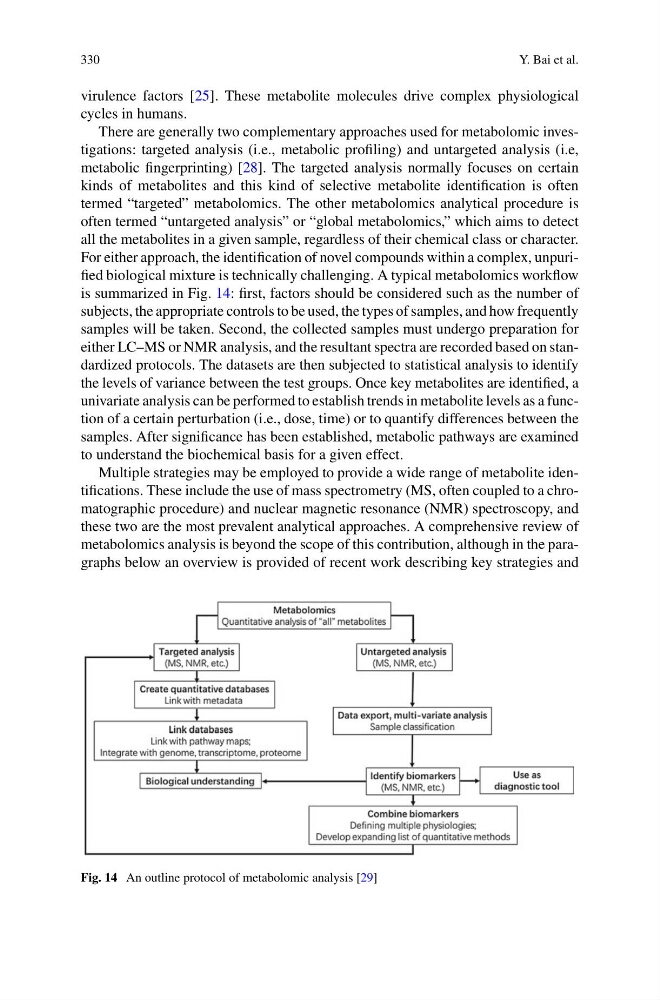
For either approach, the identification of novel compounds within a complex, unpurified biological mixture is technically challenging. A typical metabolomics workflow
is summarized in Fig. 14: first, factors should be considered such as the number of
subjects, the appropriate controls to be used, the types of samples, and how frequently
samples will be taken. Second, the collected samples must undergo preparation for
either LC–MS or NMR analysis, and the resultant spectra are recorded based on standardized protocols. The datasets are then subjected to statistical analysis to identify
the levels of variance between the test groups. Once key metabolites are identified, a
univariate analysis can be performed to establish trends in metabolite levels as a function of a certain perturbation (i.e., dose, time) or to quantify differences between the
samples. After significance has been established, metabolic pathways are examined
to understand the biochemical basis for a given effect.
Multiple strategies may be employed to provide a wide range of metabolite identifications. These include the use of mass spectrometry (MS, often coupled to a chromatographic procedure) and nuclear magnetic resonance (NMR) spectroscopy, and
these two are the most prevalent analytical approaches. A comprehensive review of
metabolomics analysis is beyond the scope of this contribution, although in the paragraphs below an overview is provided of recent work describing key strategies and
Fig. 14 An outline protocol of metabolomic analysis [29]
Y. Bai et al.
virulence factors [25]. These metabolite molecules drive complex physiological
cycles in humans.
There are generally two complementary approaches used for metabolomic investigations: targeted analysis (i.e., metabolic profiling) and untargeted analysis (i.e,
metabolic fingerprinting) [28]. The targeted analysis normally focuses on certain
kinds of metabolites and this kind of selective metabolite identification is often
termed “targeted” metabolomics. The other metabolomics analytical procedure is
often termed “untargeted analysis” or “global metabolomics,” which aims to detect
all the metabolites in a given sample, regardless of their chemical class or character.
For either approach, the identification of novel compounds within a complex, unpurified biological mixture is technically challenging. A typical metabolomics workflow
is summarized in Fig. 14: first, factors should be considered such as the number of
subjects, the appropriate controls to be used, the types of samples, and how frequently
samples will be taken. Second, the collected samples must undergo preparation for
either LC–MS or NMR analysis, and the resultant spectra are recorded based on standardized protocols. The datasets are then subjected to statistical analysis to identify
the levels of variance between the test groups. Once key metabolites are identified, a
univariate analysis can be performed to establish trends in metabolite levels as a function of a certain perturbation (i.e., dose, time) or to quantify differences between the
samples. After significance has been established, metabolic pathways are examined
to understand the biochemical basis for a given effect.
Multiple strategies may be employed to provide a wide range of metabolite identifications. These include the use of mass spectrometry (MS, often coupled to a chromatographic procedure) and nuclear magnetic resonance (NMR) spectroscopy, and
these two are the most prevalent analytical approaches. A comprehensive review of
metabolomics analysis is beyond the scope of this contribution, although in the paragraphs below an overview is provided of recent work describing key strategies and
Fig. 14 An outline protocol of metabolomic analysis [29]