

328
Y. Bai et al.
HO
N
choline
N
trimethylamine
N
O
trimethylamine oxide (TMAO)
CH 4
CutCD
D. desulfuricans
methanogenic archaea
FMO3
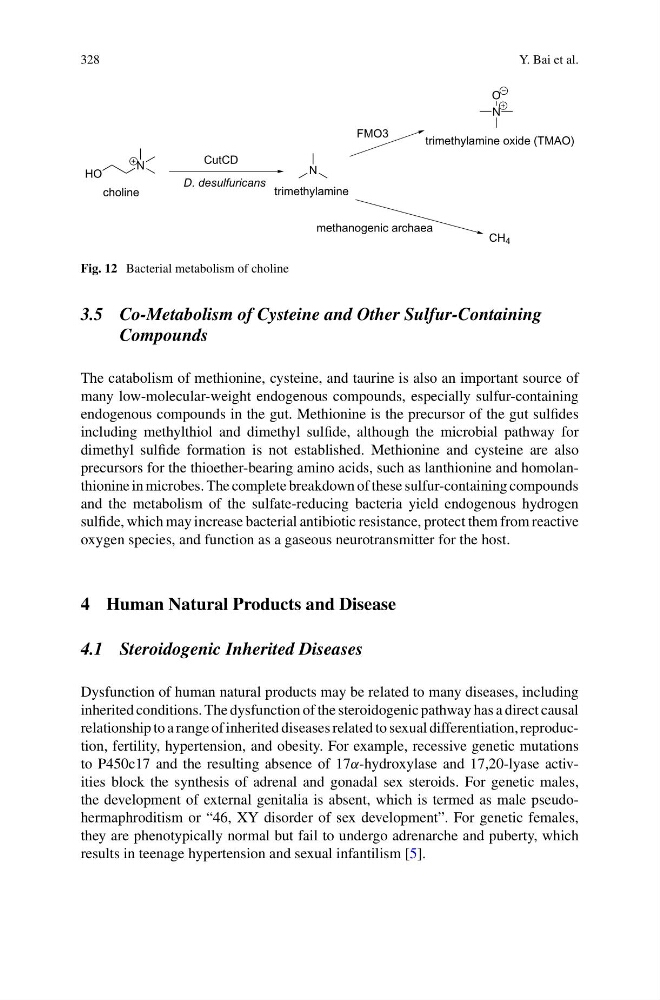
Fig. 12 Bacterial metabolism of choline
3.5 Co-Metabolism of Cysteine and Other Sulfur-Containing
Compounds
The catabolism of methionine, cysteine, and taurine is also an important source of
many low-molecular-weight endogenous compounds, especially sulfur-containing
endogenous compounds in the gut. Methionine is the precursor of the gut sulfides
including methylthiol and dimethyl sulfide, although the microbial pathway for
dimethyl sulfide formation is not established. Methionine and cysteine are also
precursors for the thioether-bearing amino acids, such as lanthionine and homolanthionine in microbes. The complete breakdown of these sulfur-containing compounds
and the metabolism of the sulfate-reducing bacteria yield endogenous hydrogen
sulfide, which may increase bacterial antibiotic resistance, protect them from reactive
oxygen species, and function as a gaseous neurotransmitter for the host.
4 Human Natural Products and Disease
4.1 Steroidogenic Inherited Diseases
Dysfunction of human natural products may be related to many diseases, including
inherited conditions. The dysfunction of the steroidogenic pathway has a direct causal
relationship to a range of inherited diseases related to sexual differentiation, reproduction, fertility, hypertension, and obesity. For example, recessive genetic mutations
to P450c17 and the resulting absence of 17α-hydroxylase and 17,20-lyase activities block the synthesis of adrenal and gonadal sex steroids. For genetic males,
the development of external genitalia is absent, which is termed as male pseudohermaphroditism or “46, XY disorder of sex development”. For genetic females,
they are phenotypically normal but fail to undergo adrenarche and puberty, which
results in teenage hypertension and sexual infantilism [5].
Y. Bai et al.
HO
N
choline
N
trimethylamine
N
O
trimethylamine oxide (TMAO)
CH 4
CutCD
D. desulfuricans
methanogenic archaea
FMO3
Fig. 12 Bacterial metabolism of choline
3.5 Co-Metabolism of Cysteine and Other Sulfur-Containing
Compounds
The catabolism of methionine, cysteine, and taurine is also an important source of
many low-molecular-weight endogenous compounds, especially sulfur-containing
endogenous compounds in the gut. Methionine is the precursor of the gut sulfides
including methylthiol and dimethyl sulfide, although the microbial pathway for
dimethyl sulfide formation is not established. Methionine and cysteine are also
precursors for the thioether-bearing amino acids, such as lanthionine and homolanthionine in microbes. The complete breakdown of these sulfur-containing compounds
and the metabolism of the sulfate-reducing bacteria yield endogenous hydrogen
sulfide, which may increase bacterial antibiotic resistance, protect them from reactive
oxygen species, and function as a gaseous neurotransmitter for the host.
4 Human Natural Products and Disease
4.1 Steroidogenic Inherited Diseases
Dysfunction of human natural products may be related to many diseases, including
inherited conditions. The dysfunction of the steroidogenic pathway has a direct causal
relationship to a range of inherited diseases related to sexual differentiation, reproduction, fertility, hypertension, and obesity. For example, recessive genetic mutations
to P450c17 and the resulting absence of 17α-hydroxylase and 17,20-lyase activities block the synthesis of adrenal and gonadal sex steroids. For genetic males,
the development of external genitalia is absent, which is termed as male pseudohermaphroditism or “46, XY disorder of sex development”. For genetic females,
they are phenotypically normal but fail to undergo adrenarche and puberty, which
results in teenage hypertension and sexual infantilism [5].