

Human Endogenous Natural Products
327
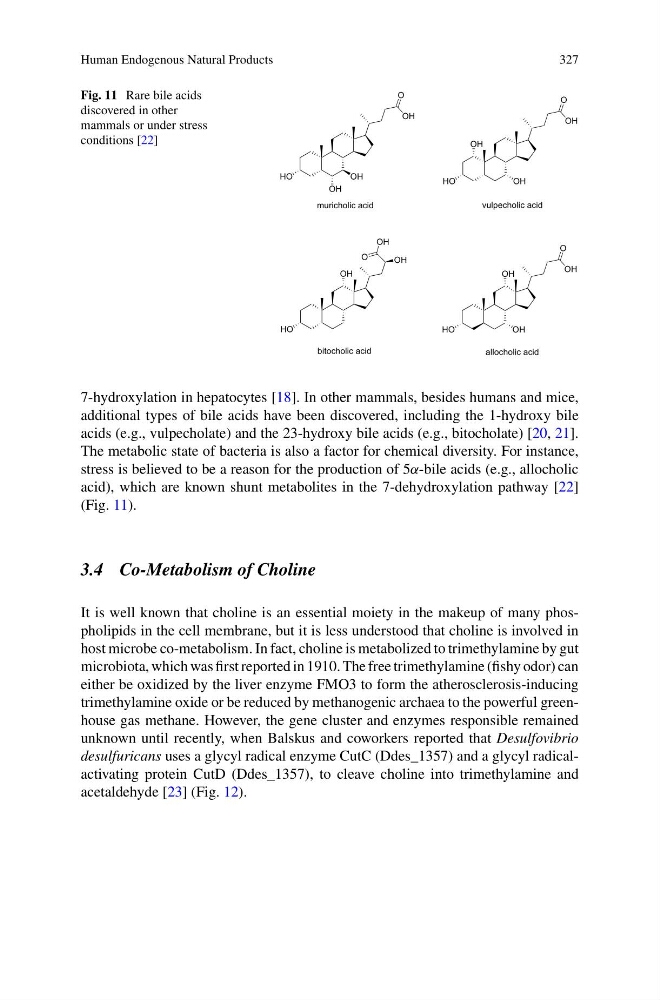
Fig. 11 Rare bile acids
discovered in other
mammals or under stress
conditions [22]
O
OH
OH
OH
HO
muricholic acid
O
OH
OH
HO
OH
vulpecholic acid
HO
OH
O
OH
bitocholic acid
OH
O
OH
OH
OH
HO
allocholic acid
7-hydroxylation in hepatocytes [18]. In other mammals, besides humans and mice,
additional types of bile acids have been discovered, including the 1-hydroxy bile
acids (e.g., vulpecholate) and the 23-hydroxy bile acids (e.g., bitocholate) [20, 21].
The metabolic state of bacteria is also a factor for chemical diversity. For instance,
stress is believed to be a reason for the production of 5α-bile acids (e.g., allocholic
acid), which are known shunt metabolites in the 7-dehydroxylation pathway [22]
(Fig. 11).
3.4 Co-Metabolism of Choline
It is well known that choline is an essential moiety in the makeup of many phospholipids in the cell membrane, but it is less understood that choline is involved in
host microbe co-metabolism. In fact, choline is metabolized to trimethylamine by gut
microbiota, which was first reported in 1910. The free trimethylamine (fishy odor) can
either be oxidized by the liver enzyme FMO3 to form the atherosclerosis-inducing
trimethylamine oxide or be reduced by methanogenic archaea to the powerful greenhouse gas methane. However, the gene cluster and enzymes responsible remained
unknown until recently, when Balskus and coworkers reported that Desulfovibrio
desulfuricans uses a glycyl radical enzyme CutC (Ddes_1357) and a glycyl radicalactivating protein CutD (Ddes_1357), to cleave choline into trimethylamine and
acetaldehyde [23] (Fig. 12).
327
Fig. 11 Rare bile acids
discovered in other
mammals or under stress
conditions [22]
O
OH
OH
OH
HO
muricholic acid
O
OH
OH
HO
OH
vulpecholic acid
HO
OH
O
OH
bitocholic acid
OH
O
OH
OH
OH
HO
allocholic acid
7-hydroxylation in hepatocytes [18]. In other mammals, besides humans and mice,
additional types of bile acids have been discovered, including the 1-hydroxy bile
acids (e.g., vulpecholate) and the 23-hydroxy bile acids (e.g., bitocholate) [20, 21].
The metabolic state of bacteria is also a factor for chemical diversity. For instance,
stress is believed to be a reason for the production of 5α-bile acids (e.g., allocholic
acid), which are known shunt metabolites in the 7-dehydroxylation pathway [22]
(Fig. 11).
3.4 Co-Metabolism of Choline
It is well known that choline is an essential moiety in the makeup of many phospholipids in the cell membrane, but it is less understood that choline is involved in
host microbe co-metabolism. In fact, choline is metabolized to trimethylamine by gut
microbiota, which was first reported in 1910. The free trimethylamine (fishy odor) can
either be oxidized by the liver enzyme FMO3 to form the atherosclerosis-inducing
trimethylamine oxide or be reduced by methanogenic archaea to the powerful greenhouse gas methane. However, the gene cluster and enzymes responsible remained
unknown until recently, when Balskus and coworkers reported that Desulfovibrio
desulfuricans uses a glycyl radical enzyme CutC (Ddes_1357) and a glycyl radicalactivating protein CutD (Ddes_1357), to cleave choline into trimethylamine and
acetaldehyde [23] (Fig. 12).