

326
Y. Bai et al.
HO
OH
(OH)
O
NHR
primary bile acids
gut lumen
HO
OH
(OH)
O
OH
deconjugated bile acids
deconjugation
HO
(OH)
O
OH
unconjugated secondary bile acids
re-adsorption
7-dehydroxylation
HO
(OH)
O
OH
unconjugated secondary bile acids
portal vein
liver
de novo
biosynthesis
HO
(OH)
O
NHR
conjugated secondary bile
acids
taurine/glycine
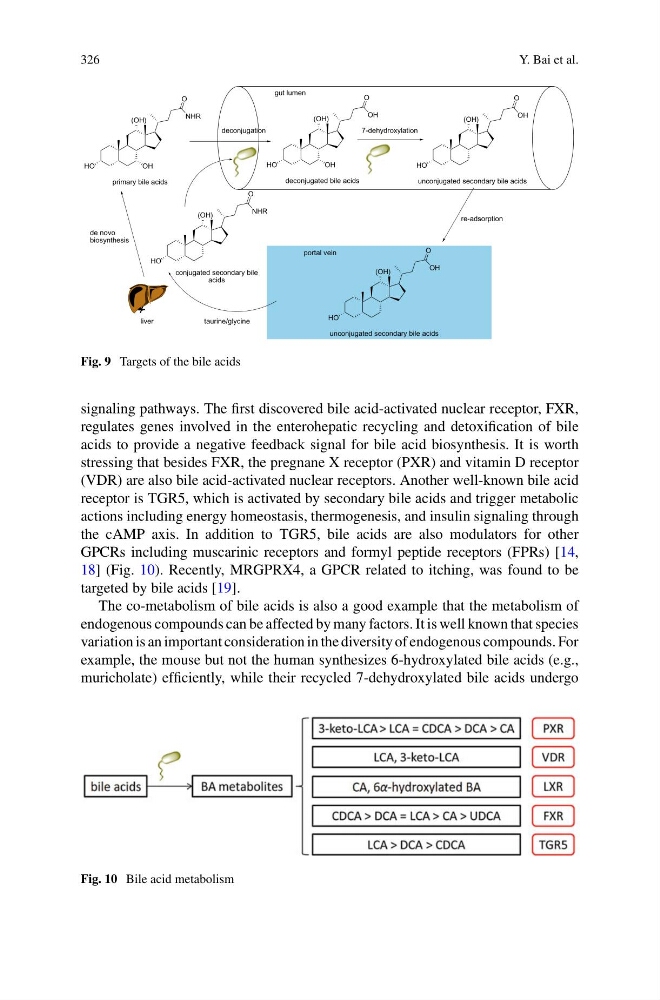
Fig. 9 Targets of the bile acids
signaling pathways. The first discovered bile acid-activated nuclear receptor, FXR,
regulates genes involved in the enterohepatic recycling and detoxification of bile
acids to provide a negative feedback signal for bile acid biosynthesis. It is worth
stressing that besides FXR, the pregnane X receptor (PXR) and vitamin D receptor
(VDR) are also bile acid-activated nuclear receptors. Another well-known bile acid
receptor is TGR5, which is activated by secondary bile acids and trigger metabolic
actions including energy homeostasis, thermogenesis, and insulin signaling through
the cAMP axis. In addition to TGR5, bile acids are also modulators for other
GPCRs including muscarinic receptors and formyl peptide receptors (FPRs) [14,
18] (Fig. 10). Recently, MRGPRX4, a GPCR related to itching, was found to be
targeted by bile acids [19].
The co-metabolism of bile acids is also a good example that the metabolism of
endogenous compounds can be affected by many factors. It is well known that species
variation is an important consideration in the diversity of endogenous compounds. For
example, the mouse but not the human synthesizes 6-hydroxylated bile acids (e.g.,
muricholate) efficiently, while their recycled 7-dehydroxylated bile acids undergo
Fig. 10 Bile acid metabolism
Y. Bai et al.
HO
OH
(OH)
O
NHR
primary bile acids
gut lumen
HO
OH
(OH)
O
OH
deconjugated bile acids
deconjugation
HO
(OH)
O
OH
unconjugated secondary bile acids
re-adsorption
7-dehydroxylation
HO
(OH)
O
OH
unconjugated secondary bile acids
portal vein
liver
de novo
biosynthesis
HO
(OH)
O
NHR
conjugated secondary bile
acids
taurine/glycine
Fig. 9 Targets of the bile acids
signaling pathways. The first discovered bile acid-activated nuclear receptor, FXR,
regulates genes involved in the enterohepatic recycling and detoxification of bile
acids to provide a negative feedback signal for bile acid biosynthesis. It is worth
stressing that besides FXR, the pregnane X receptor (PXR) and vitamin D receptor
(VDR) are also bile acid-activated nuclear receptors. Another well-known bile acid
receptor is TGR5, which is activated by secondary bile acids and trigger metabolic
actions including energy homeostasis, thermogenesis, and insulin signaling through
the cAMP axis. In addition to TGR5, bile acids are also modulators for other
GPCRs including muscarinic receptors and formyl peptide receptors (FPRs) [14,
18] (Fig. 10). Recently, MRGPRX4, a GPCR related to itching, was found to be
targeted by bile acids [19].
The co-metabolism of bile acids is also a good example that the metabolism of
endogenous compounds can be affected by many factors. It is well known that species
variation is an important consideration in the diversity of endogenous compounds. For
example, the mouse but not the human synthesizes 6-hydroxylated bile acids (e.g.,
muricholate) efficiently, while their recycled 7-dehydroxylated bile acids undergo
Fig. 10 Bile acid metabolism