

New Techniques of Structure Elucidation for Sesquiterpenes
299
data [114]. The absolute configuration of 262 was assigned in light of a single-crystal
X-ray diffraction study. The data collection was achieved using Cu Kα radiation
allowing calculation of the Flack x = 0.07(19) and Hooft y = 0.06(7) parameters
based on 1125 Friedel pairs. Given that both parameters were close to zero, the
absolute configuration of 262 was assigned as (1S,3R,4R,5S,7R,10S). In view of the
close structural relationship between eudesmane derivatives 262 and 263, the relative
configuration of the latter compound was also determined as (1S,3R,4R,5S,7R,10S).
The position of the d-glucose moiety was confirmed through an HMBC experiment
[114].
HO
OH
OH
OH
262
HO
OH
OH
O
263
O
OH
OH
HO
HO
1
2
3
4
5
6
7
8
9
10
11
12
13
14
15
A study to explore the diastereoselectivity in the 1,3-dipolar cycloaddition of
diazomethane to the exocyclic double bond of α,β-unsaturated sesquiterpene lactones
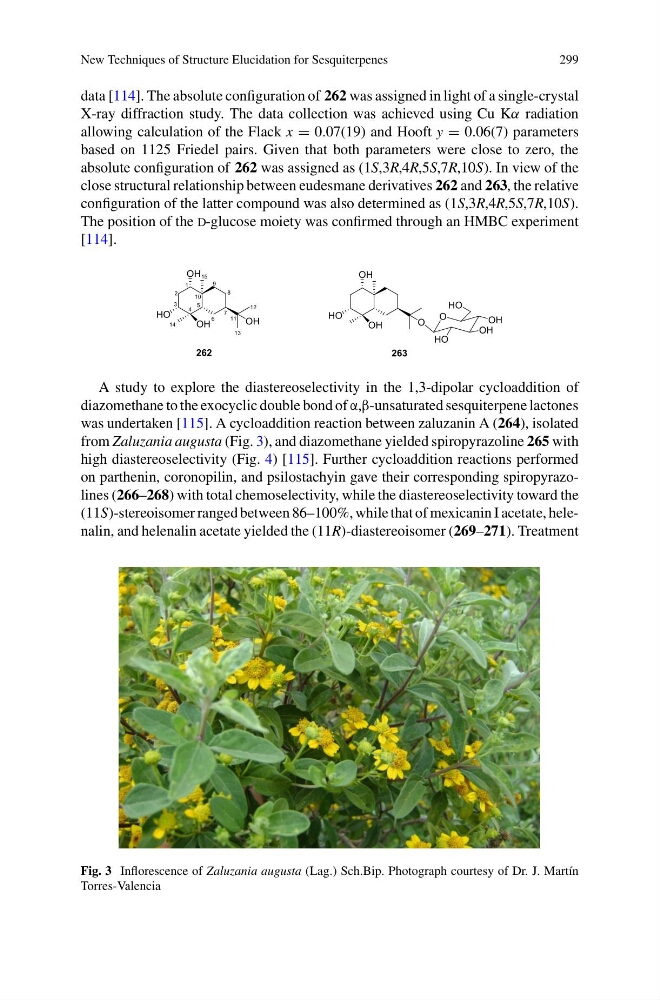
was undertaken [115]. A cycloaddition reaction between zaluzanin A (264), isolated
from Zaluzania augusta (Fig. 3), and diazomethane yielded spiropyrazoline 265 with
high diastereoselectivity (Fig. 4) [115]. Further cycloaddition reactions performed
on parthenin, coronopilin, and psilostachyin gave their corresponding spiropyrazolines (266–268) with total chemoselectivity, while the diastereoselectivity toward the
(11S)-stereoisomer ranged between 86–100%, while that of mexicanin I acetate, helenalin, and helenalin acetate yielded the (11R)-diastereoisomer (269–271). Treatment
Fig. 3 Inflorescence of Zaluzania augusta (Lag.) Sch.Bip. Photograph courtesy of Dr. J. Martín
Torres-Valencia
299
data [114]. The absolute configuration of 262 was assigned in light of a single-crystal
X-ray diffraction study. The data collection was achieved using Cu Kα radiation
allowing calculation of the Flack x = 0.07(19) and Hooft y = 0.06(7) parameters
based on 1125 Friedel pairs. Given that both parameters were close to zero, the
absolute configuration of 262 was assigned as (1S,3R,4R,5S,7R,10S). In view of the
close structural relationship between eudesmane derivatives 262 and 263, the relative
configuration of the latter compound was also determined as (1S,3R,4R,5S,7R,10S).
The position of the d-glucose moiety was confirmed through an HMBC experiment
[114].
HO
OH
OH
OH
262
HO
OH
OH
O
263
O
OH
OH
HO
HO
1
2
3
4
5
6
7
8
9
10
11
12
13
14
15
A study to explore the diastereoselectivity in the 1,3-dipolar cycloaddition of
diazomethane to the exocyclic double bond of α,β-unsaturated sesquiterpene lactones
was undertaken [115]. A cycloaddition reaction between zaluzanin A (264), isolated
from Zaluzania augusta (Fig. 3), and diazomethane yielded spiropyrazoline 265 with
high diastereoselectivity (Fig. 4) [115]. Further cycloaddition reactions performed
on parthenin, coronopilin, and psilostachyin gave their corresponding spiropyrazolines (266–268) with total chemoselectivity, while the diastereoselectivity toward the
(11S)-stereoisomer ranged between 86–100%, while that of mexicanin I acetate, helenalin, and helenalin acetate yielded the (11R)-diastereoisomer (269–271). Treatment
Fig. 3 Inflorescence of Zaluzania augusta (Lag.) Sch.Bip. Photograph courtesy of Dr. J. Martín
Torres-Valencia