

300
J. C. Pardo-Novoa and C. M. Cerda-García-Rojas
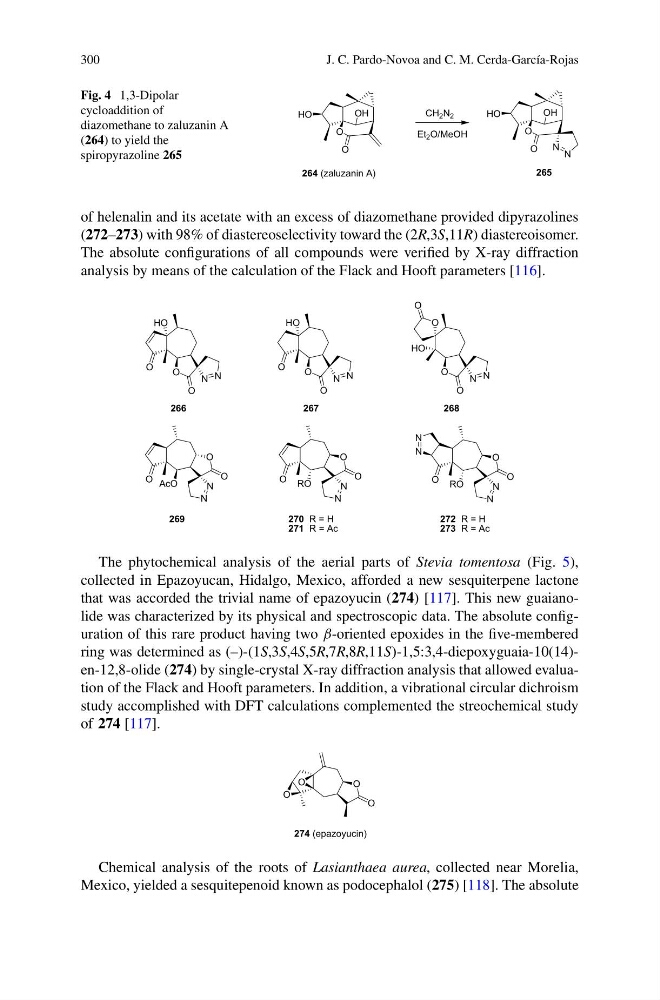
Fig. 4 1,3-Dipolar
cycloaddition of
diazomethane to zaluzanin A
(264) to yield the
spiropyrazoline 265
O
O
HO
OH
N
N
265
O
O
HO
OH
264 (zaluzanin A)
CH 2 N 2
Et 2 O/MeOH
of helenalin and its acetate with an excess of diazomethane provided dipyrazolines
(272–273) with 98% of diastereoselectivity toward the (2R,3S,11R) diastereoisomer.
The absolute configurations of all compounds were verified by X-ray diffraction
analysis by means of the calculation of the Flack and Hooft parameters [116].
O
N N
O
O
HO
O
N N
O
O
HO
O
O
N N
O
HO
O
O
O
N
N
O
AcO
O
O
N
N
O
RO
O
O
N
N
O
RO
N
N
8
6
2
7
6
2
6
6
2
0
7
2
9
6
2
R = H
271 R = Ac
272 R = H
273 R = Ac
The phytochemical analysis of the aerial parts of Stevia tomentosa (Fig. 5),
collected in Epazoyucan, Hidalgo, Mexico, afforded a new sesquiterpene lactone
that was accorded the trivial name of epazoyucin (274) [117]. This new guaianolide was characterized by its physical and spectroscopic data. The absolute configuration of this rare product having two β-oriented epoxides in the five-membered
ring was determined as (–)-(1S,3S,4S,5R,7R,8R,11S)-1,5:3,4-diepoxyguaia-10(14)en-12,8-olide (274) by single-crystal X-ray diffraction analysis that allowed evaluation of the Flack and Hooft parameters. In addition, a vibrational circular dichroism
study accomplished with DFT calculations complemented the streochemical study
of 274 [117].
O
O
O
O
274 (epazoyucin)
Chemical analysis of the roots of Lasianthaea aurea, collected near Morelia,
Mexico, yielded a sesquitepenoid known as podocephalol (275) [118]. The absolute
J. C. Pardo-Novoa and C. M. Cerda-García-Rojas
Fig. 4 1,3-Dipolar
cycloaddition of
diazomethane to zaluzanin A
(264) to yield the
spiropyrazoline 265
O
O
HO
OH
N
N
265
O
O
HO
OH
264 (zaluzanin A)
CH 2 N 2
Et 2 O/MeOH
of helenalin and its acetate with an excess of diazomethane provided dipyrazolines
(272–273) with 98% of diastereoselectivity toward the (2R,3S,11R) diastereoisomer.
The absolute configurations of all compounds were verified by X-ray diffraction
analysis by means of the calculation of the Flack and Hooft parameters [116].
O
N N
O
O
HO
O
N N
O
O
HO
O
O
N N
O
HO
O
O
O
N
N
O
AcO
O
O
N
N
O
RO
O
O
N
N
O
RO
N
N
8
6
2
7
6
2
6
6
2
0
7
2
9
6
2
R = H
271 R = Ac
272 R = H
273 R = Ac
The phytochemical analysis of the aerial parts of Stevia tomentosa (Fig. 5),
collected in Epazoyucan, Hidalgo, Mexico, afforded a new sesquiterpene lactone
that was accorded the trivial name of epazoyucin (274) [117]. This new guaianolide was characterized by its physical and spectroscopic data. The absolute configuration of this rare product having two β-oriented epoxides in the five-membered
ring was determined as (–)-(1S,3S,4S,5R,7R,8R,11S)-1,5:3,4-diepoxyguaia-10(14)en-12,8-olide (274) by single-crystal X-ray diffraction analysis that allowed evaluation of the Flack and Hooft parameters. In addition, a vibrational circular dichroism
study accomplished with DFT calculations complemented the streochemical study
of 274 [117].
O
O
O
O
274 (epazoyucin)
Chemical analysis of the roots of Lasianthaea aurea, collected near Morelia,
Mexico, yielded a sesquitepenoid known as podocephalol (275) [118]. The absolute