

298
J. C. Pardo-Novoa and C. M. Cerda-García-Rojas
O
O
O
O
1
5
7
9
11
12
13
14
14'
15'
12'
13'
15
3
1'
3'
5'
7'
9'
11'
N
O
O
O
1
3
5
9
7
14
15
O
O
O
1'
3'
5'
7'
9'
11'
12'
13'
14'
15'
257 (nardochinoid A)
258 (nardochinoid B)
259 (nardochinoid C)
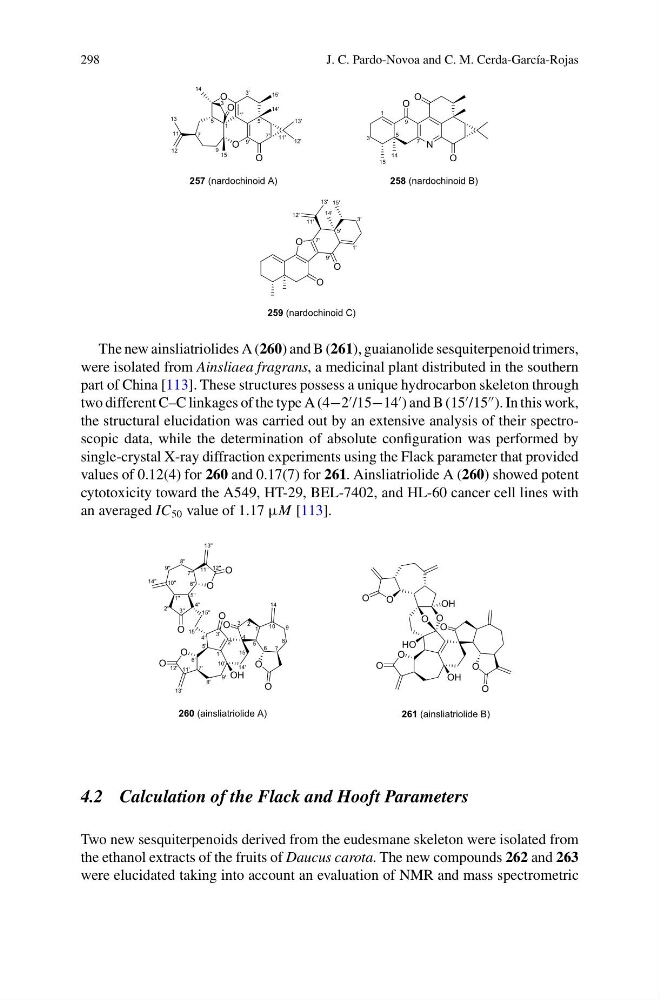
The new ainsliatriolides A (260) and B (261), guaianolide sesquiterpenoid trimers,
were isolated from Ainsliaea fragrans, a medicinal plant distributed in the southern
part of China [113]. These structures possess a unique hydrocarbon skeleton through
two different C–C linkages of the type A (4−2
/15−14
) and B (15
/15
). In this work,
the structural elucidation was carried out by an extensive analysis of their spectroscopic data, while the determination of absolute configuration was performed by
single-crystal X-ray diffraction experiments using the Flack parameter that provided
values of 0.12(4) for 260 and 0.17(7) for 261. Ainsliatriolide A (260) showed potent
cytotoxicity toward the A549, HT-29, BEL-7402, and HL-60 cancer cell lines with
an averaged IC 50 value of 1.17 μM [113].
O
O
O
O
O
O
OH
O
O
O
O
O
O
O
O
OH
O
HO
OH
O
O
O
1
2
3
4
5
6 7
8
9
10
14
15
1'
2'
3'
4'
5'
6'
7'
8'
9'
10'
11'
12'
13'
14'
15'
15''
1''
2''
3''
4''
5''
6''
7''
8''
9''
10''
14''
13''
12''
11''
260 (ainsliatriolide A)
261 (ainsliatriolide B)
4.2 Calculation of the Flack and Hooft Parameters
Two new sesquiterpenoids derived from the eudesmane skeleton were isolated from
the ethanol extracts of the fruits of Daucus carota. The new compounds 262 and 263
were elucidated taking into account an evaluation of NMR and mass spectrometric
J. C. Pardo-Novoa and C. M. Cerda-García-Rojas
O
O
O
O
1
5
7
9
11
12
13
14
14'
15'
12'
13'
15
3
1'
3'
5'
7'
9'
11'
N
O
O
O
1
3
5
9
7
14
15
O
O
O
1'
3'
5'
7'
9'
11'
12'
13'
14'
15'
257 (nardochinoid A)
258 (nardochinoid B)
259 (nardochinoid C)
The new ainsliatriolides A (260) and B (261), guaianolide sesquiterpenoid trimers,
were isolated from Ainsliaea fragrans, a medicinal plant distributed in the southern
part of China [113]. These structures possess a unique hydrocarbon skeleton through
two different C–C linkages of the type A (4−2
/15−14
) and B (15
/15
). In this work,
the structural elucidation was carried out by an extensive analysis of their spectroscopic data, while the determination of absolute configuration was performed by
single-crystal X-ray diffraction experiments using the Flack parameter that provided
values of 0.12(4) for 260 and 0.17(7) for 261. Ainsliatriolide A (260) showed potent
cytotoxicity toward the A549, HT-29, BEL-7402, and HL-60 cancer cell lines with
an averaged IC 50 value of 1.17 μM [113].
O
O
O
O
O
O
OH
O
O
O
O
O
O
O
O
OH
O
HO
OH
O
O
O
1
2
3
4
5
6 7
8
9
10
14
15
1'
2'
3'
4'
5'
6'
7'
8'
9'
10'
11'
12'
13'
14'
15'
15''
1''
2''
3''
4''
5''
6''
7''
8''
9''
10''
14''
13''
12''
11''
260 (ainsliatriolide A)
261 (ainsliatriolide B)
4.2 Calculation of the Flack and Hooft Parameters
Two new sesquiterpenoids derived from the eudesmane skeleton were isolated from
the ethanol extracts of the fruits of Daucus carota. The new compounds 262 and 263
were elucidated taking into account an evaluation of NMR and mass spectrometric