

New Techniques of Structure Elucidation for Sesquiterpenes
297
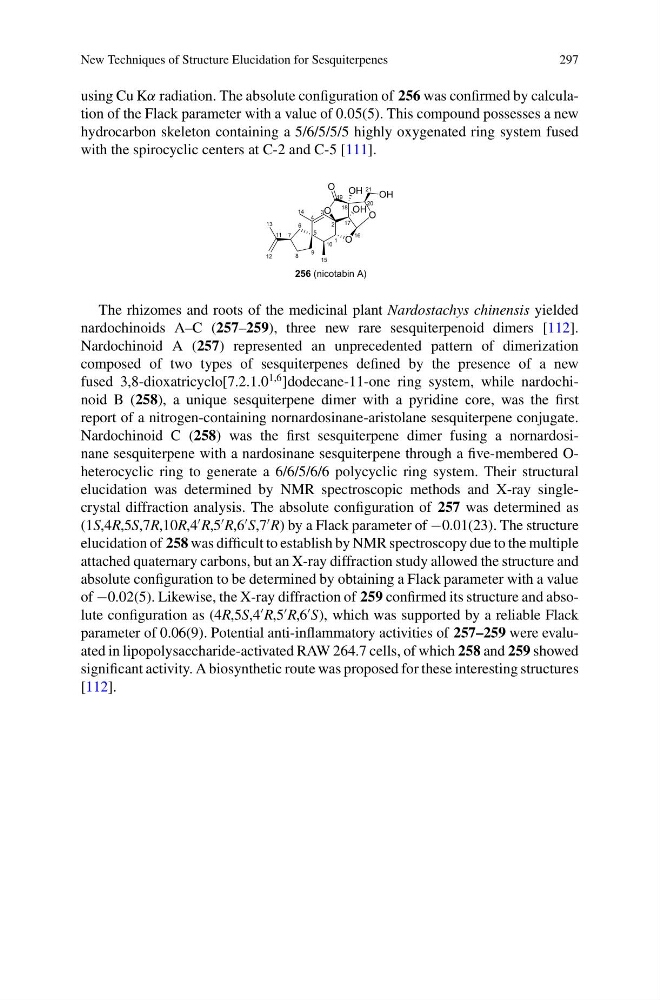
using Cu Kα radiation. The absolute configuration of 256 was confirmed by calculation of the Flack parameter with a value of 0.05(5). This compound possesses a new
hydrocarbon skeleton containing a 5/6/5/5/5 highly oxygenated ring system fused
with the spirocyclic centers at C-2 and C-5 [111].
O
O
O
OH
O
OH
OH
256 (nicotabin A)
1
2
3
4
5
6
7
8
9
10
11
12
13
14
15
16
17
18
19
20
21
The rhizomes and roots of the medicinal plant Nardostachys chinensis yielded
nardochinoids A–C (257–259), three new rare sesquiterpenoid dimers [112].
Nardochinoid A (257) represented an unprecedented pattern of dimerization
composed of two types of sesquiterpenes defined by the presence of a new
fused 3,8-dioxatricyclo[7.2.1.0
1,6 ]dodecane-11-one ring system, while nardochinoid B (258), a unique sesquiterpene dimer with a pyridine core, was the first
report of a nitrogen-containing nornardosinane-aristolane sesquiterpene conjugate.
Nardochinoid C (258) was the first sesquiterpene dimer fusing a nornardosinane sesquiterpene with a nardosinane sesquiterpene through a five-membered Oheterocyclic ring to generate a 6/6/5/6/6 polycyclic ring system. Their structural
elucidation was determined by NMR spectroscopic methods and X-ray singlecrystal diffraction analysis. The absolute configuration of 257 was determined as
(1S,4R,5S,7R,10R,4
R,5
R,6
S,7
R) by a Flack parameter of −0.01(23). The structure
elucidation of 258 was difficult to establish by NMR spectroscopy due to the multiple
attached quaternary carbons, but an X-ray diffraction study allowed the structure and
absolute configuration to be determined by obtaining a Flack parameter with a value
of −0.02(5). Likewise, the X-ray diffraction of 259 confirmed its structure and absolute configuration as (4R,5S,4
R,5
R,6
S), which was supported by a reliable Flack
parameter of 0.06(9). Potential anti-inflammatory activities of 257–259 were evaluated in lipopolysaccharide-activated RAW 264.7 cells, of which 258 and 259 showed
significant activity. A biosynthetic route was proposed for these interesting structures
[112].
297
using Cu Kα radiation. The absolute configuration of 256 was confirmed by calculation of the Flack parameter with a value of 0.05(5). This compound possesses a new
hydrocarbon skeleton containing a 5/6/5/5/5 highly oxygenated ring system fused
with the spirocyclic centers at C-2 and C-5 [111].
O
O
O
OH
O
OH
OH
256 (nicotabin A)
1
2
3
4
5
6
7
8
9
10
11
12
13
14
15
16
17
18
19
20
21
The rhizomes and roots of the medicinal plant Nardostachys chinensis yielded
nardochinoids A–C (257–259), three new rare sesquiterpenoid dimers [112].
Nardochinoid A (257) represented an unprecedented pattern of dimerization
composed of two types of sesquiterpenes defined by the presence of a new
fused 3,8-dioxatricyclo[7.2.1.0
1,6 ]dodecane-11-one ring system, while nardochinoid B (258), a unique sesquiterpene dimer with a pyridine core, was the first
report of a nitrogen-containing nornardosinane-aristolane sesquiterpene conjugate.
Nardochinoid C (258) was the first sesquiterpene dimer fusing a nornardosinane sesquiterpene with a nardosinane sesquiterpene through a five-membered Oheterocyclic ring to generate a 6/6/5/6/6 polycyclic ring system. Their structural
elucidation was determined by NMR spectroscopic methods and X-ray singlecrystal diffraction analysis. The absolute configuration of 257 was determined as
(1S,4R,5S,7R,10R,4
R,5
R,6
S,7
R) by a Flack parameter of −0.01(23). The structure
elucidation of 258 was difficult to establish by NMR spectroscopy due to the multiple
attached quaternary carbons, but an X-ray diffraction study allowed the structure and
absolute configuration to be determined by obtaining a Flack parameter with a value
of −0.02(5). Likewise, the X-ray diffraction of 259 confirmed its structure and absolute configuration as (4R,5S,4
R,5
R,6
S), which was supported by a reliable Flack
parameter of 0.06(9). Potential anti-inflammatory activities of 257–259 were evaluated in lipopolysaccharide-activated RAW 264.7 cells, of which 258 and 259 showed
significant activity. A biosynthetic route was proposed for these interesting structures
[112].